

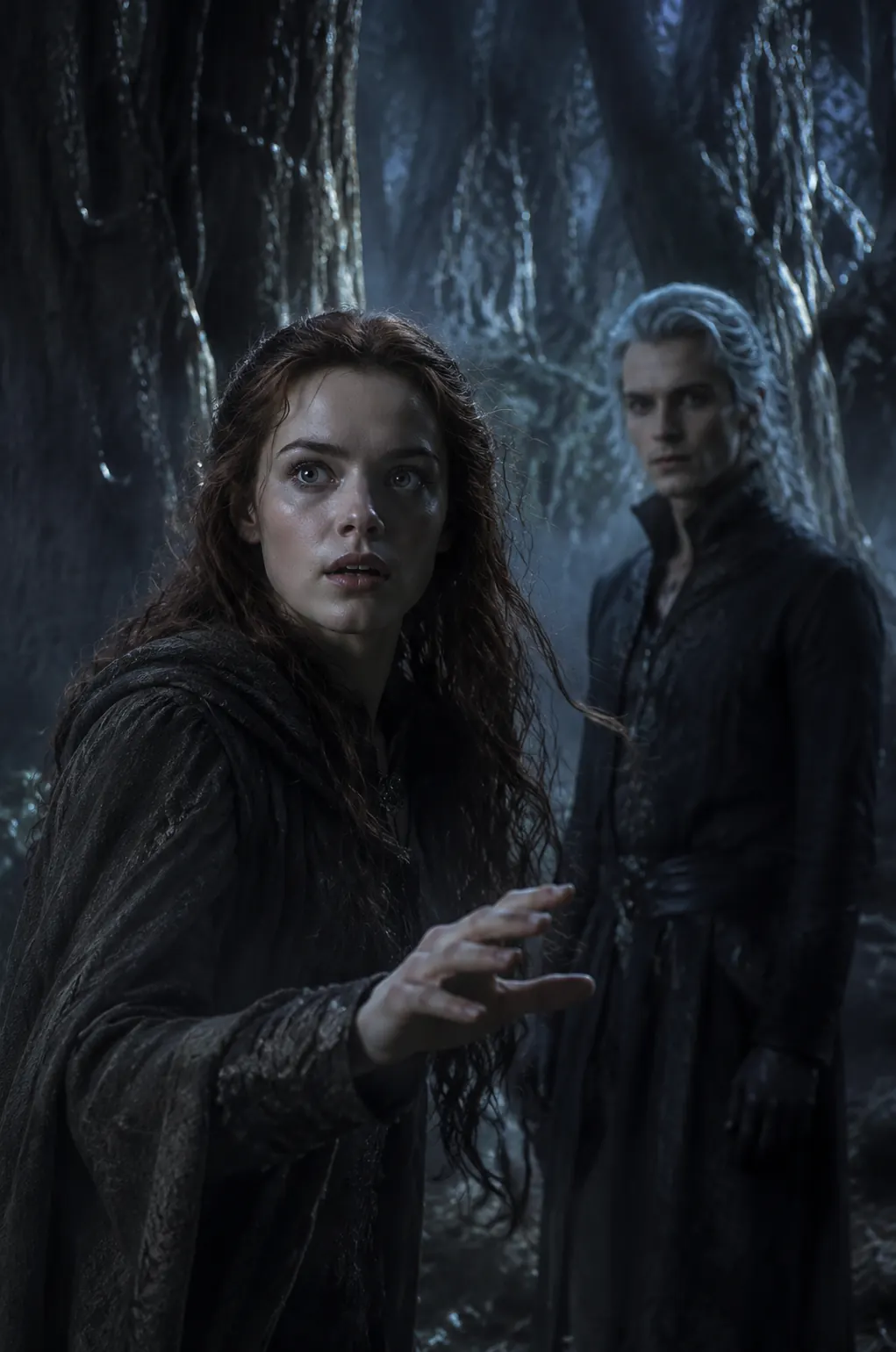
The Thornwood Vow
Chapter 1
Chapter 1: The Commission
Chapter 1: The Commission
The border wasn't where they said it was.
I'd been staring at the map for three minutes, compass divider frozen against my palm, when Lord Harwick cleared his throat.
"You're certain?" he asked.
"No." I shifted the divider half an inch east, then back. "That's the problem."
The royal map room smelled like lamp oil and old parchment—smells that usually settled me. Today they just made the air feel thick. Harwick stood too close, breathing over my shoulder, his velvet collar catching the afternoon light from the high windows. He was waiting for me to look up, to smile, to assure him the Crown's Thornwood boundary was correct and I was being thorough.
I didn't look up.
"The survey from '09," I said, "places the silver birch stands here." I tapped the map, careful not to let the compass puncture the parchment. "But Cartographer Brennan's notation in the Archives has them three miles northeast. And there's a conflict in the boundary markers—three of them don't align with the watershed he recorded."
Harwick's silence had weight. I knew what he was about to say before he said it.
"The Crown requires the Thornwood mapped, Miss Ashby. Accurately. The mining survey—"
"I know." I set down my compass. "Someone's going to pay a lot of gold to know what's actually out there. But if I'm commissioned to map it, I need to know what I'm mapping from isn't corrupted to begin with."
He didn't like the word corrupted. His jaw tightened.
I turned to face him properly. Lord Harwick was old money with new appointments—Commerce and Territory, which meant he was the Crown's instrument for converting wilderness into profit. He was also the reason I'd eaten badly and slept worse for the last week. The Thornwood commission was the kind of work that built a cartographer's name. The kind that meant I wouldn't spend the rest of my life mapping trade routes and harvest surveys.
It was also the kind of work that could get me killed if I was sloppy.
"Who last attempted the boundary," I said, "and what happened to them?"
"Cartographer Elias Brennan. He—"
"I know it's Brennan. I pulled his notations. When?"
"Three years ago. Eighteen months into the survey, he—" Harwick paused, choosing his words like he was stepping on ice. "He determined the task was incomplete and left it unfinished."
That wasn't what the silence meant. That wasn't the shape of this.
"He vanished," I said.
Harwick didn't correct me.
I stood and walked to the Archives cabinet—the long one with the locked drawers where they kept the old surveys, the failed expeditions, the records no one wanted public. My keys were at home, but Harwick didn't stop me from trying. He was past pretense now.
"Where are Brennan's field notes," I said.
"Catalogued in the restricted section."
"I'm restricted."
"You weren't three years ago."
That was fair. Three years ago I was still the competent-but-ordinary cartographer who made survey maps for merchants and the occasional Crown administrative task. Three years ago I hadn't yet mapped the Scarwind Pass, or the complete waterway system in Kelvan Province, or created the first comprehensive trade-distance calculator that actually accounted for terrain difficulty.
Three years ago, I hadn't become someone Harwick would hand something dangerous.
I turned back to him. "I need to see them."
He didn't move. "You're considering the commission."
"I'm considering whether I'm qualified to take it. Big difference."
"The Crown—"
"Already hired me to consider," I said. "That's the part we're in. So: restricted section. Now."
Harwick went to the front desk and returned with a clerk who looked like he'd rather be anywhere else. The clerk produced a key, a ledger, and a significant amount of anxiety. Ten minutes later, I was holding Elias Brennan's fieldwork.
His handwriting was precise. Almost too precise—the kind of careful lettering you do when you're trying very hard not to shake. I opened the leather journal to the earliest entries and worked forward, watching the writing deteriorate over time. Not the script itself—that stayed perfect—but the margins, the spacing, the way the observations became shorter and more fragmented.
"What's the date of this last entry?" I asked.
Harwick glanced over. "Approximately three weeks before his departure was reported."
The last entry was dated in late autumn, third month of the year. The handwriting filled half a page, dense and small. Then it stopped. A blank page. Then, two pages later, a single line in the same precise script:
Do not cross the silver trees.
That was all. Not an explanation. Not a location. Not even punctuation, as if adding a period might make the warning more real.
I read it twice. Three times. Harwick shifted his weight behind me, expecting something—recognition, dismissal, reassurance.
I turned to him. "Did he clarify what he meant?"
"There is no further clarification."
"Did anyone follow up with him?"
"He could not be located."
The room seemed to press smaller. I'd done field work—nothing as extensive as Brennan's Thornwood project, but enough to know that a cartographer who vanished didn't usually vanish quietly. There were usually searches. There were notes in the ledgers about recovery expeditions, about what was found or wasn't.
I walked back to the Archives desk and pulled the ledger the clerk had brought. I flipped to the section labeled Personnel Status and found Brennan's entry.
Elias Brennan, Cartographer First Class, assignment: Thornwood Boundary & Wilderness Survey, commissioned in commission 1482 of the third year of the reign. Survey terminated by mutual consent. Status upon termination: unlocated. Official determination: voluntary departure from Crown service.
Mutual consent. That was the phrase they used when they wanted to record a disappearance without admitting they'd searched for a body.
I didn't realize I'd gone still until Harwick spoke.
"It's possible he encountered difficulty beyond his capacity and chose to abandon the work," he said carefully. "The Thornwood is wild. Reports suggest—"
"I need to know what Brennan saw before he stopped mapping."
"That's why I've brought you his notes."
"I mean specifically. His observation logs. What changed in the last weeks of work. Why he went from detailed entries to one cryptic line."
Harwick had the look of a man who'd already decided I was going to take the commission, whatever I found in these journals. "The work is yours if you want it. The Crown is offering significant compensation for comprehensive coverage of the territory's western territories and the disputed boundary zones. You would have full access to previous surveys, full equipment allocation, and protection—"
"Protection?" I turned to him. "From what?"
"Bandits. Poachers. The usual complications of wilderness work."
He was a very careful liar. It was probably useful in his position.
I closed Brennan's journal and held it out to the clerk. "I need twenty-four hours. Full access to everything Brennan touched—notes, observations, correspondence, equipment logs. Everything."
Harwick nodded to the clerk, who nodded back with the enthusiasm of someone being asked to open more restricted files.
"Will you take the commission?" Harwick asked.
I was already thinking about the map room in my workshop, the new survey equipment I'd been saving for, the reputation I'd build if I succeeded where Brennan had apparently failed. I was thinking about the precision of that penmanship even as it fragmented. Five words written as a final warning.
"Ask me tomorrow," I said.
Harwick left an hour before closing. The clerk left at his shift change. I stayed in the Archives room with Brennan's complete record spread across the workbench—twenty-three months of field notes, observation sketches, boundary calculations, and finally, that single sentence.
Do not cross the silver trees.
By the time I locked the map room and walked out into the city streets, I'd decided three things. First: I was going to take the commission. The work was too important, too rare, and I was too good at cartography to let fear make the decision.
Second: I was going to find out what had happened to Elias Brennan, because a cartographer didn't just vanish and leave warnings without reason.
And third—the thing I didn't admit to myself until I was already walking toward my workshop to begin the preparation—I was going to treat his last notation not as a warning to heed, but as the beginning of a map I had to complete.
The silver trees would show me where the real boundary was. Whatever they marked, whatever Brennan had seen or thought he'd seen, I would find them and chart them and prove that the Thornwood could be measured, calculated, known.
I should have treated it as a warning instead.
I should have read it as the last message from a man who understood something I didn't yet. But I was twenty-eight and I was good at what I did, and the possibility of being the first cartographer to fully map the Thornwood wiped out every instinct that might have kept me safe.
So I prepared my equipment. I checked my compass. I pulled every map the Crown had of the western territories and began tracing the lines where they didn't quite align.
And three days later, I crossed the border without even knowing I was crossing at all.
You might also like