

Chapter 2
Chapter 2: Into the Wilderness
Chapter 2: Into the Wilderness
The camp took two hours to establish. I measured the clearing with my paces—forty-three by fifty-one—and marked the corners with stones I'd painted white before leaving Aethermark. The trees surrounding it were the first thing I'd noted in my journal: massive, black-barked, with veins of silver running through them like scar tissue left by something ancient and purposeful.
The silver was faint in daylight, visible only if you looked at the bark at the right angle. I looked at the right angle multiple times. The veins weren't paint and they weren't mineral deposits, though mineral deposits was the lie I told myself while sketching them into my map. It was a functional lie. It allowed me to continue working.
I set up the compass at the center of the clearing. Standard orientation: north to top of the page. It swung where it was supposed to, give or take the variance I'd noted on my approach—perhaps three degrees, likely caused by the iron-rich deposits beneath this stretch of forest. The Thornwood had always been called magnetic in the old records. Dead ends. Compasses that spun. Cartographers who didn't come back.
The man before me hadn't come back. Three years ago, the last attempt to map the boundary. His notes had been methodical until the last entry, written in a hand that had started to shake: Do not cross the silver trees. Then nothing. No final notation. No explanation.
I had no intention of crossing anything. I was here to map the edge. To measure the Thornwood's perimeter and return home with proof that the unknown was merely poorly documented. That was the commission. That was the work. That was the thing I would not allow myself to fear while the sun was up.
By noon, my hands were cramped from sketching. The bark patterns were complex and repetitive, fractal-like, and I wanted to capture them accurately before the light changed. By three o'clock, I noticed the compass had drifted five degrees. By five, it was drifting further even as I watched—a creeping movement, as if pulled by something I couldn't perceive but could watch the effects of.
I reset it. It drifted again within minutes, slower this time, as if testing how much I would tolerate. As if curious.
Mineral deposits, I told myself again, more firmly. The entire region was supposed to be rich in iron ore, though the kingdom geologists had been remarkably vague about the exact nature and distribution of those deposits. Remarkably vague in official reports. Remarkably reluctant in private conversation. Remarkably unwilling to send anyone to map it themselves.
I stopped looking at the compass after that. I had plenty of daylight left and the trees were endlessly interesting. The bark was warm to the touch despite the cool air—genuinely warm, the way heated stone holds warmth. The silver veins seemed to run deeper the longer I stared at them, as if my looking at them made them grow. Some of the trees were enormous; I estimated two of them at forty feet around the base. When I pressed my ear to one, I heard nothing. No sap moving beneath the bark. No sound at all. Just the faint, constant hum of the forest that might have been wind or might have been something else entirely.
The silence was the most unsettling part. A forest should sound like something. A forest should creak and rustle and breathe. This one was.
The sun set fast. One moment it was afternoon-bright; the next, the light had taken on a silver-grey tint that made me uncertain of the time. My pocket watch said half-past six. The sky suggested midnight. I decided to trust the watch.
I built a fire in the center of the clearing—small, efficient, contained—and made dinner from the provisions I'd packed: hard bread, dried meat, a small wheel of sharp cheese that had begun to sweat in the afternoon warmth. I ate methodically, checked my journal for transcription errors, and was putting my instruments back into their leather case when I noticed the trees.
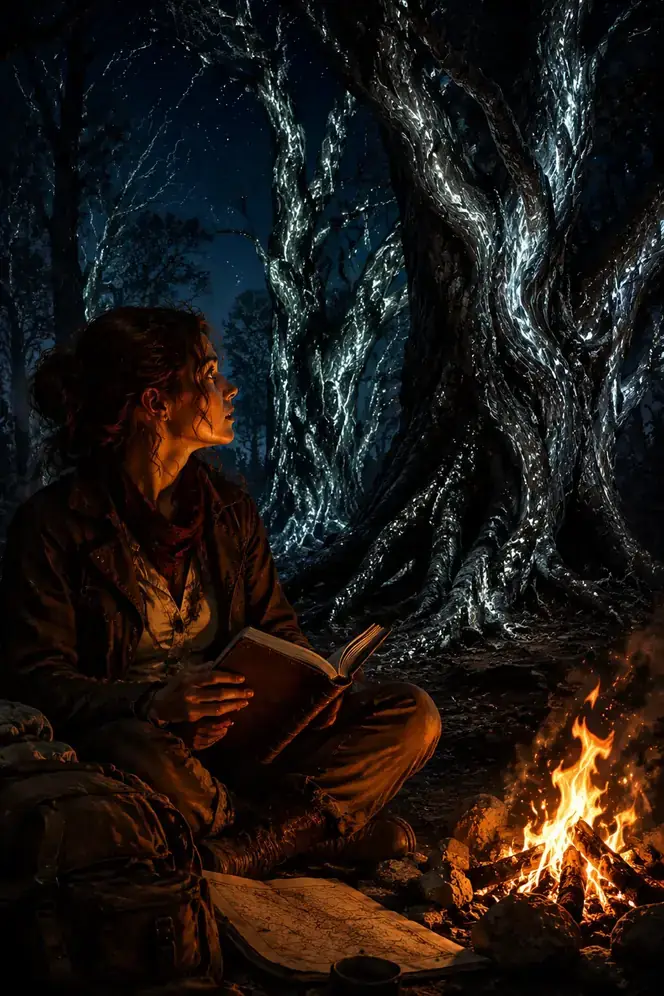
The silver veins were glowing.
It wasn't much—a faint luminescence, like phosphorescence, as if the silver had absorbed the last of the daylight and was slowly releasing it back into the darkness. I'd never seen anything like it in any forest I'd mapped. I'd never heard of anything like it in the naturalists' journals or the historical records. The thought that I was observing something genuinely unknown was followed immediately by the thought that this was probably not safe, and I had to sit with both of those truths simultaneously.
I'd never heard of anything like it, and I had no terms for what it meant.
I lay out my bedroll near the fire instead of moving to the far side of the clearing, and I watched the trees glow. The light intensified as true darkness fell, until the silver veins were clearly visible despite the distance. They formed patterns. Networks. Structures that suggested purpose and intention. I'd always assumed that things in nature followed rules—rules of biology, of chemistry, of growth and decay. These patterns suggested something else. Something designed.
Something aware.
I pulled my blanket higher and reminded myself that trees were not aware of anything, and that glowing was a known phenomenon in nature—fungi, certain insects, bioluminescent organisms. There were perfectly rational explanations. There were always rational explanations, if you dug hard enough.
I watched the trees most of the night anyway.
The compass was pointing south-southeast when I woke.
That was not possible. Compasses pointed north. They pointed north the way water fell down and objects fell to earth—not from preference or magnetism or any quality intrinsic to north itself, but from the fundamental architecture of the world. A compass pointing south-southeast would require something so catastrophically wrong with the world's fundamental architecture that my immediate reaction was to check if I was still holding it correctly.
I was. It was. The needle trembled slightly, pointing almost directly toward the interior of the Thornwood.
I tried resetting it. The needle swung back toward north, hung there for exactly two seconds like a held breath, and then swung back toward the interior. I did this five more times, deliberately, systematically, the way I approached all problems. Five attempts. Five identical results.
Okay, I told myself. Okay. There were explanations. The iron deposits had shifted during the night—possible if unlikely. The earth had moved—unlikely in the extreme. I had gone mad—also unlikely, though morning seemed as good a time as any for a complete psychological fracture. Possibly the compass itself was defective, though I'd had it for seven years and it had never misbehaved before.
Or possibly the Thornwood was not following the same rules as everywhere else.
Possibly the rules were different here.
I was repacking my instruments, moving slowly, delaying the moment when I would have to make a decision about what to do next, when the world changed.
It wasn't subtle. It wasn't a gradual shift or a slow realization. One moment I was standing in a forest of strange but otherwise solid trees. The next moment, there was light—not from the sky or the fire or the sun or any conventional source. Light that ran through the ground itself, through the soil and the roots and the deep structure of the earth, in patterns that my eyes had somehow always known how to read.
No. Not light. Light was the wrong word. Shimmer. Heat-haze on summer stone, except here it was cold, and here it ran in rivers and lines and networks, connecting every growing thing, pooling in deep wells at the base of the oldest trees. I'd seen this my entire life. I'd seen it at the margins of my vision, at the edge of things, the way you see a movement that vanishes when you look directly at it.
Except I was looking directly at it.
And it wasn't vanishing.
It was everywhere. Structured. Intricate. Beautiful in a way that stopped my hand on the pencil and dropped my stomach clean out. I didn't understand what I was seeing. I didn't have language for it or any category for it or any way to fit it into the orderly architecture of things I knew. I only knew that it was there, and it was real, and it was the most important thing I'd ever seen.
The lines were brightest deeper in.
My feet had already started moving before my mind caught up.
You might also like