
Chapter 5
Chapter 5: The Court
Chapter 5: The Court
The Thornwood didn't end so much as it dissolved. One moment I was following Cael through a forest that had started to feel like a maze with trees instead of walls, the next the trees opened onto a landscape that looked like it had been abandoned by something that built at a scale humans were never meant to match.
The stone arches rose from the ground like the ribs of a massive creature, all white and grey limestone gone soft with age. They had to be twenty feet high, maybe more. The carvings on them were intricate enough that I would have spent hours documenting them under different circumstances—spiraling patterns that might have been writing, might have been purely decorative, might have been both. Everything in fae territory seemed to be both.
"This way," Cael said, as if I had any choice in the matter.
I wasn't given the option to study the arches. He walked between two of them, and the air changed. It was colder. Thinner, somehow, though I could breathe it fine. The light altered too—not dimmer, but different, like it was coming from a source that wasn't the sun, because it wasn't. The sun was still visible overhead, but it seemed very far away.
Beyond the arches, the Court began.
I have been to grand places. I have mapped the vaulted ceilings of the royal library in Ardynn. I have stood in the great halls of merchant nobles with their ostentatious columns and gilt work. Nothing I had ever seen prepared me for this.
The Court was built downward and outward, carved into what might have been a canyon or might have been a deliberate excavation on a scale that made my mind hurt to contemplate. The structures rose in spiraling tiers, all pale stone and bioluminescent architecture, lit from within by sources I couldn't identify. Silver flowers bloomed in wall niches, glowing faintly. The light they cast made everything look like it existed slightly underwater.
The ceiling was so far up it might as well have not existed. But it did exist, and it was carved. Every inch of it was carved with scenes that shifted when I wasn't looking directly at them—or at least, that was the impression they gave. Great hunts, I thought. War scenes. Celebrations that looked like slaughter. The usual fae pastimes, rendered in exquisite detail by craftsmen who had probably had centuries to perfect their work.
"Do not wander," Cael said. He hadn't stopped walking.
I scrambled after him, my boots loud on the stone. Everything else about me was loud too. My breathing. My pulse. The whisper of my coat. Around us, the fae moved like water, silent and fluid and wholly unconcerned with my presence. They looked at me as we passed—really looked, the way a merchant might examine a curiosity item at market. There was hunger in some of those looks. There was contempt in others. And there was something else in all of them: a careful distance, a deliberate acknowledgment of Cael's presence as the boundary I was not to be crossed.
I filed that observation away. It might be useful.
The room I was given was, apparently, what passed for modest quarters in the Unseelie Court.
It was carved entirely from what I assumed was marble, though the stone had a faint luminescence to it that suggested it might be something else entirely. The walls were ribbed, which I initially thought was structural until I realized it was purely decorative—the real support was provided by columns at each corner, each one carved into a twisted shape that might have represented dancers or might have represented something far less pleasant. The floor was warm underfoot, which made no sense and I chose not to dwell on.
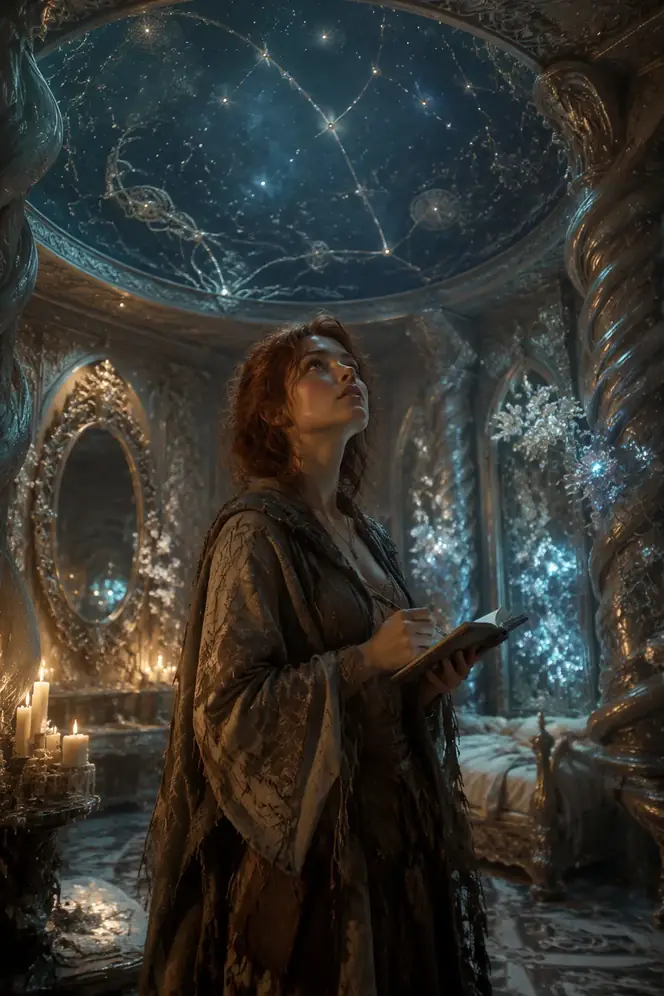
The ceiling was painted, with pigments that caught the light in a way that suggested they weren't conventional. Stars, rendered in silver and blue, with constellations I didn't recognize.
The furniture consisted of pieces so beautiful they seemed actively hostile to functionality. A bed that was essentially a sculpture, four posts carved into spiraling shapes and supporting a frame that looked like it had never been intended to hold anything as mundane as a human body. A mirror with a frame so elaborate that the actual reflective surface was almost an afterthought. A writing desk with legs like tree roots.
I sat on the bed—as if it might shatter—and took inventory of what I had with me.
My coat. My boots. The trousers and shirt I'd been wearing when I went out to map the Thornwood border, which felt like a lifetime ago. A knife with a bone handle, which had been a gift from my mother. My personal field kit, a leather satchel the size of a book, containing: a compass (magnetic and reliable), a set of measuring calipers, three pencils, one mechanical pencil with two remaining tips, a sharpening knife, an eraser, and a small leather-bound journal with perhaps thirty pages left.
It was the personal kit. Not the working kit. The working kit had been in my saddlebag on a horse I would never see again, assuming the Thornwood hadn't eaten that too.
No one had taken anything from me. They'd brought me to this room and left.
The food came an hour later, delivered by a fae I didn't recognize—a woman with bones so sharp they seemed to cut through her skin, with eyes like opals and hair that moved of its own accord. She set down a tray without speaking and left before I could work out if I was supposed to acknowledge her.
The food was the problem. It looked remarkable: dishes I didn't have names for, prepared with such artistry that I almost convinced myself it was safe. The tray held fruits that glowed faintly, meats arranged in careful patterns, and bread—clearly bread—except somehow the wrong color. Too pale. Too luminous.
I had read the stories. Every child in Ardynn was raised on them: fae food bound you, fae water made you their subject, fae bread unmade your name entirely.
I didn't eat any of it.
But I did catalogue it. I pulled out my journal and spent a careful hour documenting each dish: size, shape, color, approximate composition. The descriptions kept me occupied in a way that suggested I was doing something useful rather than sitting in a fae palace and waiting to learn why I'd been marked instead of killed.
Cael didn't come to the room. I saw him once, hours later, walking down a corridor I glimpsed from the threshold when I convinced myself I should at least understand the geography of my prison. He was walking with another fae, taller than him and silver-haired in the opposite way—where Cael was white-blonde, this one was silver-grey. They weren't talking. The other fae looked at me for just long enough to make clear I wasn't worth addressing.
When Cael passed, I saw his eyes. They caught the light of the bioluminescent flowers and reflected it like water reflecting the moon. He didn't acknowledge me. His jaw was set in a way that suggested he had made some decision and was not open to discussion about it.
I went back to my room.
The night was long. I didn't sleep. My mind kept cataloguing—the exact pattern of the carved ceiling, the temperature of the stone, the precise shade of the silver in the flowers, the sound the Court made at night, which was virtually nothing except for the faint hum of something I couldn't identify. Magic, probably. I was coming to the conclusion that if I couldn't name it, it was magic.
I organized my kit. I reread my journal. I studied the measurements I'd taken before the Thornwood. I tried very hard not to think about the Mark on my wrist, which burned when I did, in a way that wasn't quite pain but wasn't quite anything else.
I was cataloguing the precise shade of the marble for the third time when the first real light of morning came through the window I hadn't noticed was there until the sun actually rose. It revealed the window to be deeply impractical—all curves and no real panes, more sculpture than glass. Light came through it the way light comes through water.
The morning light revealed the desk.
There was a leather satchel on the polished surface, identical in size and construction to my working kit, except it wasn't the one I'd brought with me. I knew my kit. This one was new. Pristine. And closed.
I stood up too quickly. The bed released me with something that might have been relief.
My hands shook when I opened it.
The kit was complete. Every implement I could possibly need: pencils in three grades, mechanical pencils with enough tips to last months, erasers, sharpening knives, measuring calipers in three sizes, watercolor sets sealed in wax paper, ink in careful glass bottles, paper—good paper, the kind I used for final drafts, the kind that cost more than most people's monthly wages.
There was a new journal too. Leather-bound in the same shade as the one I carried, but thick, full, completely empty.
I sank back onto the bed and stared at it.
No one had asked me what I needed. No one had given me the option to request anything. I hadn't mentioned my kit to Cael, hadn't told anyone I was missing my full equipment, hadn't explained that my personal journal was nearly used up and I needed something to replace it.
Someone had looked at what I was—a cartographer with a nearly-full journal and a kit that had seen work—and had provided exactly what that person needed.
Before I asked. Before I could ask.
I stared at the satchel until my vision blurred.
You might also like