
Chapter 16
Chapter 16: The Renegotiation
Chapter 16: The Renegotiation
The final convergence point was at the center of the chamber, beneath the apex where three major lines met. I had charted them individually, traced their divergences and reunions, mapped the dozen smaller lines that fed into them like tributaries into a river. Everything else on the page was complete. Only this remained.
I pressed the charcoal to the parchment and drew the mark—not a knot, exactly, but a kind of recognition, the moment where three currents became one and didn't collapse. The charcoal moved in my hand with absolute certainty. I had not doubted this line in days. The lines did not lie.
I lifted the pencil.
The map was complete.
I stood in the convergence chamber with the parchment spread across the stone table, every inch of its vast surface covered in lines and notations and the accumulated weeks of work. The light from above caught the charcoal in places, made the paper gleam. Behind me, the chamber hummed. The sound was different than before—not the fractured, discordant vibration of ley lines tearing at one another, but something deeper. A resonance.
I looked up.
The lines in the stone walls were moving. Not fast, but measurable. The fractures that had spider-webbed through them, the places where the magic had begun to rupture—they were closing. The lines were sliding back into alignment, drawing themselves together like threads being woven back into a loom. Where before there had been fragmentation and discord, there was now a settling. A return.
I had gotten closer to the center than Mara had ever been able to get. Close enough that I could see this.
It took a moment to retrieve the map from the table without disturbing it, to roll it carefully and secure it, to carry it out of the chamber with my hands steady. The paper felt warm. The charcoal smudged slightly against my fingers where I held it.
Cael was waiting in the hall. He always was.
I handed him the map. "It is complete," I said.
He took it. His hands were large enough that the entire roll fit in one palm, and he held it like that for a moment—just held it—before unrolling it slowly across the length of his arms.
He did not speak. He read every line. Every notation. Every convergence point and rupture. He read the margins where I had written notes to myself in a shorthand only I understood, reminders about wind patterns and water tables, about the way certain lines moved differently under rain. He read the whole of it, and his eyes—silver and absolutely still—moved across the parchment with the precision of someone reading his own language.
Behind him, the walls of the Unseelie Court seemed to settle. I could not see the lines from here, but I could feel them. The sharp, discordant sensation that had lived in the base of my skull for weeks was fading. The chamber was healing.
When he finished, he rolled the map closed again and held it against his chest for a moment. Then he looked at me.
"The service is complete," I said. "The debt is paid. Release the Mark."
He was silent. For just long enough that I thought perhaps he would not. That this was the moment where the bargain transformed into something else, something I had not accounted for.
Then he said, "Yes. I will release it."
He did not move his hands, and neither did I, but I felt it happen. The Mark had been a constant weight on my collarbone, a pressure just beneath the skin, a reminder that I was bound. It lifted. Simply lifted, like air leaving water, like the moment a held breath was released. The space where it had been felt strange—empty, but not in the way of loss. In the way of space that had suddenly opened up.
I could have walked out. I could have walked out right then, and nothing would have stopped me.
Cael did not give me that time.
"There is another bargain," he said. "If you wish to hear it."
I did not move.
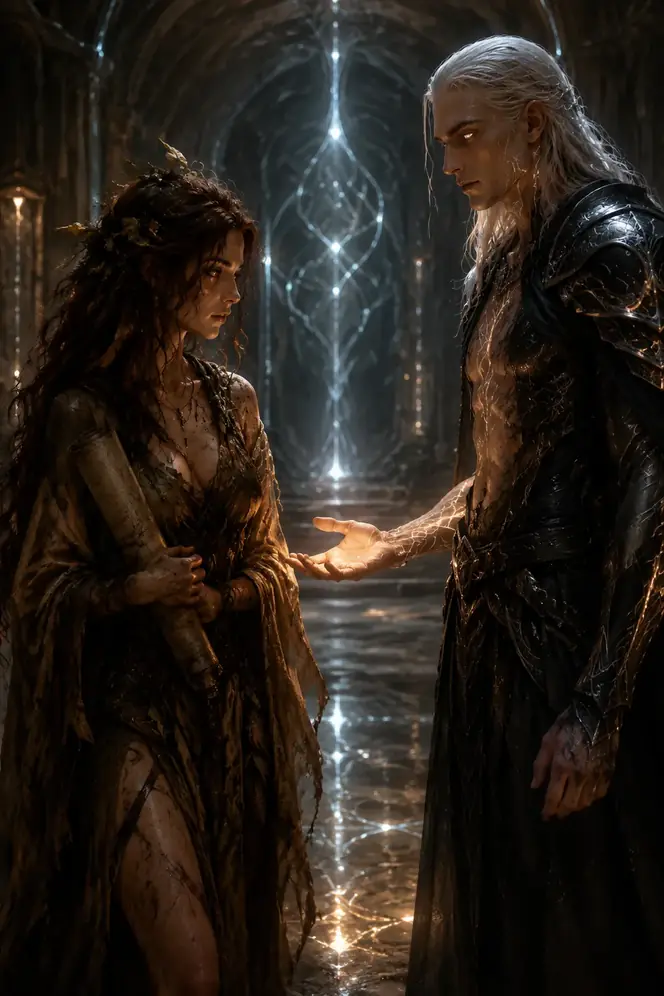
"The map you have made is yours. A copy will remain within the Court, for the healing of the lines. But the original is your possession. You may leave the Unseelie Court whenever you choose. You may return whenever you choose. There are no terms attached to either departure or arrival. No debt. No obligation."
His voice did not change as he continued.
"The Mark you wore was a seal of contract. I will not replace it with another seal. But if you consent, I offer a different marking—not a debt or a claim, but a thread. It will not compel you. It will simply hold. When you choose to reach for it, you will know where I am. When I reach for it, you will know where I am. Nothing more. Nothing less."
I looked at him. The parchment was still against his chest. His hair was like moonlight. His eyes held no reflection because there was nothing in them that reflected—only depths, only the silver of something ancient and precise and entirely inhuman.
"These are the terms," he said. "If you accept, they replace all others. If you refuse, you are free regardless. The Mark is lifted. You may go."
I took the map from his hands. It was warm, just as it had been warm in the chamber. I unrolled it partially, looked at my own work—at the convergence points and the lines I had drawn and the map of something I had learned to see. The lines in the chamber had been healing themselves. That was real. That was not contingent on anything except the completion of the work.
"In ten thousand years," I said quietly, "you have never renegotiated."
"No," he said. "I have not."
I closed the map again. Rolled it closed. Held it against my chest the way he had held it.
"Why now?" I asked him.
He looked at me for a long moment. The silver in his eyes seemed to deepen, to absorb the light from the torches without reflecting it.
"You changed the terms of what I wanted," he said.
You might also like