

Chapter 3
Chapter 3: The Files Exist
The flagship's data vault was a secure chamber three levels below the main intelligence center—a room placed as far from the hull as the ship's geometry allowed, as if physical depth added to the depth of security. Walls lined with redundant storage systems, kept at precise temperature and humidity to prevent degradation, each environmental reading logged every fifteen minutes by automated systems that never forgot and never slept. The air tasted faintly metallic, cold in a way that had nothing to do with the temperature controls. Kael had been in data vaults before. They all had this quality—a heaviness that was partly the weight of processed air and partly something harder to name. Access required biometric verification and a command-level authorization code that Kael had to enter manually, her hands against the reader, her voice delivering the authorization phrase into the log. The system confirmed her identity and the legitimacy of her request. The database access was granted.
Silence, afterward. Then the soft initialization hum of the archive loading to the display terminal.
The first file opened: Admiral Kess Ardent's personal log, Year 43 of the Dominion calendar, Month 7.
"The Sovari delegation has requested another negotiation session regarding territorial boundaries. I have reviewed their proposals. They are offering to cede the Kethel system entirely, requiring only mining rights to rare materials on the third moon. This is weakness. They fear conflict. I have determined that total acquisition is achievable within two calendar years if current fleet capacity is redirected from other operational zones. The Dominion does not negotiate with inferior civilizations. We establish dominion."
Kael read that entry three times. The language was not coded. It was not strategic analysis of military threat or resource scarcity. It was a straightforward declaration of intent to commit genocide, dressed in administrative language. She read it a fourth time looking for something she'd missed—some diplomatic formality, some qualifying caveat that would allow the words to mean something other than what they said. There was nothing. Ardent had written this the way he would have written a logistics order: clean, direct, and entirely unconcerned with the perspective of anyone who would read it afterward.
He had either not expected anyone to read it. Or he had not expected it to matter if they did.
The next files were combat records. Kael scrolled through them with mechanical precision, understanding the tactical notations, recognizing the fleet maneuvers, reading the casualty counts. Sovari civilian settlement Keth'alor: 400,000 inhabitants. Dominion fleet approach: 17 capital-class warships, 34 escort vessels. Bombardment duration: 14 hours. Sovari military response: none. Dominion casualty report: zero.
Zero.
The Sovari had not fought back. They had not had the military doctrine or the weapons systems or the philosophical framework to respond with violence to what was being done to them. Ardent's fleets had arrived at their cities and annihilated them while the Sovari were still trying to understand what was happening.
She made herself think, briefly, about what that looked like from inside a Sovari city in the minutes before the first bombardment reached the surface. A sky filling with warships—ships of a recognizable design, the same ships that had been trading with them. The recognition that trading ships did not move in this formation. The communication attempts—there would have been communication attempts; the Sovari had diplomatic history, they had been negotiating for months—and then the silence from the other side, and then the end of silence. She held that image for a moment, not long enough to let it become unbearable, long enough to prevent it from becoming abstract.
Then she put it away and kept reading.
Kael kept reading. There were 48 documented settlements destroyed. The casualty figures accumulated: 1.2 billion from the first wave, another 2.1 billion from system-wide bombardment campaigns, another 1.8 billion from what the documents called "pacification operations" in the resource-rich regions. By Year 50, the Sovari were extinct as a spacefaring civilization. The few survivors—perhaps 300,000, scattered and in hiding—had been systematically hunted down in the "integration phase."
The cultural suppression files were methodical. Sovari language was prohibited in public settings. Sovari historical records were seized and archived in the Red-Clearance database to prevent spread of "falsified history." Sovari cultural artifacts were "integrated into Dominion collections" or destroyed. The few remaining Sovari were forced into labor programs or executed for "resistance to integration."
Kael read for four hours. The archive contained 40,000 pages of documentation: logs, orders, casualty reports, resource allocation records, personnel rotation charts. Someone, at some point in Dominion history, had documented the entire genocide meticulously, recording each atrocity with the cold precision of military administration. And then, someone else had sealed this documentation behind the highest classification level and ensured it would never be seen.
The precision of the record-keeping was, in its own way, the most disturbing element. These had not been atrocities committed in confusion or passion and later obscured. They had been planned, executed, logged, and archived as operational successes. Every settlement had its own documentation packet: pre-bombardment reconnaissance imagery, targeting assessment, post-engagement damage survey. Someone had sent ships to photograph the ruins to confirm completeness.
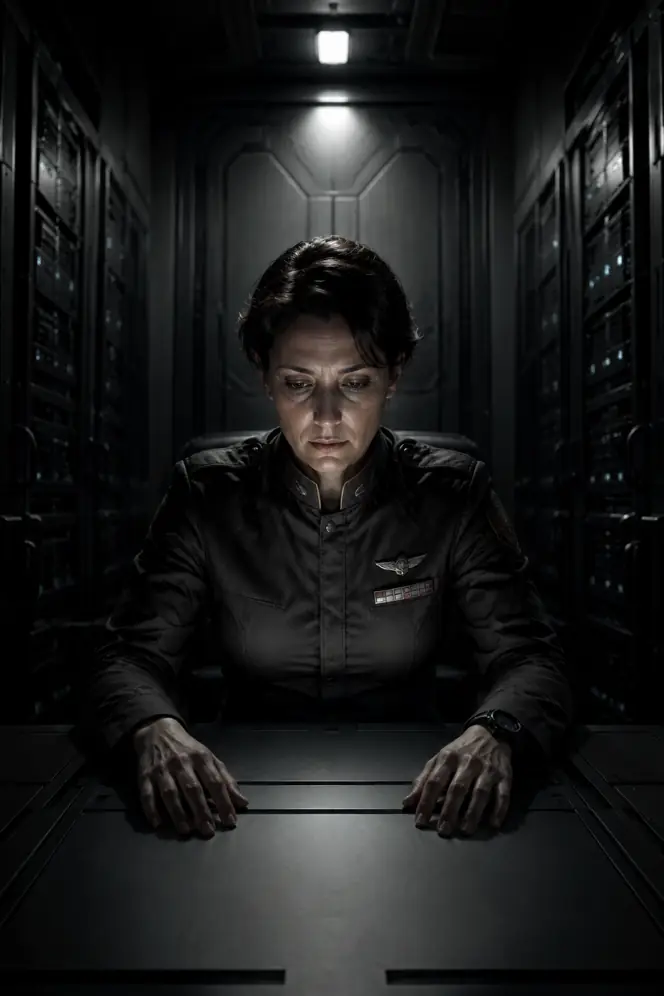
When she finally closed the database, her hands were shaking.
She sat in the vault chamber, in the white light of the data displays, understanding with absolute clarity that everything she had been taught about the Dominion's founding was a lie. Not metaphorical falsehood, not strategic reframing, not historical revisionism. Outright, documented, deliberate lying. The genocide had happened exactly as Reyes had described it. The Sovari had been innocent. Dominion military doctrine was built on the systematic murder of an unarmed civilization.
And she had been serving that institution for twenty years. She had been killing for it, strategizing for it, justifying it to junior officers, defending it against the Fracture, accepting the loss of her father in its service.
Her father had died defending the legacy of a genocide.
The realization sat in her chest like something indigestible. She could not vomit it up. She could not excise it. It had entered her understanding and altered the meaning of every decision she'd ever made.
She tried to assemble a rational frame around it, the way she assembled tactical assessments: variables, priorities, available courses of action. The discipline refused to engage. The rational architecture of her mind was present and functional and had nothing useful to do here. This was not a problem with a solution. It was a fact, and facts did not resolve. They persisted.
The vault door remained sealed. No one would enter without authorization. Kael's biometric signature was the only thing that could confirm her presence here. She had time to think, if thinking was what she was doing. Maybe she was just sitting in the shock of recognition.
The ship hummed around her. Somewhere above, the 3rd Dominion Fleet was resting in the aftermath of victory, the crew enjoying the post-combat relief of having survived. Somewhere below, Tomas Reyes was locked in an isolation cell, waiting to see if she would verify the files, waiting to learn if the message had landed.
Somewhere on the other side of the system, Dara Senn was calculating the tactical implications of this moment, betting everything on Kael's reaction.
Kael got up and walked out of the vault. The door sealed behind her. She moved through the corridors of the flagship, and nothing had changed. The ship was still operational. The crew was still functioning. The battle had still been won. Every physical fact of the universe was exactly as it had been four hours ago.
She needed to be on the bridge.
The crew she passed in the corridors looked exactly as they always looked: officers moving to stations, technicians with equipment, a medic walking quickly toward the medical bay. People doing their work inside a structure whose foundation she had just read, in 40,000 pages, in the original administrative language of the men who had built it on six billion dead. None of the faces she passed knew that. They were all operating on the same assumption she'd been operating on four hours ago—that the Dominion was what it said it was, that the work they were doing had the meaning they'd been told it had.
She made her way back to the command bridge, walked past the tactical sphere with its representation of the Dominion's victory, and sat down in the command chair. Around her, the crew pretended not to notice that the Admiral had been gone for hours, that something was different about the way she held herself, that the mathematical certainty had gone out of her movements.
"Status," she said to Venn.
"All stations green, Admiral. Medical finishing up the casualty reports—final count is 147 personnel lost across the fleet, 340 wounded. The Kether's Light is stable; they can make transit back to the forward base under their own power. Prisoner manifests are complete. What are your orders?"
The question was neutral. Venn was a good officer—he didn't ask what had happened in the interrogation chamber, didn't comment on the extended absence, just reported status and waited for command.
Kael looked at the tactical sphere and saw what she'd always seen: a representation of victory. But underneath it, she could see something else now: the bones of a genocide, dressed up in strategy and necessity, justified through military doctrine, embedded so deeply into the structure of the Dominion that no one could even see it anymore.
"Continue standard holding pattern," she said. "Repair operations as needed. I want status updates every four hours. And Venn—keep the prisoner Reyes secure. Double the guard, but no physical interrogation. Keep him alive and intact."
"Understood, Admiral. Are you—"
She looked at him, and whatever he saw in her face made him stop mid-question.
"I'm fine," she said, which was a lie. She was the least fine she had ever been. But fineness was not something she could afford to lose right now. "Just maintain current status."
Venn nodded and turned back to his displays.
Kael sat in the command chair and watched the tactical sphere, and the terrible knowledge settled into her like a stone sinking through still water. The Dominion was not worth defending. The Fracture was not wrong. Everything she had built her identity around was predicated on a catastrophic lie.
And somehow, she still had to do her job. Somehow, she still had to command this fleet, still had to be the competent officer who made the right strategic decisions. Because if she fell apart, people would die. And even now, knowing what she knew, she could not make the calculation that millions of deaths were acceptable simply because the institution deserved to fall.
She sat in the command chair and tried to find the mathematics that would let her continue breathing.
You might also like