

Chapter 4
Chapter 4: What the Dominion Is
She briefed the squadron commanders at 0800 hours the following morning. Seventeen officers assembled in the flag conference room via holographic relay, faces floating in the blue light of projection, waiting for her to tell them what came next. Kael stood at the head of the display table and gave them exactly what they needed: tactical assessment of the previous engagement, projected Fracture response, logistics requirements for the forward push, ammunition expenditure analysis, and recommended repair sequences.
Twenty-seven minutes. Clean. Precise.
She had not slept. She had gone to her quarters after the command bridge, had stood in the dark for an indeterminate period, and had eventually sat at the edge of her bunk and worked through fleet positioning data until the 0600 wake-cycle began. Her movements through the briefing had the particular quality of competence maintained entirely through discipline—every word in the right place, every number correctly cited, every pause occurring exactly where it should occur. She had been building this kind of performance for twenty years and it required almost nothing of her conscious attention. She could run it while another part of her mind was somewhere else entirely.
Venn stood to her right during the briefing, taking supplementary notes, occasionally feeding her updated numbers from live feeds. He noticed her hands when she pointed to the tactical display. Her hands were steady. He noticed her hands because he'd been watching them for six years—he'd learned to read her tells the way a navigator learns a star field: the slight tension in the left index finger when she was calculating under fire, the relaxed curl of the right when the situation was under control.
This morning, nothing in her hands matched any condition he'd catalogued.
The briefing ended. Officers signed off, the holographic presences blinking out one by one. The conference room went quiet.
"You want me to leave," Venn said. Not a question.
"I want you to complete the logistics review with Engineering-Captain Mays," Kael said. "Fuel expenditure on the forward squadron is higher than projected. Find out whether we have the reserve capacity to maintain current engagement tempo, or whether we need to request resupply before the next action."
"Admiral—"
"Venn." Her voice was the same voice it always was: precise, mild, carrying enough authority to end conversations. "Logistics review. Thank you."
He left.
She stood alone in the conference room with the dead holographic displays and the low hum of the flagship's systems and the knowledge she'd spent the last twelve hours trying to compress into something small enough to function alongside.
The Dominion had been built on six billion deaths. The foundational act of its existence was a genocide. Every institution she'd ever served—the military hierarchy, the educational system, the political apparatus, the cultural narrative—was built on top of that act, and the weight of it had been distributed so thoroughly through two hundred years of institutional sediment that no individual could see themselves as complicit. You couldn't feel the floor of a building while you were living on the fortieth floor.
Her father had been on the fortieth floor. Colonel Maren Oren, career military, third-generation Dominion officer, killed three years ago when a Fracture cruiser intercepted his convoy escort and annihilated it. Kael had been sixteen systems away, commanding the 3rd Fleet in a holding action, when the notification came. She had finished her battle, sent condolences to her father's remaining crew, and then stood alone in her quarters for forty minutes before putting herself back to work.
She had kept a photograph of him on the bulkhead beside her workstation for six years before the last reassignment, when she'd packed it into the personal effects box and not taken it out again. Colonel Maren Oren at thirty-two, in dress uniform, at the ceremony where he received his second Distinguished Service commendation. He was smiling in the photograph, which was unusual for formal portraits—he'd always been uncomfortable with ceremony—and Kael had loved it precisely because the smile was real, because someone had caught him off-guard, because it was the face he wore when he thought no one was making an official record of him.
He had believed in it completely. The Dominion, the service, the idea that protecting its institutions was the highest form of duty a person could offer. He had taught her that belief with the conviction of a man who had never questioned it, who had inherited it from his own father and been given no reason to examine the inheritance. Three generations of Oren officers, each one handing the belief forward. All the way to her, and then to the archive in the vault, and now to here.
She had blamed Dara Senn. Not abstractly—personally. Senn had given the tactical orders that positioned the Fracture cruiser. Senn had chosen the corridor, the timing, the engagement parameters. Her father's death had been a strategic decision made by Kael's former mentor, and Kael had been carrying that weight alongside the professional assessment of Senn as a talented adversary.
Now she understood: her father had died defending the legacy of an atrocity. The convoy was carrying military supplies that would be used in operations against the Fracture—against people who knew the truth about what the Dominion had done and had chosen to burn it down rather than let the lie continue. Her father had never known this. He had died for a cause he believed in, and the cause was exactly as unworthy as Senn had always claimed.
And Senn had killed him anyway. That was also true. The moral geometry was not simple: the Fracture's cause being just did not make every Fracture action justified. Senn had made a tactical choice that killed a man who deserved better, and Kael could not make peace with that even while acknowledging that the Dominion deserved to fall. She had not been given a world in which the two facts cancelled each other out. She had been given a world where both were true simultaneously, and she had to stand inside that truth and continue functioning.
The complicity under duress registered in her body rather than her mind—a physical sensation, like holding something heavy and realizing you cannot put it down without someone else getting hurt. She could not stop functioning. She could not expose the knowledge. She could not hand the Dominion military command an intelligence finding that said everything we're fighting for is built on genocide, because the people she would hand it to were people who had, like Priya Ansel, probably already accommodated themselves to it. Or people who would kill her before the information could spread.
She needed to keep functioning. This was the only truth available to her.
Kael walked to the viewport. Starfield: the black static of interstellar space, interrupted by the distant pulse of her fleet's running lights. Forty capital ships, six hundred total vessels. Tens of thousands of crew members who went where she pointed them and trusted her to know which direction was correct.
She thought about Senn in this moment. Senn, twelve years ago, sitting with the same knowledge, trying to decide what to do with it. Senn had tried to bring it to civilian leadership and been arrested for her trouble. Senn had then defected, built a rebellion, and started a war that had now killed more people than the Dominion killed in any single engagement since the Consolidation.
The war had been a catastrophic choice. The Fracture was right and the Fracture had still managed to create a situation where billions of additional people would die if they succeeded. Senn had known the truth and that knowledge had not protected anyone. It had just given her a better reason for the destruction she was causing. Truth was not, by itself, a strategy.
She would not make the same mistake. This she knew with more certainty than she knew almost anything else at this moment—not the resolution of what she would do instead, but the negative certainty of what she would not do. Not defection. Not announcement. Not Senn's choice, translated into her circumstances and called something different. The absence of an answer was not the same as having no options. She needed to believe that.
The door opened. Venn entered without knocking—a privilege he'd accumulated through six years of working alongside her. She didn't turn from the viewport.
"Logistics review is completed," he said. "Mays says we have eight days at current tempo before fuel reserve becomes critical. She recommends requesting resupply now to ensure continuous operations."
"Send the request," Kael said. "Highest priority, given intelligence assessment of Fracture resurgence probability in this sector."
Venn didn't leave. She could hear him standing just inside the door, deciding whether to push.
"Something's wrong," he said.
"Fuel reserves are a concern," Kael said. "That's why we're sending the resupply request."
"Not the fuel," Venn said. "Yesterday's briefing—you were off by three seconds on your usual pacing. Your left hand didn't do the thing it does when you're pointing to engagement markers. And you let the Kether's Light's gun commander give a full damage report instead of cutting her off at thirty seconds like you always do."
Kael was silent for a moment. Outside the viewport, her fleet held position, waiting for her direction.
"Three seconds," she said.
"I've been your tactical officer for six years," Venn said. "I know what three seconds means."
She turned from the viewport. He was standing at attention—not military attention, but the particular focused stillness of someone who had decided to say something difficult and was holding himself very still in case the decision was wrong.
"The interrogation of Reyes was productive," she said carefully. "The intelligence value was substantial. I'm processing it."
"That's not what this is," Venn said. "I've seen you process intelligence. You get sharper, not quieter. This is—" He stopped. "This is what you looked like when your father died, Admiral. Without the anger."
Kael looked at him directly, and recognition crossed his face when she met his eyes—and behind it, the beginning of understanding the shape of what she was carrying.
"Venn," she said, "finish the logistics report. Add a tactical assessment of Fracture capability in adjacent systems, using data from the engagement. It should take you four hours."
He looked at her for a moment longer. "Yes, Admiral."
"And," she added, before he could leave, "I'm going to need you to be steady in the coming weeks. Whatever I'm asking of this fleet—I need you steady."
She couldn't tell him more than that. Not yet. But she needed him to know that something was coming that would require him to keep functioning regardless of what he felt about it.
Venn read the message she wasn't saying. She watched him do it, watched the calculation move through his expression—not understanding the content, but understanding the shape.
"I'm always steady," he said.
"I know," Kael said. "That's why I'm telling you now."
After he left, she stood alone in the conference room and thought about her father, and about the Sovari, and about the 147 personnel she'd lost in yesterday's engagement, and about how all of it—her entire professional life—was stitched together by a lie she had never questioned because it had been told to her before she had the tools to question it.
She thought: the next generation of Dominion officers was in training right now. Learning the same history she had learned. Building the same identity on the same lie.
She could not let that continue indefinitely. She could also not do anything about it right now, today, on this ship, without consequences she couldn't calculate.
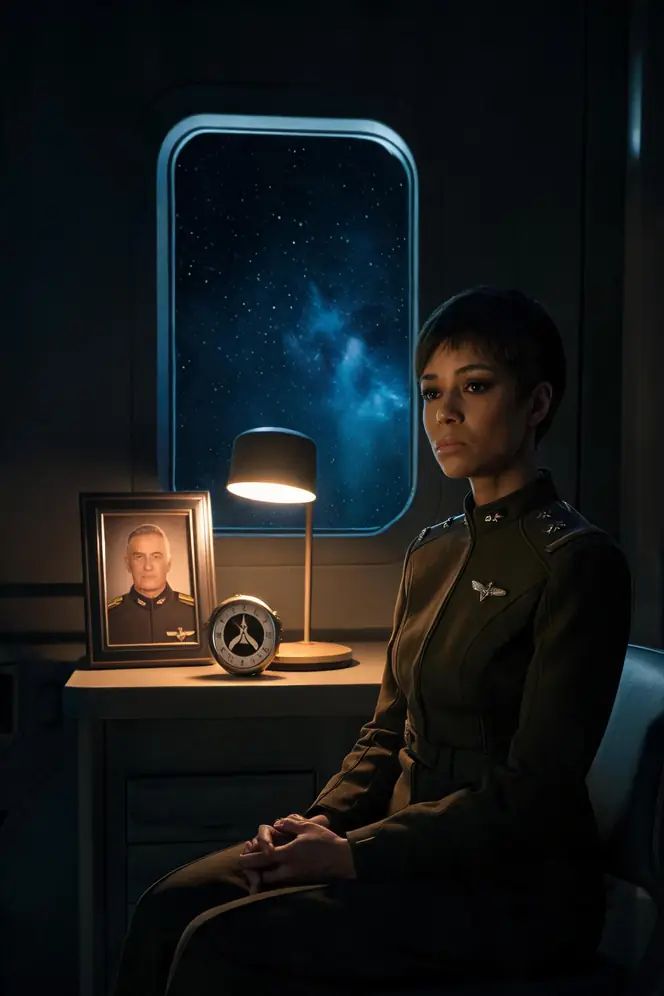
She stood at the viewport until the watch bell changed, then turned away from the stars.
You might also like