

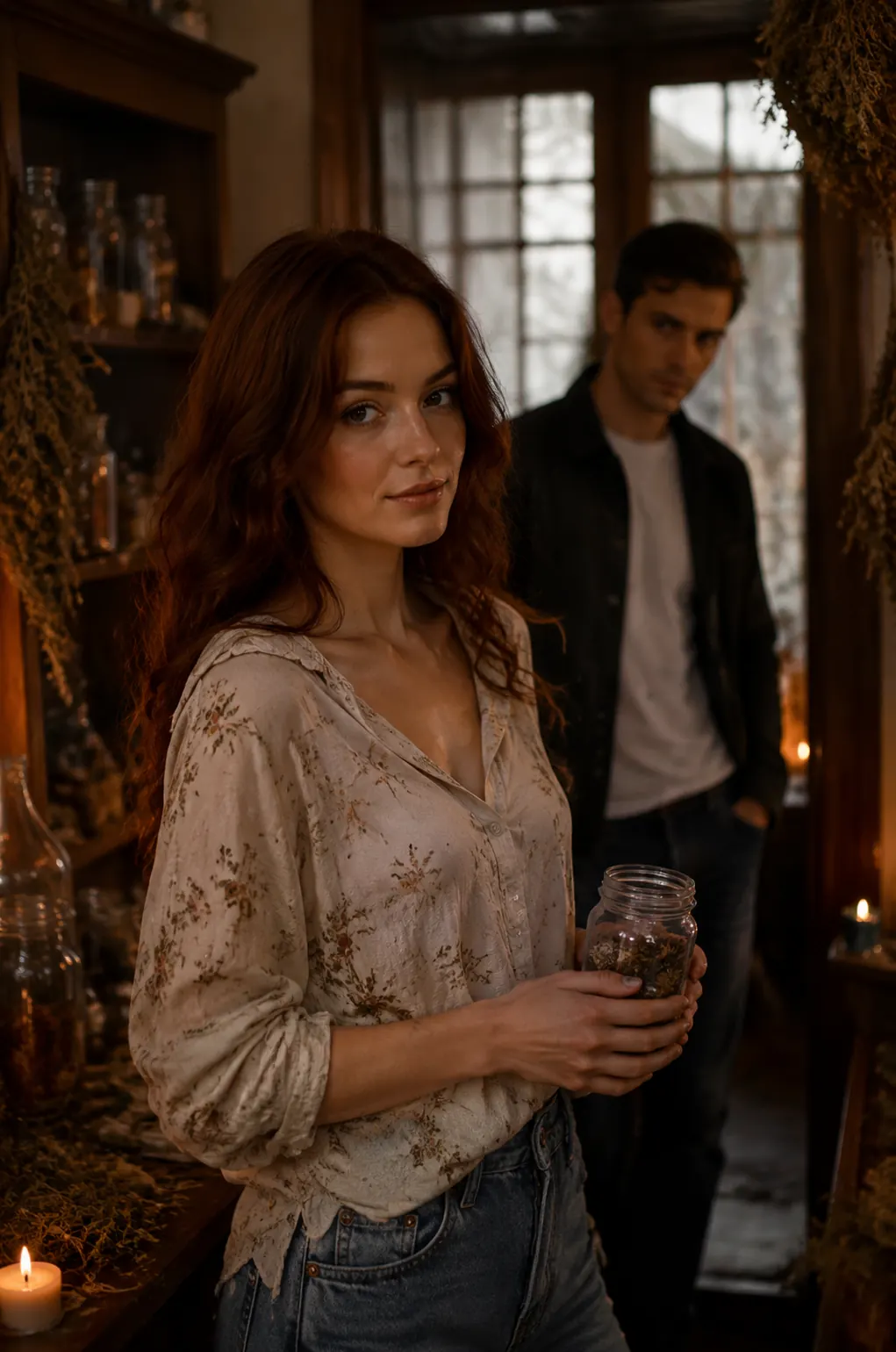
The Witch Next Door
Chapter 1
Chapter 1: Curiosity Protocol
Marcus had organized the boxes by room using a color-coded system: blue for kitchen, green for bedroom, red for his office, yellow for the study area that would function as both living space and a backup desk if work ever required more than the kitchen table. The labels were printed and laminated, each one cross-referenced to a master spreadsheet that noted contents, approximate weight, and priority unpacking order. He was currently stacking the blue boxes against the wall of his new kitchen, checking them off in a note on his phone as he did, when the front door swung open with a bang that suggested someone had misjudged its momentum.
He straightened too quickly, misjudged the height of his own kitchen in response, and bumped his head on the overhead fixture he'd already mentally catalogued as impractical for anyone over five-foot-nine. For a moment, his vision swam with the particular brightness of minor pain.
"Oh, no," a voice said from the hallway. "I didn't mean to—are you alright?"
Marcus rubbed his crown and turned to find a woman standing in his open doorway. She was perhaps thirty, maybe a few years younger, with dark red hair tied back with what appeared to be a wine cork. Her arms were full of herbs. Not grocery-store herbs in plastic clamshells with generic labels. These were the kind of things that arrived in farmers markets, already fragrant with damp and earth—the smell of actual growing things, not preserved approximations. He could identify at least four distinct scents: something minty, something that smelled like licorice and anise, something woody, and something he couldn't quite place that reminded him of autumn.
"I'm fine," he said, because he was, mostly. His head would probably have a small bruise, but the impact had been minor. "Do I know you?"
"You're moving in next door," she said, not quite as a question. She shifted the bundle of herbs to one hip with the ease of someone used to carrying awkward things, balancing the weight as if she'd been doing it for years. "I'm Wren. I live in 2B, across the front room. The other ground-floor apartment."
Marcus filed the information with precision. The brownstone had been converted into two street-level apartments—he'd checked the deed records, the building history, the floor plans archived online. She would have the front room and the space toward the back of the building, the kind of layout that maximized natural light and foot traffic. He had the more compartmentalized floor plan, separate rooms, better for focused work. They shared the narrow stoop, its brick worn smooth by decades of footsteps, its black iron railings original to the 1880s based on the craftsmanship.
"Marcus," he said. "Cole."
"Well, Marcus Cole, I'm sorry to intrude. I was coming back in and I saw your door was open." She smiled, the kind of smile that suggested genuine friendliness without requiring anything from him. "Thought I'd introduce myself, but I should have knocked first. I'm a consultant. I work out of my front room, so if I ever seem to have clients at odd hours, that's why. Just so you know what to expect."
"Consultant," he repeated, filing that away as a category that required a subsidiary category.
"Magical consultancy. Spell work, divination, cleansing, that sort of thing. Practical magic, really—nothing you'd see on television." She said this the way another person might say "I'm an accountant." She said it the way someone said something obvious, something that required no explanation, as if the supernatural were a reasonable Tuesday thing, as if witchcraft were just another job category that happened to exist in Brooklyn.
Marcus's data-scientist brain, which prided itself on inference and verification and the observable world, stalled like a computer encountering corrupted data. For approximately two seconds, he didn't process the sentence at all. Then he processed it. Then he wondered if he'd misheard it.
"Right," he said, which was absolutely the wrong response but the only response his mouth seemed to produce.
She wasn't defensive about it. She wasn't even self-conscious. She seemed unbothered by his evident confusion, which was itself a data point. Most people performed embarrassment when claiming something unverifiable. She didn't. "Most of my clients book online through my website. Some walk in if they happen to be in the neighborhood and feel called to it. But the majority are scheduled appointments. You shouldn't be disturbed by stray clients, and my work isn't loud. The only thing you might notice is incense sometimes, and I do try to keep that contained to the front room."
"Good to know," Marcus said, which was a reasonably neutral response while his mind performed a quiet regression analysis of how likely it was that his new neighbor was either deeply committed to a specific personality aesthetic or was genuinely as unconcerned about normal social interaction as she appeared to be. Maybe forty-sixty. Maybe thirty-seventy.
"I really should let you get back to it," Wren said, gesturing at the boxes with the hand that wasn't supporting herbs. She glanced at the kitchen with something like appreciation. "You've got a system."
"Color-coded by room," Marcus confirmed, and then found himself explaining in more detail than was strictly necessary. "It reduces the search time for any given item by approximately forty percent during the unpacking phase. Statistically significant across multiple data sets. I also photograph the stoop and the hallway before and after, so there's a visual record of what goes where and when."
"That's efficient," she said, and she sounded like she meant it. "That's really thoughtful. A lot of people just throw things in boxes and hope." She paused at the threshold, her gaze moving briefly to his labeled system, his color coordination, his obvious methodology. "Well. Welcome to the building. If you need anything—sugar, a wrench, someone to water a plant—I'm usually home."
"I don't have plants," Marcus said.
"You will eventually," she said, which was a strange thing to say with such confidence. "And I promise I'm less disruptive than I look carrying twenty pounds of dried herbs and various other questionable items."

She turned to go, then paused on the stoop. Marcus, from his vantage point in the doorway, watched her chest rise—one, two, three, holding. Then she turned back to him.
"How often do you look at the stoop?" she asked. "Actually look at it, I mean. When you come and go."
Marcus thought about the question with the same care she'd taken to ask it. "I've been in and out thirteen times today. I looked at it before each trip. I have a photograph from 3:42 PM." He paused. "Why?"
"What do you think of it?"
"The stoop?" He considered this. "Structurally sound. The mortar could use repointing in a few places. There's a slight unevenness in the third brick from the bottom where someone probably settled unevenly. It's from the 1880s. It's—" He stopped. "Why are you asking me this?"
She smiled, that same unbothered smile. "Tomorrow morning, keep an eye on it. Actually look at it when you go out. And don't panic."
"Panic about what?" Marcus asked, but she was already moving down the stairs, navigating the narrow stoop with remarkable grace for someone holding a large quantity of dried vegetation. She moved like she'd done it a hundred times, confident in her balance, unconcerned about the weight.
He watched her reach the sidewalk, watched her pull keys from her pocket (a ring of them, too many keys for one apartment), watched her unlock her door (his door, the shared building's ground-floor entrance), and disappear inside.
You might also like