

Chapter 8
Chapter 8: The Private Session
Chapter 8: The Private Session
The observation lounge was empty at this hour. The gas giant rotated in the viewport—rust-colored, banded with storms that would last centuries—and I waited by the viewport with my hands flat against the cold glass.
Zane entered without knocking. He closed the door behind him, waited a beat, and said nothing.
"Thank you for meeting me," I said.
"I've been waiting for this conversation for two weeks."
I turned to face him. The light from the viewport cast everything in amber. He stood near the seating area, making no move to sit, as if this were something to be gotten through standing.
"What do you want?" The question came out exact and level.
He studied me for a moment—not as if assessing whether to answer, but as if confirming something he already knew.
"The archive to be made public. Operation Quiet's operational records, declassified in full. The directors' names attached to every order, every decision. Helios Extraction, Meridian Colonial Holdings—and the specific individuals who signed off on it. All of it in the public record, where it cannot be filed away or erased again."
My chest did not move. I was breathing, but the breath was thin and managed.
"You processed those classification documents," he said. "Didn't you."
"Yes."
"You didn't know what you were processing."
"No."
The pause sat between us. The gas giant turned.
"That matters," he said. "But it doesn't change what you processed."
"I know."
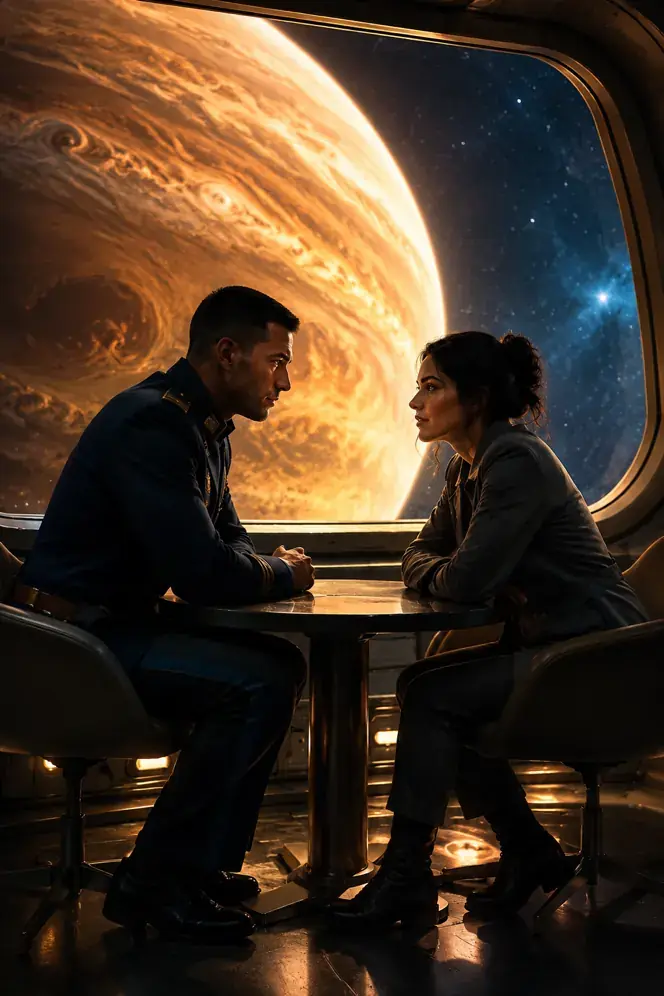
He moved closer to the viewport but did not come near me. He kept his distance with the precision of someone measuring it. "Seven years," he said. "I've been building toward this for seven years. Since Meridian pulled out of the outer colonies without explanation and the Authority classified why. Since people died of preventable illness in the settlements they abandoned, and no investigation happened because everyone who could have pushed for one had a file with their fingerprints on a classified document."
"The corporate chain of command."
"The corporate chain of command, yes. But also everyone in the regulatory apparatus who enabled it. Everyone in Meridian's lobby who knew what was happening and said nothing. The Authority's internal auditors who logged the complaints and buried them. The medical officers who were ordered to falsify reports." He turned from the viewport to look at me directly. "You're one piece of that chain."
The words were delivered without malice. That was what made them land.
"I know," I said.
"The difference between you and the rest of them is that you can still move. They're locked into their positions—their stakes are fixed. Yours aren't."
I waited.
"The only way this works," he said, "is if someone on the inside opens the files. Not to me. To the public record. The Authority's own archives, unsealed and public. The directors' own correspondence, published. No interpretation—just the documents."
"That's a breach of the highest classification level."
"Yes."
"That's treason against the Authority."
"Yes."
I turned back to the viewport. The storm bands rotated through their geometry. "If I do this, I lose my position."
"You lose everything," he corrected. "Your clearance, your status, your access to the Authority's systems. You become unemployable within the system. And that's the minimum consequence. There could be prosecution."
"Then why would you ask this of me?"
"Because you're the only person who has access and no other investment in protecting them."
The precision of it was almost surgical. He was right. I had no family wealth to protect, no connected relatives in the corporate apparatus, no personal fortune tied to the Authority's stability. I had only my job and my reputation, and both of those had been built on the work of processing documents whose contents I had chosen not to examine too closely.
"This negotiation," I said. "Everything these past weeks. This is what it's been building toward."
"Yes."
"Not toward a settlement with the outer colonies."
"There will be a settlement. I'll make sure of it. Better terms, actual autonomy, medical support restored." He paused. "But that's not the main objective. That's leverage. The settlement is what the Authority thinks they're negotiating. The declassification is what I'm after."
I looked at him. "You came here to use me."
"I came here knowing that you might be willing to be used. There's a difference." He held my gaze without wavering. "You've been waiting two weeks for someone to ask you directly. You arranged this meeting outside the official record. You could have continued processing documents and pretending you didn't know what they were. Instead, you came here and asked what I want."
He was right about that too.
"I'll show you tomorrow," he said. "Everything. The files on Meridian, on Helios, all of it. You'll know exactly what you're revealing and to whom. You'll have twenty-four hours to decide. If you say no, I'll proceed without you. The declassification will be slower, messier, and it won't be as complete. But it will happen. That's fact you need to decide on, not hope against."
The gas giant filled half the viewport. Its storms would outlast any decision I made.
"What happens if I say yes?" I asked.
He did not answer immediately. The silence stretched, comfortable in the way silences between honest people can be.
"I protect you as much as I can," he said finally. "I have contacts outside the Authority—journalists, historians, legal advocates. I can make sure you're not prosecuted alone. I can make sure the story is told accurately, which means your role is clear—you weren't destroying the Authority out of ideology. You were refusing to bury evidence of mass harm. That distinction matters legally and politically."
"But I go into exile."
"Probably. At least until the regime changes."
The word regime hung there. I had never heard anyone speak of the Authority that way in an official capacity. The idea that it could change, that what we were discussing was not a gesture of reform but a structural collapse—
"And you?" I said. "What happens to you?"
"That depends on how well the declassification works. If it's complete enough, if the public response is strong enough, I might escape to the outer territories and establish a government there that has no love for the Authority but no need to fight it militarily. If it's incomplete, or if the Authority manages the narrative—then I'll be a warlord with no territory, and they'll hunt me. Either way, I don't go home to a desk job and a pension."
He said it with the flatness of someone who had already accepted both possibilities as equally real.
"I came here," I said, "expecting you to ask for something I could refuse."
"This is something you can refuse."
"No. I came here knowing I was going to say yes. I just needed to hear you say it first."
His expression shifted to something closer to recognition. "Then I'll show you the files tomorrow."
"In the morning. Before the formal session."
"Yes."
The gas giant rotated. The pressure bands compressed and expanded, compressed and expanded, following mathematics that had nothing to do with us.
"There's one more thing," I said. "After I do this, after the files are released—I need immunity. Full immunity. If I'm going to burn my entire life down, I need guarantees that I'm not burned for it."
"I can't guarantee immunity from the Authority."
"Not from them. From you. Whatever happens after this, whatever you do with the power you gain from the declassification, I need your word that I'm not a loose end to be managed."
He considered this. The fairness of the request was obvious to both of us.
"You have it," he said. "And more than that—when this is finished and the Authority is no longer a force, I'll make sure your role is recorded accurately. Not sanitized, not simplified. You were complicit. You're also the person who refused to stay that way."
I nodded once.
He turned back to the viewport, and we stood in silence as the gas giant made its slow rotation through the dark. The light from its reflected storms moved across his face—amber, shadow, amber again. He was waiting for something, but not from me. He was waiting the way people wait who have already decided their path and now have only to walk it.
"I'll show you tomorrow," he said again, quieter. The statement hung there like a promise that could not be taken back once received.
I did not answer. The silence was its own agreement, and we both knew it.
You might also like