

Chapter 2
Chapter 2: The Chip
Chapter 2: The Chip
The chip was smaller than I expected. Flat, graphite grey, standard military encryption.
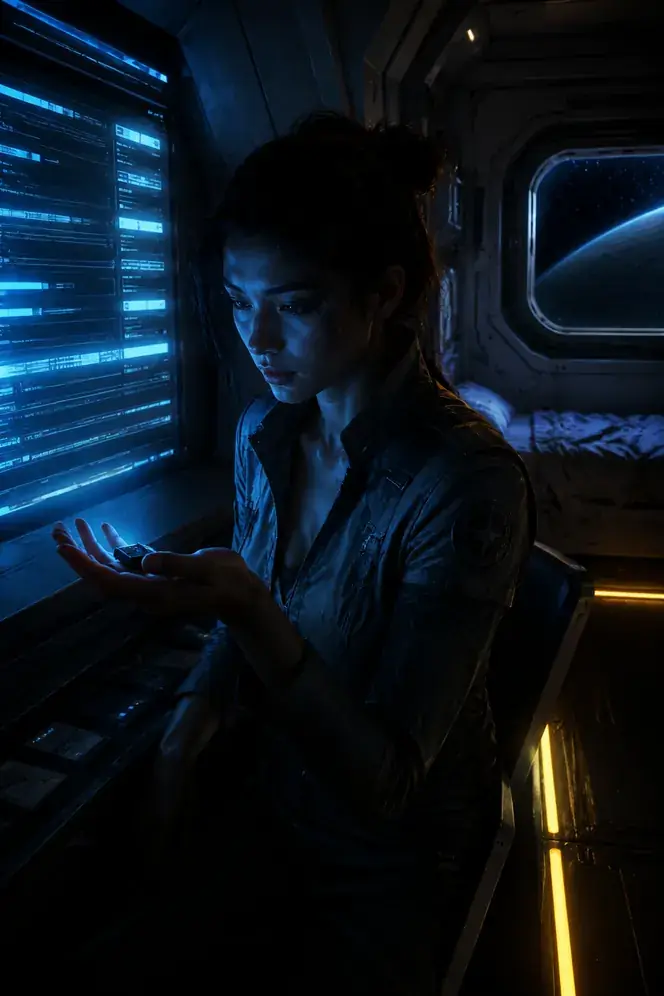
I sat at the terminal in my assigned quarters aboard the Tessera and turned it over in my palm twice before inserting it into the reader. The quarters were minimal—bunk, workstation, a shower stall that rattled when the ship's gravity adjusters cycled. A Level 4 Treaty Negotiator's accommodations. Functional. Everything in the Terran Authority military was functional.
The timestamp on my wrist unit read 23:47.
The chip's directory appeared on the screen. A single file, no title. Compressed and nested. I opened it.
Coordinates. Forty-three sets of coordinates, laid out in three columns: spatial reference, sector designation, and a code string I recognized immediately. Level 5 classification indicator. Narai Passage cluster system reference.
I leaned back in the chair.
Zane Ren had been precise about this during the negotiation session—so precise it almost looked like an accident. He'd placed the chip on the table between us with the kind of deliberate care that suggested he'd done it a hundred times. "There are coordinates on that chip not included in your issued charts. You have access to the archive that will explain them."
Not included in the charts. Level 5 designation. The chips and tactical deployment plans the Authority had provided for these negotiations were deliberately incomplete.
I knew what that meant. Everyone at the negotiation table knew what that meant. But there was a difference between knowing and being certain. Certainty required verification.
I opened the Terran Strategic Archive terminal and entered my credentials. Level 4 clearance, negotiator tier, valid for another eighteen months. The archive's main directory expanded. Geographic site designations. Classification indices. Historical record correlations. All of it familiar territory—I'd pulled from this system since I started in the Diplomatic Corps at twenty-two.
I cross-referenced the first coordinate string against the geographic site designation database.
The result appeared in 2.3 seconds. Archive response time was usually slower. This one came fast, which meant the system had the query cached. That meant other people had been asking this same question.
The site came up with a Level 5 flag. I couldn't access the full operational designation, but I could see the classification index number. Six digits. Batch-filed. I made a note.
The next coordinate took 3.1 seconds. Another Level 5. Different batch file.
By the eighth coordinate, I recognized a pattern. They weren't random. The batch reference numbers were sequential, or near-sequential, spanning a time range of approximately eighteen months. All filed within the same archive cycle.
I switched to the classification processing records and pulled the batch index.
The archive took longer this time. The processing records were secondary storage, older protocols. But my clearance was current, and the query was legitimate. I watched the cursor blink while the system retrieved data that seven years ago I'd helped to file.
The batch references started appearing. PR-2018-07-447 through PR-2018-08-623. Diplomatic Corps Strategic Documentation division. Filed July through August, 2018. Seven years ago. I would have been twenty-four.
I was twenty-four in July 2018. That detail was correct.
The classification index opened. A cover summary field appeared at the top:
Operation Quiet. Terran Authority Joint Command Initiative. Level 5. Restricted Distribution.
I didn't reach for the water bottle on my desk or push the chair back or make any of the small physical gestures people make when they're absorbing impact. I sat still and read what was on the screen.
Operation Quiet. Yes. I'd seen that name. Seven years ago, in batches of cover summaries that arrived in my inbox from the Joint Command Strategic Division. My job at the time had been straightforward: receive the batch, verify the classification level, confirm that the markings were correct, that there were no transcription errors, that the seal was appropriate to the security level. If everything checked, stamp it. Move to the next batch.
I remembered very little about those batches. The summaries were intentionally generic. Operational objective: Theater Security Enhancement. Theater: Outer Rim Colonial Interface. Classification rationale: Strategic methodologies and force deployment assets. Standard boilerplate. I'd processed hundreds of similar summaries that summer.
The processing records came up clean. No flags. No queries. No exceptions noted.
I pulled the list of sites associated with Operation Quiet.
The archive expanded the data. Forty-three designated locations. Seventeen in the Narai Passage sector. Twelve in the Rim Colonial space. Eight scattered across mining and agricultural territories that had been disputed at various points in the last decade. Six in territories that were currently under Terran Authority administrative control.
I could see the site designations. Coordinates. Sector classifications. Installation type codes. Infrastructure ratings.
What I could not see was anything in the operational records. That was Level 6 clearance minimum. I was Level 4. I could see the shape of the thing—the scope, the distribution, the timeline. I could see that it was massive. What I could not see was what had happened at those sites, or what the coordinates were meant to explain, or why the Terran Authority had been running a Level 5 classified program across the disputed territories for eighteen months without disclosing it to their negotiating partner.
I could see my name on the processing stamp for batch PR-2018-07-614. Saya Cortez, Diplomatic Corps Strategic Documentation Division, 2018-07-23, 09:14 AM.
Tuesday morning. Standard processing time.
I stared at the timestamp until the screen timeout warning appeared at the bottom of the display. I dismissed it without scrolling back. The archive remained open, neutral and patient. The data remained visible. Forty-three locations. Level 5 classification. My handprint on the original batch filing, seven years old, made when I was someone who read cover summaries and stamped them and didn't ask questions because that wasn't my job.
That wasn't my job—but I was twenty-four in July 2018, and on that particular Tuesday morning at 09:14 AM, I'd been sitting at a terminal like this one—smaller, older, installed in the Diplomatic Corps secure documentation wing in São Paulo—and I'd been verifying batch classifications. That was my job. That had been entirely my job. I received the summaries. I checked them. I stamped them if they met protocol.
The cover summary I'd stamped must have said something. Even generic markings contained information if you knew how to read them. Theater: Outer Rim Colonial Interface. Seventeen sites in Narai Passage. Twelve in Rim Colonial space. That alone was specific. That alone was actionable intelligence if you were an experienced reader, which I wasn't, not at twenty-four, not on my second year in the Diplomatic Corps when I'd still believed that the work I did was precisely what it appeared to be.
I closed the archive query and sat in the silence of my quarters.
The Tessera had particular sounds in the late hours. The gravity adjusters cycled at forty-minute intervals. The ventilation system dropped from optimal throughput to maintenance mode around midnight. Somewhere in the lower decks, someone was working through the night—equipment sounds, structured and purposeful. The lighting in my quarters defaulted to a low emergency spectrum after 22:00, the kind of dim blue-green that made it easier to sleep if sleep became possible.
I didn't close the terminal.
Instead, I opened a separate archive session and pulled historical communications records from July 2018. Standard protocol queries. Authorization requests filed by Joint Command Strategic Division during that time period. Clearance elevations. Data access requests from field personnel.
The data came back clinical and incomplete. I couldn't access the full routing or the stated purpose for the requests, but I could see the volume. During the summer of 2018, there had been forty-seven high-level data access requests originating from Joint Command. Forty-seven in two months. That was approximately three times the quarterly average.
Zane Ren had been in the fleet in July 2018. I could verify that much. Public records. Commissioned five years prior. Rising through the ranks. Narai Passage sector command, promoted to fleet operations in 2019.
He would have been twenty-nine years old in July 2018. He would have had access to classified operational records. He would have known exactly what Operation Quiet was.
I logged out of the archive and closed the terminal.
The clock on my wrist unit read 04:23.
I hadn't slept. That fact registered as distant and separate, a thing that had occurred but didn't require immediate response. In approximately three hours, the ship's day cycle would begin. In approximately five hours, I'd be in the second formal negotiation session with Zane Ren and his military strategists, discussing territorial boundaries and shipping corridor rights and the formal terms of a ceasefire that was already seven years old, written on July 23rd, 2018, in fifty-four classified batches that I'd processed on a Tuesday morning while the Tessera's fleet was conducting operations that I'd been cleared to know nothing about.
I stood and moved to the small window that looked out onto the docking sector. Stars, at this distance, looked like static. The Tessera was anchored at Station Seven, in neutral space, specifically chosen for these negotiations because neither the Terran Authority nor the Rim Coalition had any territorial claims on it.
Specifically chosen. Neutral. The word seemed thin now, and false.
I pressed my forehead against the cold metal frame of the window and thought about Tuesday mornings. I thought about the person I'd been seven years ago, sitting in a secure documentation wing, reading cover summaries and stamping batches. I thought about what I'd known and what I'd chosen not to ask. I thought about the difference between those two things, if there was a difference.
The data chip sat on the workstation behind me, inert and grey and perfectly functional.
In the morning, I would sit across from Zane Ren and negotiate. We would discuss terms. We would pretend that the charts were complete, that our information was symmetrical, that we were both working from the same understanding of what had happened in the disputed territories during the summer of 2018.
For now, I watched the docking lights turn through their cycles and didn't move.
You might also like