
Chapter 11
Chapter 11: Proximity
Chapter 11: Proximity
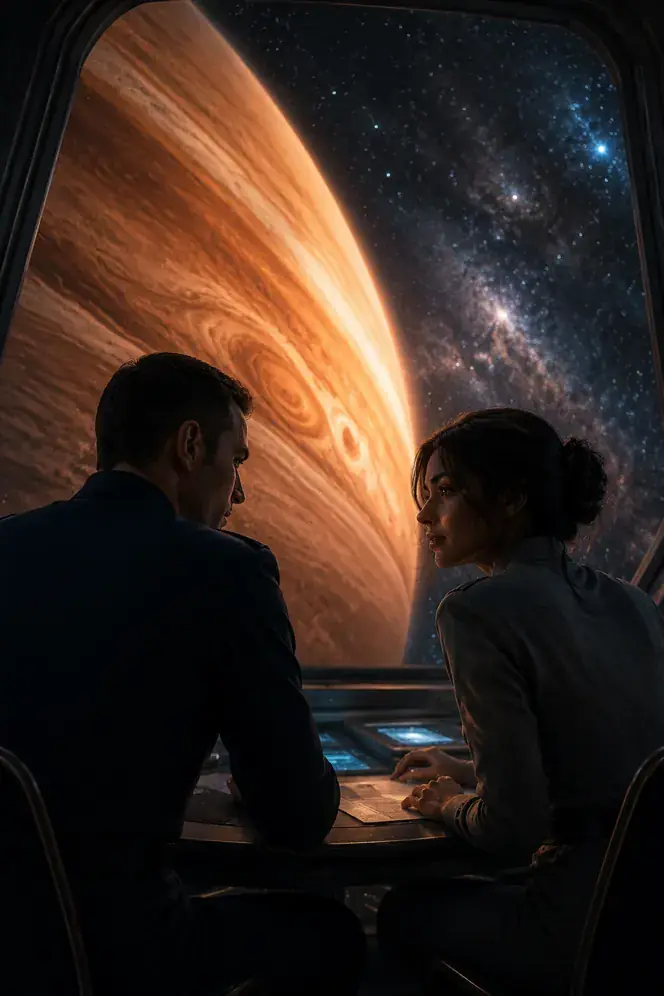
The observation lounge was darker in the late cycle. The gas giant filled half the viewport in shades of rust and amber, its cloud bands catching whatever starlight reached this deep into the system. I'd always liked it at this hour—the Tessera quieted, the formal traffic through the main corridors thinned down to the essential rotations, and the work could happen without the ambient pressure of a ship at full operational tempo.
Zane was already at the small table when I arrived, his uniform jacket unbuttoned at the collar, a clear indicator he'd been here long enough to stop performing for the protocol cameras. He had three data cards laid out in a careful sequence, and he looked up from his wrist terminal as I approached.
"The coordinate archive from the third extraction site," he said, sliding the first card toward the empty chair across from him. "Cross-reference against your Level 4 access to the colonial logistics routing. If we can prove the same supply manifests moved through both channels—civilian commerce logs and classified fleet operations—that's part of the authentication chain."
I sat. This was the third time we'd met like this, in this specific way: nominally reviewing something operational, actually building something else. I'd decided three days ago that I was going to help him make the archive public. I hadn't told him that. But we both understood what the work meant.
"The logistics routing is compartmentalized," I said, opening the data card on my tablet. "But I can access the civilian commerce layer without triggering any flags. That's legitimate trade oversight. If the supply movement matches—"
"Then the classified route isn't actually classified. It's just using administrative obscurity as cover." He leaned forward slightly, his attention fully on the screen as I pulled up the manifest data. "Which means any of this could theoretically be part of the public record. It just requires proving the precedent."
The air between us shifted. It was always like this now—the work was real, but the work wasn't all of it. We moved through the documents like we were excavating something, and the excavation mattered, but what mattered more was the specific quality of his attention when I spoke, the way his hand moved to adjust the display angle so I could see it without leaning across the table, the precision with which we divided the labor.
"Here," I said, isolating a subset of the manifest data. "These coordinates match the procurement request from the ninth sector station. Date, time, volume—exact match."
He pulled up a corresponding entry from his archive. For a moment we both stared at the screen, at the proof that two supposedly separate records were actually the same thing, viewed through different administrative lenses.
"One correlation," he said quietly. "That's interesting. But isolated. We need at least five independent data points before the authentication chain becomes defensible."
"That's assuming the Federation review board actually cares about evidence." I moved the data card aside and pulled up another one. "They might just want the opportunity to claim the archive was improperly classified in the first place."
He was quiet for a moment. "Do you think they will? Actually care about evidence?"
The question was different from the work. It was asking me something beyond the documentation. I kept my attention on the tablet.
"I think that depends on whether anyone inside the Federation wants the archive to be public, and how much political capital they're willing to spend on it," I said. "The evidence doesn't matter if the decision's already made. The evidence matters if someone's undecided."
"And you think someone is?"
I looked up. He was watching me in that way he had—not casual. Not distracted. The full weight of his attention, directed at the specific question of what I believed.
"Yes," I said. "I think at least one person is."
He held my gaze for two more seconds than the work required. Then he set his wrist terminal aside and leaned back in his chair.
"I was eighteen when I left the colony," he said. "I had the option to stay, take a position in the administrative hierarchy. My family had the connections. But I wanted to understand the Fleet from the inside—what it actually was, not what the colony told us it was."
It wasn't part of the work. We weren't analyzing this. We weren't documenting it. He was simply telling me something that wasn't necessary to tell.
I waited. The ship hummed around us, the familiar vibration that meant nothing was actively breaking, that we were still stable in this orbit.
"When I applied for officer certification, they ran a security assessment. Deep file audit. They pulled reports from the colony archives going back to my grandfather's generation. All of it classified. All of it officially unnecessary for my clearance determination." He was quiet for a moment. "I never saw any of it. The assessment cleared me—obviously it did, I'm here—but the justification stayed sealed. I still don't know what they pulled or why they ran that deep."
I understood what he was doing. He was telling me that he already knew. That he'd already lived inside the gap between what the Federation classified and what the public had a right to know. That the anger he had about the archive wasn't abstract or theoretical. It was personal.
"That's not in the official record," I said.
"No. It's not." He picked up the coordinate data again. "But if this works—if we get five points and document the authentication chain and get it in front of someone in the Federation who's already thinking about these questions—then maybe someone else gets to know why their clearance took six months instead of two."
It was one sentence more than he needed to say. Everything before it was operational. That last sentence was why it mattered.
I set my stylus down. "The authentication chain isn't just documentation, is it? It's evidence that the classification system itself is compromised."
"Yes."
"Which means the review board can't just declassify it. They have to address the integrity of the classification protocols that allowed this in the first place."
"Yes."
I stood up and walked to the viewport. The gas giant turned slowly, its bands shifting in colors that probably had names somewhere in meteorological databases. Somewhere in a classified archive, probably. Someone, somewhere, had studied that rotation and documented it officially in a way the public would never know.
"We need documentation going back to the archive's original creation," I said, still looking at the planet. "Not just the coordinate data. The authorization request. The classification justification. The original mandate that designated it sealed in the first place. If we can show that the original classification was issued under false pretenses, or without proper authorization, or based on threat assessments that are now demonstrably outdated—"
"Can you get that?" His voice was closer now. He'd stood too, and the distance between us had compressed.
I turned. "Some of it. Not all. My Level 4 access is military administrative. There are technical archive files I can't touch."
"But you know which archives hold them."
"Yes."
"And if I had to retrieve them through other channels—"
"Then I'd need plausible deniability," I said. "Which means I stop being involved the moment the retrieval starts. Which means I can file a complete and honest report right up to that threshold, and after that point, I have no knowledge of what happened."
He was quiet for a moment. We were standing maybe a meter apart, with the gas giant behind me and all the empty space of the observation lounge around us. The Tessera's outer hull thrummed with the rhythm of distant systems. Somewhere on this ship, Petra was sleeping. Somewhere in the Fleet, analysts were working standard-day hours, none of them aware that we were already three data points toward something that couldn't be unlearned.
"Thank you," he said. "For deciding to do this."
It wasn't flirtation. It wasn't even affection, though it contained something that resembled it. It was recognition. He knew that I'd made a choice—not with him, but parallel to him—to move the archive from theory into action. He was acknowledging that I'd done the work to understand what that choice actually cost, and I'd chosen to do it anyway.
"I haven't done it yet," I said.
"You've done more than half of it. The part that required deciding." He picked up his jacket from the back of his chair. "The rest is just execution."
We worked through two more coordinate sets before the cycle got late enough that staying any longer would start triggering scan patterns. The ship's AI didn't categorize private meetings in the observation lounge as suspicious by default, but the longer the meeting ran, the higher the probability that some junior analyst would glance at the logs and wonder why a Fleet Commander and a Federation negotiator were spending three hours in an empty room.
I packed the data cards back into their secure container. He sealed the authorization logs on his terminal. The work was real, and it was progress, but it was also incomplete and would remain so for another few days until we met like this again.
"You should go," he said. "You're running closer to detection threshold than I am."
I nodded and stood, gathering my tablet and the sealed container. I was halfway to the door when he spoke again.
"Do you think this is going to work?" he asked. "Not the authentication chain. The larger thing. Making the archive actually public."
I turned back. He was standing by the viewport now, looking at the gas giant, his posture suggesting someone who was asking the question he'd actually meant to ask four statements ago.
"I think," I said carefully, "that the difference between what's classified and what's true is finally narrow enough that someone might notice the gap. Whether they do anything about it—that's not up to us."
"But you're doing it anyway."
"Yes."
He turned to face me, and the distance between the viewport and the doorway felt suddenly significant—not as space to cross, but as the precise measure of how far apart we actually were in every way that mattered.
"That's more than I expected," he said.
It wasn't a question. It wasn't even pointed at the work anymore. It was pointed at me. At the decision I'd made. At the specific kind of person who would take a risk like this for something as abstract as the integrity of public record.
"I'm not sure what you expected," I said.
"Neither am I, anymore."
I left before the quiet could become something I'd have to acknowledge in the open. The corridor was empty as I stepped into it, and I stood there for a moment with my tablet and the data container, feeling the specific pressure of understanding that the distance between where we were and where we might be had narrowed to a choice. Neither of us had made it tonight. But I understood that he was aware of it, and his awareness wasn't incidental or accidental. It was deliberate. He'd chosen to speak one sentence more than the work required. He'd chosen to ask me the question that wasn't about the archive. And I'd answered, which meant I'd made my own choice about what that moment was.
I started walking. The Tessera hummed around me, full of people who didn't know what the two of us knew, who would never know unless this worked, unless we managed to build the authentication chain and get it in front of someone who cared about the gap between classification and truth. We were the only two people in any room who knew what we knew. Not about the technical architecture of the archive—others knew that. But about this specific working closeness, about the particular texture of building something together while understanding exactly what it cost.
I had shared this kind of collaboration with colleagues before. But never with anyone who understood what I was working toward and why. Never with anyone who would have asked the question he'd asked. Never with anyone who would have answered, if I'd asked it back.
I passed the medical section, turned toward the delegation quarters, and kept walking. Tomorrow the treaty sessions would resume. We would sit across the table from each other in the formal meeting room with Petra and the colony representatives, and we would negotiate language about supply routes and administrative procedures and resource provisioning, and none of it would mention the three hours in the observation lounge or the authentication chain we were building or the distance that had narrowed to something that both of us understood.
That was the work. Everything else was what happened in the margins—in late-cycle observation lounges and in the specific way he looked at me when I answered a question honestly, in the detail of standing three meters apart with a gas giant between us and the rest of the Tessera.
I opened the door to my quarters and didn't turn on the lights right away. In the darkness, I could still see the viewport, the planet's rust and amber, the slow rotation of something that had been spinning since long before I was born and would keep spinning long after this was finished.
The archive would get public, or it wouldn't. Someone would care about the gap, or they wouldn't. But I would know, from this point forward, that there was one person in any room who understood why I was willing to take the risk. One person who had asked, not with flirtation or seduction, but with genuine precision: Why? And I had answered. Which meant everything that happened next was happening with full knowledge of what I was choosing, and what the choice could cost.
I turned on the lights and set the tablet and container aside. Outside, the Tessera continued its orbit, and somewhere in the Fleet sector, Zane was probably sitting in his quarters doing what I was doing—thinking about the words we'd almost said, the distance we'd almost closed, the work that was both urgent and infinite.
Tomorrow, we would be professional. We would negotiate. We would sit across from each other in the formal architecture of the treaty process and pretend that nothing had changed. But the change had already happened. And it had happened with intention, with full awareness, with the specific recognition that comes when two people understand they are the only ones who know what they know.
He'd asked me one question more than the work required. I'd answered one truth more than I needed to. And now we both understood that the distance between proximity and action was narrower than it had been yesterday.
But there was still work to do. And neither of us would stop doing it. Not tonight.
You might also like