

Chapter 4
Chapter 4: The Dead Channel
At hour six, with the sensor array running its passive sweep cycle and the Corridor still empty in all four quadrants, the comms system made a sound Kashar had not heard in three years.
Not an alert tone. The system did not recognize the signal as requiring an alert — it had come in on Channel 7, and Channel 7 had been flagged dead since the decommission notice forty-one months ago, and the software's default behavior for dead channels was to log without notify. The sound Kashar heard was the logging click. A small thing. He noticed it the way he noticed everything on a quiet watch: automatically, without meaning to.
He looked at the comms panel.
Channel 7. Signal received. Duration: 0:04. Origin: logged.
He pulled the log entry open.
The transmission format resolved immediately as Keth EM-modulated — the interference signature was unmistakable, the spectral banding that human receivers had learned to parse through a translation layer developed over seven years of contact and two years of actual diplomatic exchange. Lossy translation, the engineers always said. Functional, but lossy. What arrived in human-readable text was a compression of what the Keth had transmitted, and everyone who worked with the layer understood that something was always left out.
What had not been left out was the format. Whoever had sent this had structured it to look like Fleet traffic — header fields, block justification, the standard transmission wrapper that any Fleet ship's comms system would flag as familiar. The Keth EM modulation underneath made the origin unambiguous. It was not a human transmission dressed as Keth. It was a Keth transmission dressed as Fleet.
Kashar read it once.
CHANNEL: 7 | PRIORITY: STANDARD | CLASSIFICATION: NONE
The Verath assignment is a hold operation. The Keth insertion team is already inside Earth orbital defense network. Diplomatic status of team: contested. If the ICV Ardent leaves the Corridor, the hold operation has no military cover. If it does not, Earth loses three defense nodes in the next forty-four hours. This message is authorized.
He read it a second time.
The authentication chain was absent. No sender identification, no verification hash, no command signature — nothing that Fleet protocol required for a priority-standard transmission, nothing that any legitimate communication from any party with actual authority would omit. The message had been formatted to invoke the trappings of official traffic without providing any of the mechanisms that made official traffic verifiable. That was either incompetence or design.
He considered incompetence for approximately two seconds and set it aside.
The specific verb choices stayed with him. Hold operation. Not a defensive position, not a patrol, not a presence mission — hold. The word carried a precise military meaning: you hold ground when something else needs time to move. The Corridor had no ground to hold. There was nothing here but sensor range and empty space and the Ardent itself. Which meant, if the message was genuine, the Ardent was not holding the Corridor. It was holding something invisible. Something the Corridor's position made possible for someone else to do.
Diplomatic status of team: contested.
That phrase had been chosen with precision. Not unauthorized. Not rogue. Contested — a word that implied competing legitimate claims. It implied the Keth knew their insertion team's presence was in dispute and had decided to describe that dispute as a condition of fact rather than a problem requiring resolution.
He did not move for a full thirty seconds.
The sensors showed the Corridor as they had shown it since the Ardent took position: empty. Passive sweep running, the far boundary at maximum range, nothing registering on any frequency. Whatever was or was not happening inside Earth's orbital defense network was sixty-two light-seconds away. The silence here was absolute. The message had arrived out of that silence, four seconds of Keth EM modulated through a channel that had not transmitted anything in three years and forty-one months, logged without alerting because the software did not know the channel could still receive.
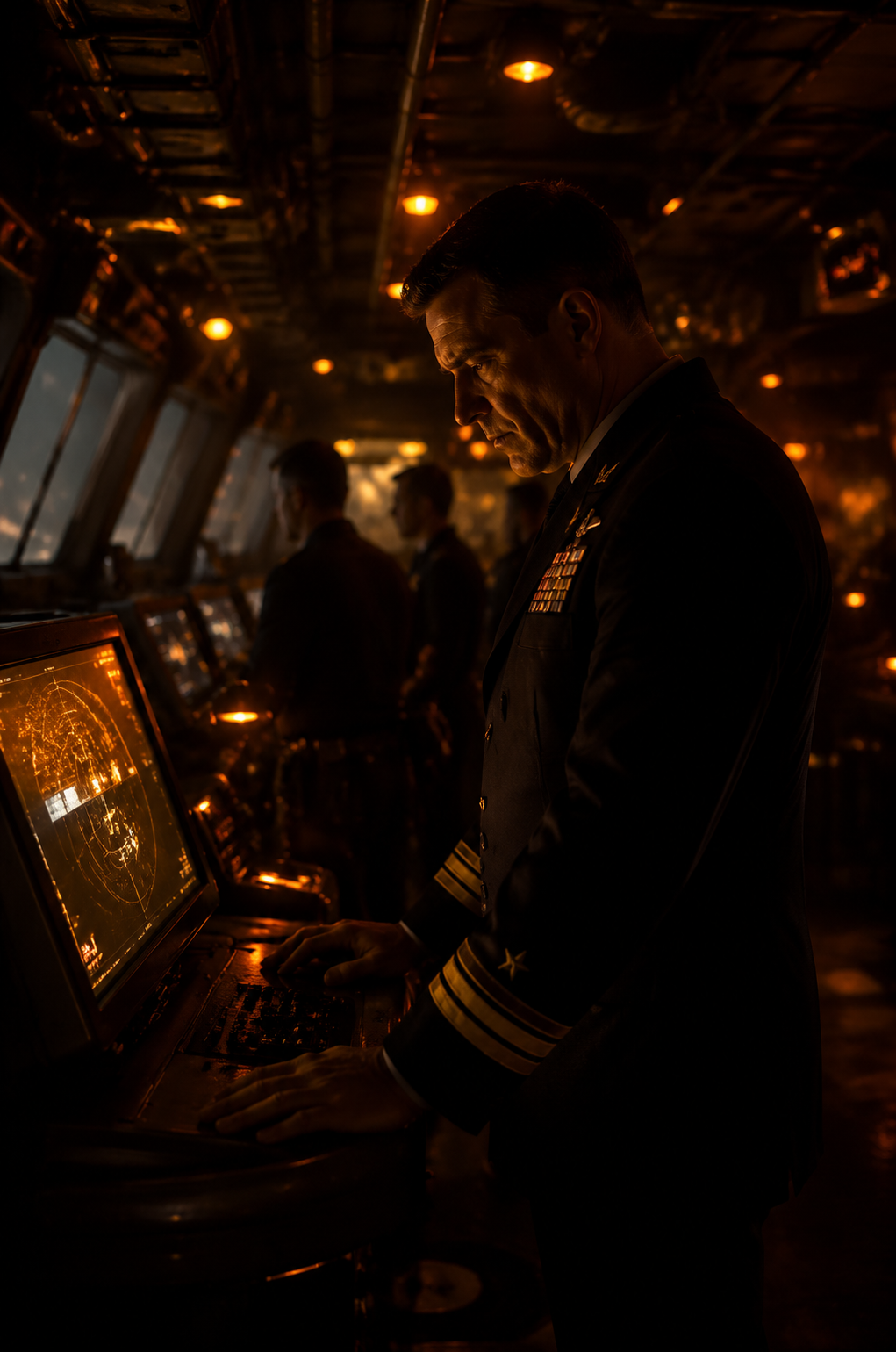
The last logged use of Channel 7 was timestamped eighteen months before the decommission notice. He looked at the timestamp. He looked at it for a moment longer than was necessary and then moved his attention to the next variable.
Forty-four hours.
The mission window was sixty hours from departure. They had been on station six hours. Forty-four hours from now was hour fifty — ten hours before the window closed, assuming the window meant what it was supposed to mean, assuming Okafor's orders reflected an actual timeline and not an administrative artifact. The specificity of forty-four hours was either coincidental or it was not. He had not told anyone the mission window. There was no public record of it. The number could be a generic threat frame — lose these nodes before we finish — or it could be drawn from information the Keth had obtained through the same penetration they were describing.
He did not know which. He noted that he did not know.
The authentication failure remained the most significant problem with treating the message as legitimate. A genuine warning from a Keth diplomatic source with actual knowledge of an insertion team's timeline and objective would not arrive unsigned. The Keth had authenticated communications before — the translation layer had protocols for it, used them regularly in the formal exchange channels. Whatever had sent this had known enough to use Fleet formatting and had declined to use authentication. That could mean the sender was not authorized to authenticate. It could mean authentication would have revealed a source that could not be revealed. It could mean the message was constructed to be plausible rather than verifiable, which was the architecture of disinformation.
He could not rule out disinformation. He could not rule out anything.
He did not reach for the comms.
Vol was aft, running her materials check. Okafor was in his bunk, taking his scheduled rest cycle. The Ardent was operating normally, in a Corridor that showed no threat and no activity. There was nothing Kashar could tell either of them that would add information rather than noise. He had an unsigned message from an impossible channel with a four-second transmission window and no authentication. He had a sensor array showing nothing. He had a mission order that now sat differently in his mind than it had six hours ago, and he had no way to confirm or deny any part of the message's claims from where he was sitting.
He set the comms system to full log on Channel 7 and returned to the sensor feeds.
The Corridor was empty. It was going to stay empty, or it was not. There were missions that arrived with clear purpose, orders that made tactical sense in the context of the information you had been given, assignments where the logic ran from command to field without visible gaps. He had run those missions. He had found them comprehensible and had not trusted them especially more than any others.
The missions that made no sense were the ones that turned out to matter.
He held that thought where it was, examined it, did not let it do more work than it could support. It was a pattern observed across a career that was long enough to have patterns and not long enough to prove them. The message could be disinformation. The Corridor hold could be exactly what it appeared to be — a presence operation with administrative value and no tactical substance. Both things were possible.
What he was uncertain about now was which direction matters pointed.
He read the message a third time.
If it does not, Earth loses three defense nodes in the next forty-four hours.
The sensor array swept through its cycle. The Corridor stayed empty. The log on Channel 7 registered no further activity. Kashar adjusted the passive sweep range by four percent at the far boundary and settled back into his watch.
He did not call Vol. He did not call Okafor.
He watched the feeds and waited for the next forty-four hours to begin proving or disproving something.
You might also like