

Chapter 21
Chapter 21: The Cost
Hour fifty-four. Tav flew the scout drone into the L4 maintenance sector and every sensor on the insertion team's grid lit up at once.
He had expected this. He narrated it anyway.
"Contact on passive at sixty-two hundred meters. They're reading me — active sensor sweep, broad-spectrum, looks like they're using secondary array hardware. Military-grade, not commercial." His voice was level in the way that meant he was tracking twelve things and could not afford to weight any of them. "Sixty-one hundred. No fire control. They're looking, not targeting."
On the bridge of the Ardent, no one spoke.
"Fifty-eight hundred. I'm picking up seven operator signatures — body heat, suit emissions. Positioned in a loose semicircle around the maintenance grid access points." A pause, two seconds. "They're not moving."
Kashar sat in the captain's chair. He did not move either.
"Four compact arrays, fifty-five hundred meters. Bearing — logging now. Oriented at precisely seventeen, forty-three, sixty-one, and eighty-nine degrees relative to grid north. Those are the angles." Another pause, longer. "Sir, those angles map to the four primary monitoring nodes. They'd hit all of them simultaneously. That's not incidental positioning. That's designed."
The Ardent received the drone's data feed in real-time. The transmission was clean — Tav had set the relay parameters himself before launch, back when the plan was still a plan and not a thing already happening.
"Fifty-two hundred. The arrays are Expansionist-signature equipment. I can see the manufacturer coding in the emission profile." His breathing was audible for exactly one second. "Logging all of it. You're getting everything I'm getting."
"Confirmed," Kashar said.
"Pulling the sensor package now. Full capture. Confirmed transmission to Ardent." A longer pause, during which the data transfer completed. "Beginning return approach. Fifty-four hundred meters."
He made it back.
Kashar transmitted the sensor package to Cross and Senn simultaneously, at hour fifty-four minutes thirty-one. Then he sat in the captain's chair and the crew of the Ardent did their work around him.
The mission clock read fifty-four hours, forty minutes.
Okafor ran diagnostics on the communications relay. Vol updated the fuel expenditure log. Tav secured the drone in its bay and filed the approach record without being asked. The ship hummed. The corridor outside the bridge was quiet. Through the forward viewport, the sector's maintenance grid was a faint geometric suggestion against the dark — visible only because the Ardent's sensors made it visible, not because it deserved to be seen.
Four minutes. Twenty seconds.
Kashar wrote the mission log entry during the silence. He wrote it in the captain's log format, which had specific fields and specific expectations, and he filled them accurately.
Hour 54. Mission status: data acquisition complete. Sensor package documenting seven-operator Keth insertion team with Expansionist-signature equipment has been transmitted to Fleet command and Keth anti-Expansionist liaison simultaneously, per the arrangement I negotiated at hour forty-one.
I disobeyed a direct order. I negotiated with a Keth commander through an unauthorized channel. A crew member entered a hostile perimeter at my order, protected only by an enemy officer's assurance. The result is consistent with the mission objective as I understood it.
I am not certain I had the authority to determine what the mission objective was. I am certain that I did determine it, and that the sensor data now in Fleet command's possession is what Cross's back-channel negotiation required to proceed.
The crew performed without qualification. The mission outcome, if it holds, is theirs.
He signed it. He sent it to Fleet command.
He was still looking at the sent confirmation when Senn's message arrived.
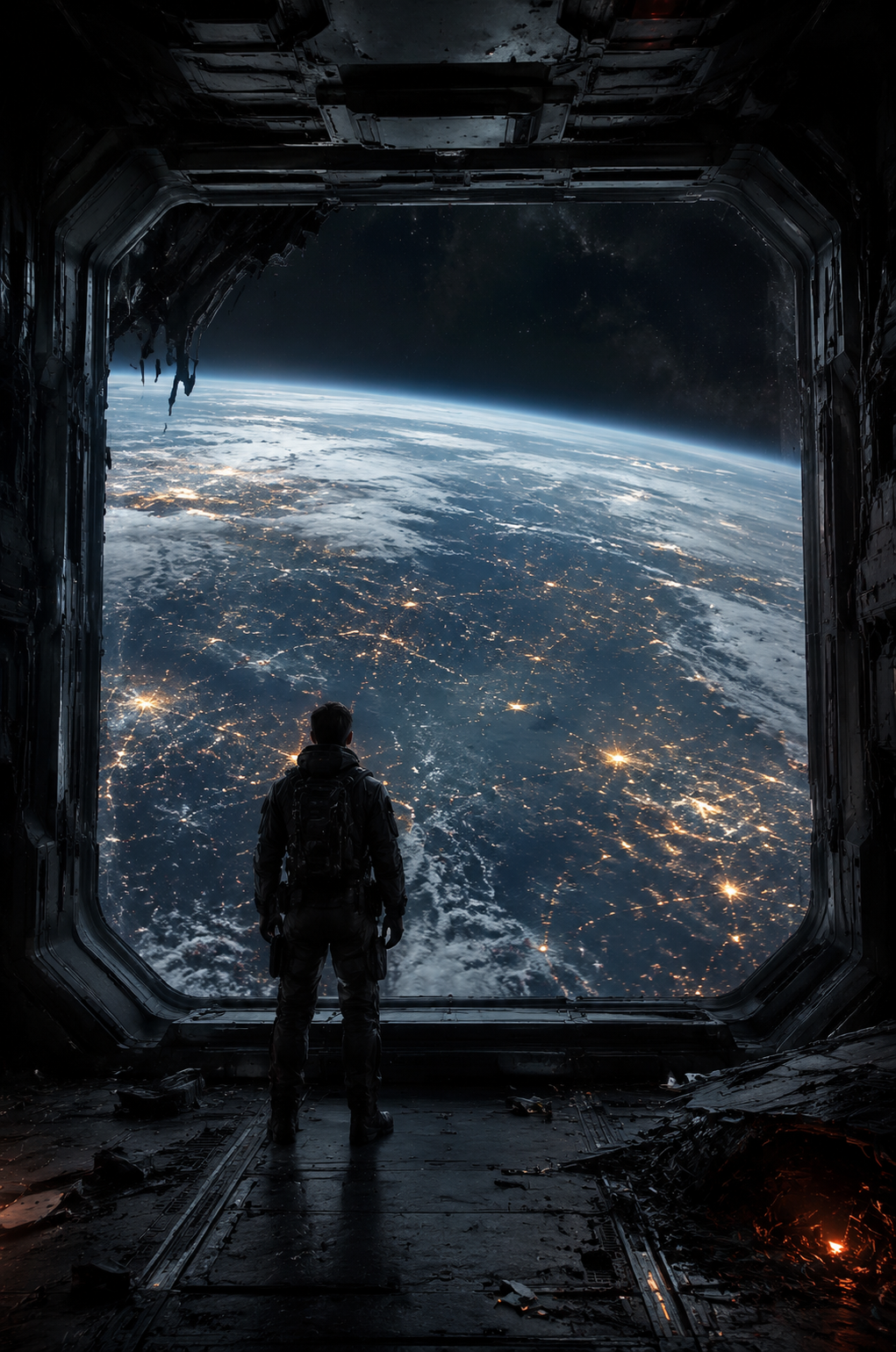
It came through the translation layer, brief and without preamble: The team is standing down. The arrangement is complete.
That was all.
Cross's confirmation came eleven minutes later — the delay was real, the time required for grid monitoring to register the change in the insertion team's operational status and route confirmation back through the relay chain. When it arrived it was three sentences. The active operations of the insertion team had ceased. The sensor package had been received. Further instructions would follow through the standard command channel.
The mission clock read fifty-eight hours, zero minutes.
The Corridor window closed in two hours.
The cost was not a death.
Tav was alive. Okafor had not been asked to do the thing she had prepared herself to do. Vol had not needed to choose. The Ardent was damaged in two systems and functional in all the rest. The crew was intact.
The cost was what Kashar had written in the mission log and sent without revision. The cost was what Cross would read before she forwarded it — and she would forward it, because that was what the chain of command required and Cross had not survived fourteen months of back-channel diplomacy by failing to manage her documentation. He knew what the next command review would look like, and what he would say in it, and that he would say it accurately and without apology because that was the only version he knew how to give.
The cost was that the arrangement had worked and that it had not been sanctioned by either command structure. Earth was safer by a margin that would be quantified in intelligence assessments he would never read. The monitoring grid remained intact. The back-channel talks would proceed. The thing that had needed to happen had happened, and Kashar had made it happen through a chain of decisions that had begun with a dead-channel message and ended with a cup of terrible coffee.
Vol set the coffee on the console without comment.
It was not a gesture that required explanation. The ship's coffee was bad — had been bad since the second day out, when the primary heating element in the galley had degraded and no one had had time to replace it. Vol knew this. Kashar knew this. Vol had brought it anyway.
Kashar looked at the cup. He looked at Vol.
Vol said: "For what it's worth, sir. I think you were right."
Kashar picked up the coffee. It was terrible — thin and over-processed and slightly wrong in temperature. He drank it.
"For what it's worth," he said, "I know."
Vol nodded once, and returned to his station.
The Ardent turned for home.
You've finished The Void Pact.