

Chapter 11
Chapter 11: The Crew
He called the crew to the main corridor at hour twenty-two.
Not the ready room — the ready room held fourteen standing and was positioned aft of the engineering section, and the Ardent carried thirty-one people. The main corridor ran the length of the ship, a hundred and eighty meters from the bow junction to the drive housing bulkhead, and it was the only space where thirty-one people could exist in the same place without requiring someone to stand in a doorway listening to something they could not fully hear.
Twenty-nine of them fit with room to turn. Petty Officers Maret and Tav had to stand with their backs to the secondary comms junction, and Petty Officer Senn — security, a broad-framed woman who had been on the Ardent since its last refit and who moved through the ship's corridors the way experienced crew moved, as though she had memorized the floor plan in three dimensions and no longer needed to look — stood at the far end with a half-sealed suit, helmet mag-clipped to her left shoulder, because she had been on EVA prep rotation when the call went out and had not had time to fully strip down. Three others were in the same configuration. The helmet catches made small sounds when the Ardent adjusted its attitude: a periodic tick against the suit fabric, regular as a clock.
Kashar stood at the corridor's midpoint, where the primary lighting junction ran, and waited until the movement settled.
He said: "I'm going to tell you what I know, what I don't know, and what I've decided. Then I'll take questions."
He told them about the message. Channel 7, hour six, four seconds of Keth EM-modulated traffic in Fleet format, no authentication. He told them what the message said: that the Verath assignment was a hold operation, that a Keth insertion team was inside Earth's orbital defense network, that three defense nodes would be lost if the Ardent held station. He told them he had attempted to reach Admiral Cross at hour fourteen and had not received a response, and that Cross had not re-established contact in the eight hours since.
He told them what he had decided.
He was not going to use words like considered or weighed. He said: "I've decided to move on the coordinates in the message. We depart in forty minutes."
He said: "If the message is disinformation, we are flying toward an enemy insertion position with a damaged ship and a court-martial waiting when we come back. If it is genuine, the alternative is watching Earth lose three defense nodes while we hold station in empty space following orders that may have been constructed to keep us here."
He said: "I don't know which it is. I've told you what I know."
The corridor was quiet. The helmet catches ticked. Someone near the engineering section adjusted their weight against the wall.
Then Petty Officer Chal — young, technical rating, who had been running the aft sensor array since Okafor's injury — raised a hand partway and said: "The court-martial. You're talking about facing that yourself, or is that for all of us?"
"Command decisions trace to the commanding officer," Kashar said. "The record will show I gave the order. That's what the record is for."
Chal nodded once, still working through it.
The second question came from the middle of the group, from a warrant officer named Deke who ran propulsion maintenance and whom Kashar had spoken to perhaps six times in eleven months of this posting — a quiet man, competent in the way people who spent their careers next to large machinery tended to be, careful and unhurried. "What happens if we get to those coordinates and there's nothing there? Or if it's a Keth position?"
"If there's nothing there, we were wrong and we turn around," Kashar said. "If it's a Keth position, we are a patrol vessel with a damaged secondary array and sixteen combat-rated crew against whatever is waiting. We don't engage. We collect what the sensors can collect and we withdraw." He paused. "I won't promise you that's clean. I'm telling you that's what the protocol is."
Deke looked at the floor for a moment and then back up. He did not look satisfied. He looked like a man who had received an honest answer to a question he had hoped might have a better one.
The third question was Senn's.
She was still at the far end, one hand resting on the mag-clipped helmet, and she said: "Have you tried Cross again? Since hour fourteen?"
"Three times," Kashar said. "Hour sixteen, hour nineteen, and hour twenty-one. No response."
Senn absorbed this. Her expression did not change in any way Kashar could read specifically, but she moved her hand off the helmet to her side.
Nobody else spoke. Kashar looked along the corridor — the length of it, the thirty-one people compressed into a space designed for transit rather than assembly, some of them leaning against the curved walls, some standing with their arms loose at their sides, all of them still. He waited the full count of ten seconds to be certain the silence was a conclusion and not a pause.
"Forty minutes," he said. "Return to stations."
They dispersed by section, the way crew dispersed when there was work to return to — not all at once, but in clusters, the groups that shared watch rotations drifting back together the way they always did. It took less than four minutes. The corridor emptied until it was just corridor again, the primary lighting junction humming at its normal frequency, the attitude adjustments sending their small sounds through the hull.
Tav caught him before he reached the bridge.
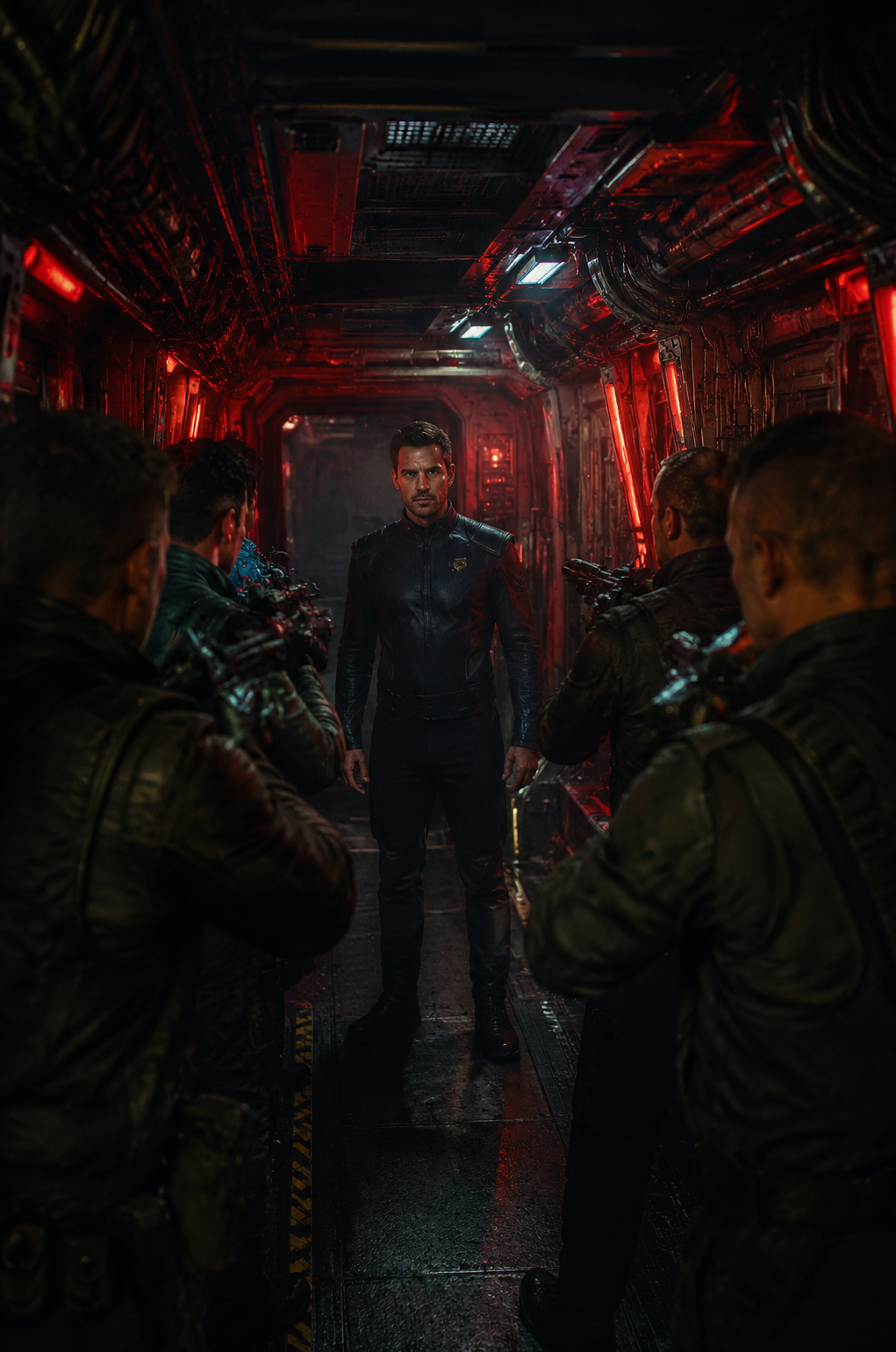
He came from the secondary comms junction where he'd been standing, and Kashar heard his footsteps and stopped and turned. Tav was twenty-three, possibly twenty-four — Kashar had not memorized his personnel record beyond what was relevant to his station assignment — and he had the slightly over-alert quality that good comms specialists developed early: a professional attentiveness, calibrated to catch the things that other people's hearing filed as background. He was carrying a handpad.
"Sir," he said. "I identified the dead channel's last logged use before decommission."
"You went into the archive."
"Yes, sir. It's buried in the engagement record — you have to pull the raw comms log, it doesn't surface in the standard summary." He looked at the handpad and then at Kashar. "The last logged transmission on Channel 7 before it was decommissioned was from the Ardent, sir. Eighteen months ago. During the Crossing Point engagement."
Kashar said: "I know."
Tav waited. The question was visible in the way he held himself — a stillness that wanted to move.
"How do you know?" Tav said.
"I sent the message."
The corridor held that for a moment. Tav's expression worked through something, not surprise exactly, but the recalibration that followed it — the sensation of a piece arriving in a frame you had not known was incomplete.
"Channel 7 was the only uncontested channel during the engagement," Kashar said. "Primary fleet channels were jammed. I sent the withdrawal coordinates to any ship that might still be alive in the zone." He paused. "Nobody who was at the Crossing Point and survived would have needed the archive to know the channel was used. They would have heard it."
Tav's eyes moved, reading the implication. He was quick. That was why he was on comms.
"So whoever sent this message," Tav said, "either had intelligence assets at the Crossing Point—"
"Or researched the Ardent's comms history specifically enough to find a transmission that is not in any standard summary document." Kashar looked at him. "That is not evidence the message is genuine. It is evidence the message is not random."
Tav was quiet for a moment. "Does that change what you decided?"
"No."
Tav nodded once. He looked at the handpad, then held it out. "I can file this in the mission record, sir. The archive pull. The log entry."
"File it."
"Yes, sir."
He left, footsteps moving back toward the comms section, and Kashar stood for a moment in the corridor with the hum of the primary lighting junction and the sounds the hull made when the ship moved. Someone aboard the Ardent had used the one channel that traced directly back to the worst day of his career. They had done it intentionally, or they had done it because they knew exactly what they were doing when they reached into a dead archive and chose a frequency.
Both possibilities required that someone had built a reason to find him in particular.
He did not know yet what the reason was.
Thirty-eight minutes to departure. He walked back toward the bridge.
You might also like


