

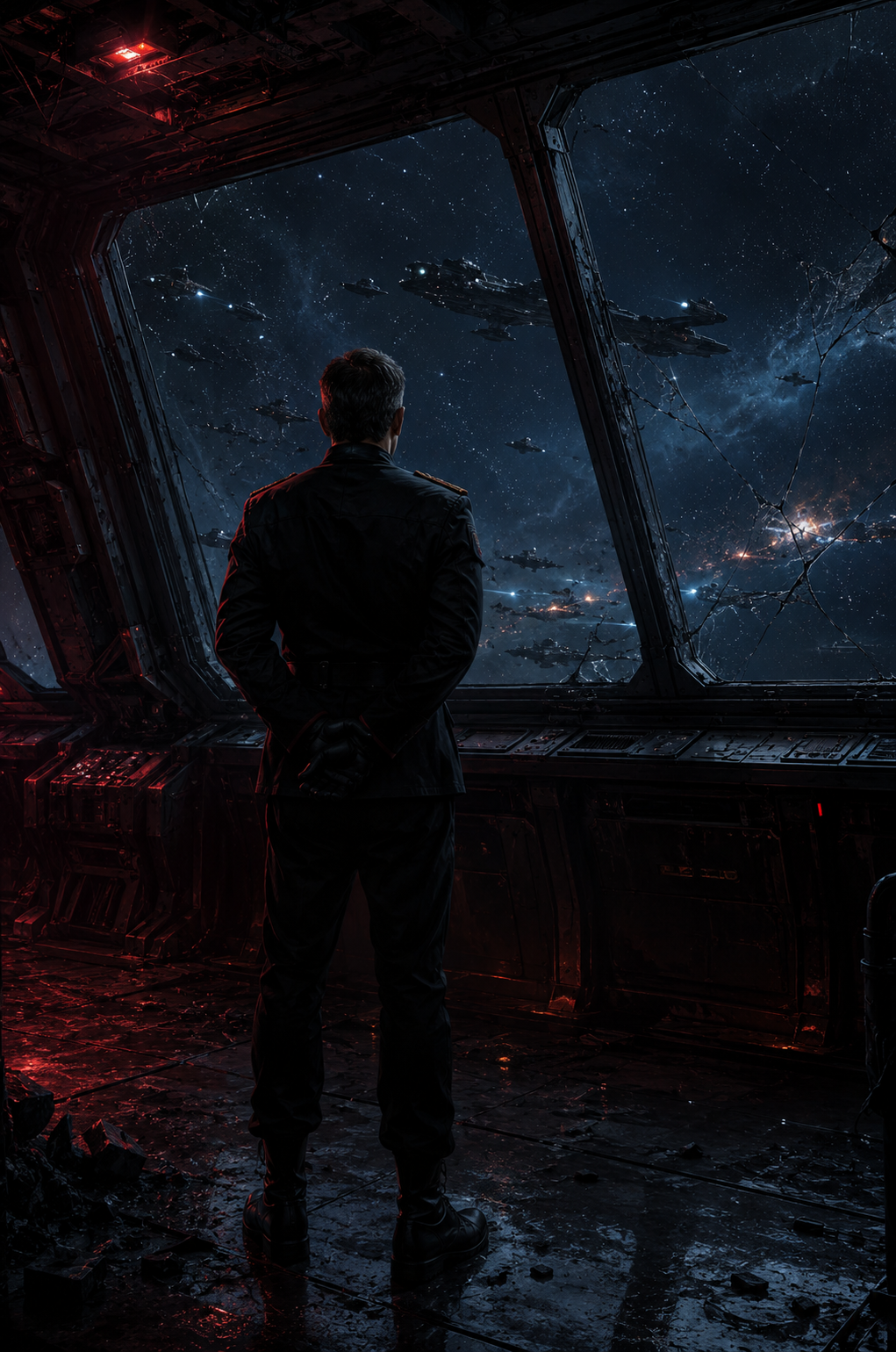
The Void Pact
Chapter 1
Chapter 1: The Corridor Assignment
The Ardent shed velocity at 0.4g — an eleven-minute retrograde burn that put weight on the wrong side of every corridor and made the junior ratings move in careful, flat-footed steps through sections they knew by feel. Commander Rael Kashar stood at the nav console in forward operations, one hand on the rail, and read the mission geometry for the third time.
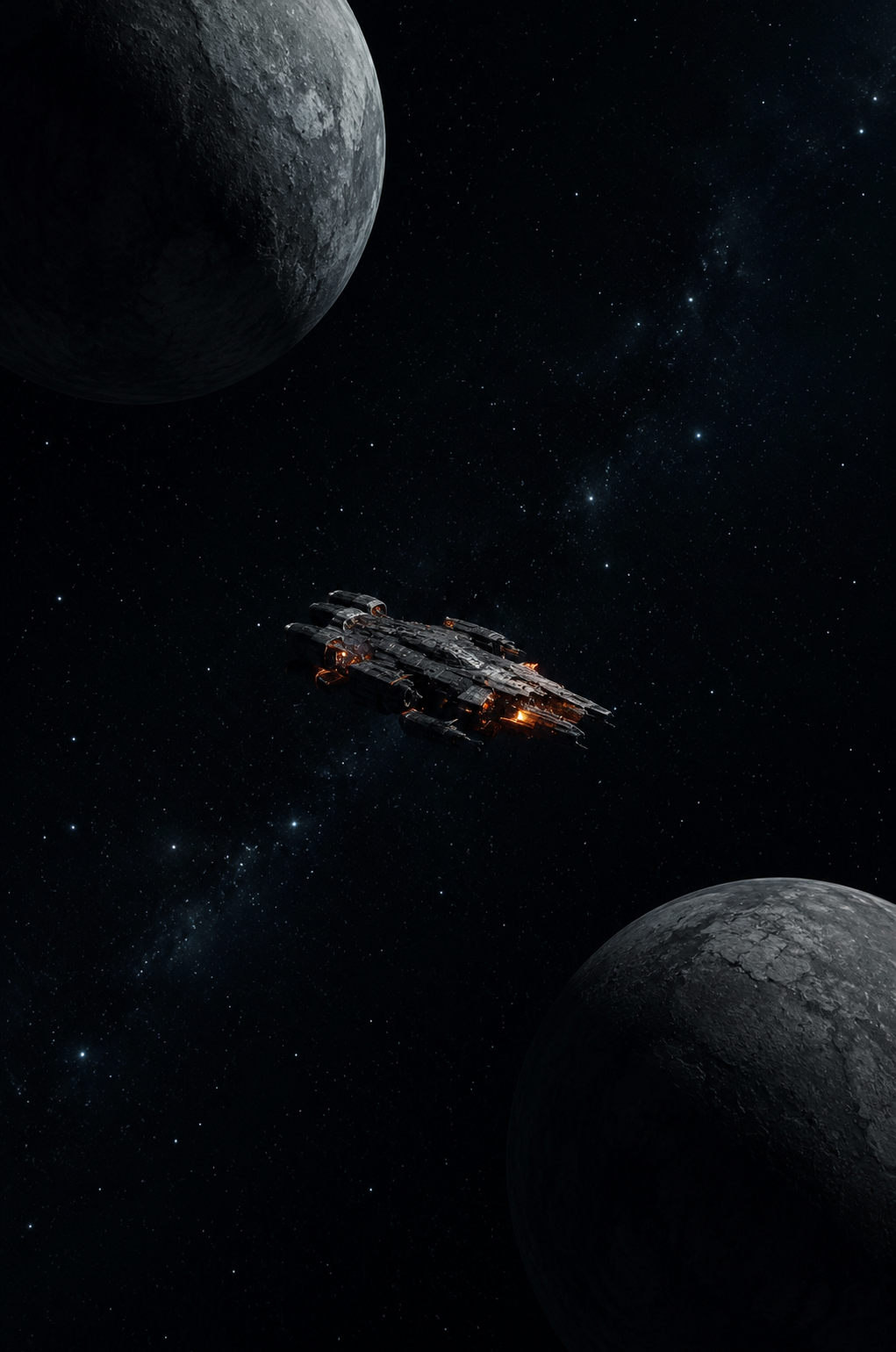
Verath Prime occupied the left margin of the tactical display: 2,100 kilometers of cratered basalt, no magnetosphere, no atmosphere, no tactical use. Verath Minor sat opposite at 800 kilometers distance, 400 kilometers smaller, equally dead. The gap between them at the narrowest point measured 12,000 kilometers, widening to 14,200 at the mouth. The Ardent would station-keep at the 11-hour mark inside the Corridor — centered, equidistant from both moons — at the point where sight lines opened in all cardinal directions and cover existed in none.
The mission order used the phrase defensive presence without defining what that meant.
He had read the full order during the four-day transit. He had read the tactical appendix. He had run the geometry twice on the third day and again now, and reached the same conclusion each time: there was nothing here worth holding. The Corridor offered no bottleneck, no choke point, no positional advantage for a single corvette. The dead moons blocked active radar in two directions and provided no protection in any. If the Keth came through the port mouth in force, the Ardent had 90 seconds of passive sensor contact before engagement range. If they came through the starboard mouth, slightly less.
The math was not complicated.
The burn ended. The ship settled — a long structural groan that moved through the hull from aft to forward, the particular sound of frame 47 cycling through the temperature differential as the thrusters cooled. The patch at frame 47 had held for eight months. Kashar had filed three requisitions on it. The third had been acknowledged and deferred with a notation: resource-constrained environment. He understood. The Fleet was running short of everything: ships, crew, parts, time. The Ardent existed at the end of that particular logistics chain, 4.2 AU from the nearest repair dock with a hull that had been described in the last external survey as structurally sound within accepted operational parameters.
He logged the position data — station-keeping established, Corridor entry confirmed at 1407 ship time — and went to find his officers.
The briefing room had been designed for twelve and now served six. The table had a crack down one side from a concussion wave at the Crossing Point, filled with epoxy by someone who hadn't filed a maintenance note. The chair at the head had a dent in the right armrest that Kashar had stopped noticing six months ago.
Lt. Commander Yusuf Vol stood at the display wall with his hands behind his back. He was three years older than Kashar, which put him at 41, and he carried that age in the way he stood rather than in his face: the particular stillness of a man who had spent eleven months in Keth custody and come back measured where he had once been quick. The prisoner exchange had not been publicly acknowledged by the Fleet. Vol had never mentioned it to Kashar. Kashar had never asked. What he knew was that Vol showed up on time, read every document before it was due, and had the specific patience of someone who had survived worse meetings than this one.
Chief Engineer Mirela Okafor sat at the table corner with her datapad flat in front of her. At 44 she was the oldest person aboard and had kept the Ardent functional through three commanders and one engagement that should have ended it. She delivered her opinions in the format of damage reports: accurate, complete, and free of anything resembling reassurance.
Nav Specialist Harric and Comms Officer Peña sat further down the table and did not speak. Harric was 26, the youngest officer on the ship. He had a habit of writing things down before he was told to write them down, which Kashar found useful.
Kashar pulled up the Corridor geometry on the wall display and left it there without annotating it.
"Sixty hours," he said. "We hold position at the 11-hour mark while a political treaty negotiation proceeds at an unspecified location. The order doesn't specify the parties, the stakes, or what the Corridor secures." He looked at Okafor. "Drive status."
"94% on the main. Portside RCS is running 84%, which is where it's been for six weeks — it'll hold station-keeping without complaint." She turned a page. "I moved C4 through C7 onto a secondary power loop this morning. If we need emergency rerouting, I can isolate the sealed sections without crew intervention. Torpedo bay two has the charge misalignment I flagged last month. I wouldn't trust it past 60%."
"Weapons?"
"Rail batteries charged. Bays one and three loaded and ready. Bay two is available at reduced reliability."
Kashar nodded once. "Vol. Sensor coverage."
"Full passive sweep is running on both approaches." Vol's voice was level, informational. "We're reading nothing in the Corridor and nothing at either mouth. Verath Prime is blocking approximately 40 degrees of our active radar arc on the port side. Anything coming through the port approach — we have 90 seconds of passive contact before they're at weapons range. Starboard is cleaner, maybe 110 seconds." He paused. "I set the active sweep interval at six minutes. The order language implied presence over patrol activity."
Kashar looked at the display. The geometry sat there: two dead moons, 12,000 kilometers of nothing, one ship with 31 crew and three sections sealed because 16 of the people who should have been in them were still at the Crossing Point.
He looked at the geometry again.
It was the same as the last three times. The sight lines remained identical. The tactical logic remained absent. He was looking for something that the numbers kept confirming was not there, and he was aware that looking for it a fourth time was not going to change that.
"Harric," he said. "Set an automated alert on both approach boundaries — any object crossing the gravitational threshold at either mouth, ten meters or larger. I want it waking up the duty officer, not waiting for the sweep interval."
Harric was already writing. "Yes, sir."
"Okafor, keep the drive at ready-state. I don't want a cold startup sequence."
"Already running warm," she said. "I figured."
"Status reports from all departments by 1800. Questions."
There were no questions. There were rarely questions in briefings like this, because the officers had read the same order and run the same geometry and arrived at the same conclusion, and none of them were going to say it out loud in the briefing room. That was not how the Ardent worked. The ship worked because nobody said the obvious thing when saying it changed nothing, and because everyone knew what their job was and did it regardless.
"That's all."
The room cleared in under two minutes. Vol was the last to leave. He moved without apparent delay — collecting his notes, straightening nothing, pausing at the door not because he was slow but because he was waiting, and Kashar had learned the difference.
Kashar was still looking at the display.
"I'm scheduling a full crew status review for 0600," he said. "All hands. Department heads provide readiness assessments."
Vol looked up from his notes.
Full crew status reviews were logged events. They required all-hands attendance and generated an official record entry. The Ardent had run one in eighteen months. Kashar had ordered it the morning after the Crossing Point, when the ship had been three days out from the debris field and he had needed a count of who was still aboard and who was not. He had stood in this same room with a list and read out names until the list ran out.
"I'll put it on the rotation board," Vol said.
"Thank you."
Vol left. The door closed.
Kashar stayed at the display for another moment — the Corridor geometry, the two dead moons, the 12,000-kilometer gap that the mission order said to hold for sixty hours without explaining why, or what would happen if they didn't, or what the Ardent was actually supposed to accomplish here with its 31 crew and its patched hull and its 84% portside RCS in a position that favored no one.
He logged off the display and went forward.
At 1831, Vol added the crew status review to the ship's rotation board: 0600, all hands, Commander's order. He set the notification for 0530 so the night watch would have time to prepare their assessments.
He looked at the time. He did not ask about it.
You might also like