
Chapter 4
Chapter 4: What's in the Room
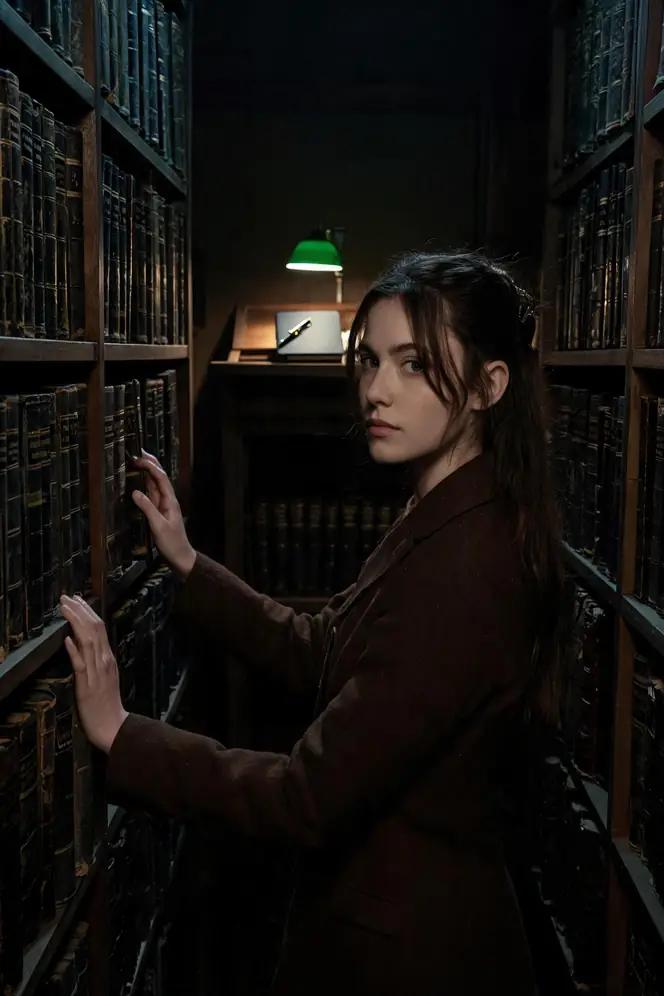
The reading room adjacent to the restricted archive contained deaccessioned materials—books that had been removed from the regular collection, materials deemed too obscure or damaged for circulation, archival documents that required controlled access but didn't warrant the restricted cabinet. Petra had mentioned it casually during Maren's first visit: "You can browse there if you want. Might find materials from previous Scholars if your research overlaps with theirs."
It took Maren three weeks to understand that this was an invitation to find something specific.
She discovered Marcus Odell's notebook on a shelf marked "Deaccessioned (Keep Out)" on a Tuesday evening when the archive was empty except for her. The notebook was leather-bound, maroon, filled with handwriting that progressed from careful to frantic across the pages. No name on the cover. No date. But the handwriting matched a signature she'd seen on a transfer form in the archive's official collection: Marcus Odell, Scholar #17, May 2022.
The notebook's first entry was dated January 15, 2022:
I've decided to investigate this properly. Callum says I'll have access to everything. I don't believe him entirely, but I'm willing to test the boundaries. What I want to understand: Why does the Severance matter? What are they actually doing? Are they truly secret or just performing secrecy?
Maren sat at one of the unmonitored carrels in the reading room (she'd verified: no camera, no climate control, not technically restricted but not advertised) and began reading.
Marcus's investigation was methodical. He'd constructed the same timeline Maren was constructing—Scholar appointments, disappearances, official exits. He'd dated every entry carefully. By February, his tone had shifted from curious to concerned:
Found something odd today. The ceremony dates don't align with the academic calendar. All the Scholars listed as leaving have a ceremony date of May 1, but the official university records show different dates. Some show May 3, some show May 7. It's like the ceremony is May 1, but the official departure is filed later. Why the gap?
Maren felt her hands go cold. This was the same date anomaly she'd found.
By March, Marcus was explicitly stating his suspicion:
The Severance orchestrates Scholar disappearances. I don't think this is metaphorical or institutional in the abstract sense. I think they find Scholars who might talk, and they make sure they don't. The disappearances are real. The people are gone.
By late April, Marcus's handwriting became erratic:
Callum knows I'm getting close. He's started making comments—nothing direct, but implications. He asked me today if I'd found anything "concerning" and whether I was "comfortable" with what I'd learned. He's trying to gauge what I know. I'm being careful. But I'm also beginning to understand that this investigation was meant to happen. They wanted me to find these things. The question is why.
The notebook's final entry was dated April 30, 2022, one day before the ceremony:
I think I understand now. This wasn't an investigation into the Severance. It was an investigation by the Severance. They let me find things. They let me believe I was discovering truth independently. I was finding what they wanted me to find, on a timeline they controlled. Tomorrow I have the ceremony. I'm going to walk in there and face the Council, and they're going to explain to me—very clearly—that I was never investigating them. They were investigating me. I was always the subject, never the investigator. Whatever happens tomorrow, I need to remember this: the trap is architectural. It's not about violence or threats. It's about making someone complicit in their own constraint. If I go willingly, that makes me culpable for my own disappearance.
There was no entry dated May 1 or after.
Maren closed the notebook and sat completely still.
She opened her phone and photographed every page of Marcus's notebook. Twenty-three pages, some with multiple angles to capture the handwriting clearly. She worked methodically, each frame deliberate, hands steady. She was a scholar. She was gathering evidence.
It took forty minutes.
When she was done, she replaced the notebook exactly as she'd found it. She checked the area to ensure she hadn't disturbed anything. She filed her research log (noting only that she'd reviewed deaccessioned materials in the reading room, no specific titles). She packed her things and climbed the basement stairs.
Petra was still at her desk, cataloging materials into the system. She didn't look up as Maren left.
Once outside, Maren texted Callum: found something I want to ask you about. when are you free?
The response came five minutes later: tomorrow, same place as before. 3 pm.
She went back to her dorm and locked the door. Jess was at the library (journalism assignment, would be back late). Maren opened her laptop and began reading through her photographed documents in sequence: the date anomalies, the transfer paperwork, the financial disbursement ledger. Then Marcus's notebook entries, which she'd organized in a separate folder.
The timeline became clearer through Marcus's eyes: The Severance selected Scholars who were curious, intelligent, investigative. They gave them access. They let them find pieces of truth. Then, systematically, they guided those findings toward false conclusions—conclusions that would make the Scholar complicit in the trap, would make the Scholar unable to speak, would make the Scholar disappear willingly or with resignation to an inevitable architecture.
Marcus had understood this. Marcus had named it. And Marcus had gone to the ceremony anyway, because walking away would have meant more consequences than walking through.
Maren understood, in her gut, that she was now in the same position. But she also understood that Marcus had only partially solved the puzzle. Marcus had recognized that he was trapped. What Marcus hadn't done—what Maren needed to do—was figure out how the trap worked, who was operating it, and whether there was a way to escape or fight.
She spent the rest of the evening organizing her research. She created three separate digital files: one with her official findings (the materials she'd photographed in the restricted archive), one with Marcus's journal entries, and one with her analysis of how the trap might function.
She wrote in her leather journal, the one the Severance had given her:
Marcus Odell, Scholar #17, disappeared May 2022. The official record says Edinburgh. Marcus's notes suggest he was gone by design. I'm following the same path. Question: Can I reach the same conclusions without disappearing? Or is the architecture inescapable?
The next morning, she walked into Holt Hall and descended to the archive. Petra was already there, as if waiting.
"Did you find the reading room useful?" Petra asked.
"Yes," Maren said carefully.
"Some materials in there are quite illuminating for Scholars who know how to read them."
Maren met Petra's eyes. For the first time, she explicitly addressed the silence between them.
"Marcus Odell found something. Before he disappeared."
Petra didn't respond immediately. She cataloged a document, entered something in the system, then turned her full attention to Maren.
"Marcus Odell is a name I'm not supposed to discuss with Scholars. I'm not confirming that he existed or didn't exist. I'm also not preventing you from drawing your own conclusions about materials you find in this archive."
"Is he alive?" Maren asked.
"I don't know. I'm an archivist. I preserve what was. I don't determine what became of things after they left my care."
"Thank you," Maren said.
"Don't thank me," Petra said. "Just be careful. The archive is a place where you can find almost anything, if you know where to look. But finding things and surviving them are different skills."
Walking back through campus that afternoon, the question settled without ceremony: she wasn't investigating the Severance. She was moving through an investigation the Severance had designed for her. Every piece she'd found was permitted, staged, placed.
But she could see the path now.
The question wasn't whether to follow it. The question was whether following it was the same as being led.
You might also like