
Chapter 17
Chapter 17: The Severed Hour
The room had been arranged with care that was not decorative. Five chairs in a semicircle on the far side of a long oak table. A single chair on her side, positioned so that whoever sat in it faced all five at once. A length of rope on the table—black, braided, knotted at each end. Two candles, lit, providing most of the light. The windows were covered with cloth.
She sat. Callum took a position to her left, standing, not seated. He had not spoken since the car.
The five Council members were unmasked. She had recognized three from photographs: the Deputy Vice-Chancellor for Research, a Senior Fellow at Whitmore College, the Bursar's chief of staff. She had recognized a fourth from her own experience: Dr. Erica Soames, the faculty welfare officer who had checked in on Maren twice during her first term, who had left a handwritten note under her dorm door during examinations. If you need anything, my door is always open.
The fifth was a man she hadn't seen before. Late fifties, a wristwatch that cost more than her parents' car.
No one wore robes. No ceremony she had imagined would have looked less ceremonial than this.
The Deputy Vice-Chancellor opened a manila folder and began to read.
He read for eleven minutes.
She watched the second hand of the clock on the mantelpiece while he read her investigation back to her—not because she needed to time it, but because she needed an object in the room that was not a face. 660 seconds during which she learned the shape of everything she hadn't known she didn't know.
He read her September application essay and the specific phrases in it that had marked her as the candidate for this cycle's selection. He read a catalog of her archive access requests: every file she had opened, in the order she had opened them, with notes indicating which materials had been placed before her arrival and which she had found without guidance. The financial ledgers she'd discovered: "materials staged for discovery in the second phase of investigation." Fenn: "a predictable investigative detour, resolved within expected parameters." Sable's contact: "a third-stage seeding event." He noted Callum's interventions and Petra's movements — each one in the catalog, in sequence. Marcus Odell's journal: "bait accepted in week eleven, as anticipated."
He read the names of three external contacts she had believed she'd cultivated on her own. Each appeared in his notes as Severance-adjacent.
When he finished, he closed the folder and set it on the table.
"Are there questions about the accuracy of this account?"
"No," Maren said.
This was her first word in the room. She had rehearsed for this: the question they would ask, the answer she would give, the register she would use. She had rehearsed for eleven months and then again for eleven minutes while the Deputy Vice-Chancellor read.
"Good," he said. "Then we can proceed."
He explained the offer. The language was familiar from the archival materials she had found: a sum held in trust, accessible through a numbered account; a new identity package including documentation and a name. The expectation of institutional silence. The understanding that any deviation from that silence would result in consequences for her academic record, her professional prospects, and—a pause here, held exactly as long as necessary—certain members of her family, who had no institutional protection.
"You have until the rope is cut to accept or decline," the Bursar's chief of staff said. "After the cutting, the ceremony is complete and the terms are fixed."
"I understand the terms," Maren said.
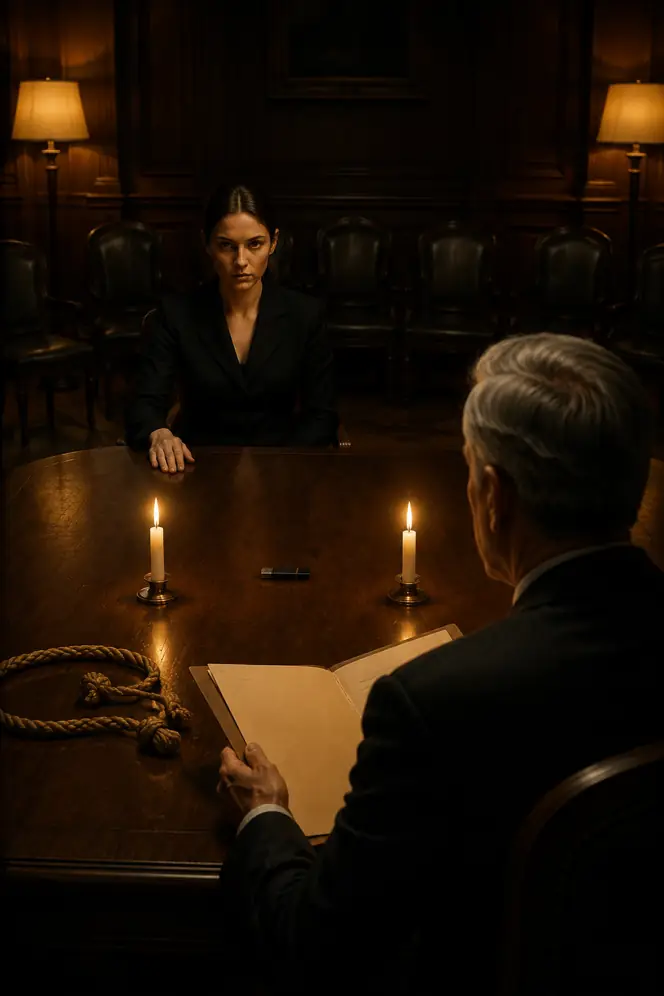
She reached into the inner pocket of her jacket and set a USB drive on the table between herself and the five of them.
"Before we proceed," she said. "I want you to understand that everything you've just described—the mechanism, the financial structure, the identities of each of you in this room—is documented. That documentation is held by someone outside this institution. If I disappear without incident, the documentation is held. If my disappearance draws attention, it's released."
She had worked these sentences down to their minimum. Each one was a statement of fact. She did not vary her tone from the tone in which she had said no.
The Deputy Vice-Chancellor looked at the drive on the table, then at her. "Ms. Calloway."
"Yes."
"We found that drive three days ago. While you were in lectures. We imaged it and returned it to its location." He folded his hands on the table. "It contains file headers and nothing else. 847 kilobytes. The files themselves are empty. It's a thorough shell."
She had built it to be thorough. Forty minutes, with Jess asking whether the file sizes looked plausible.
"So we know about the decoy," he said. "What we'd like to understand is whether the person you say is holding the real documentation is in a position to act on it."
Dr. Soames spoke for the first time. Her voice was the same as it had been in Maren's dorm doorway: measured, careful, modulating toward concern. "Jess Harlow was brought in this morning for a welfare check at the university counseling center. Voluntary, technically. She'll be released this evening."
The word voluntary was doing a great deal of work.
"We also spoke with her editor at the student newspaper," the Senior Fellow said. "As a precaution."
Maren kept her hands in her lap. She could feel her phone against her left thigh, audio recording, battery at seventy-three percent. She had not looked at it. She would not look at it.
"The person holding the documentation isn't Jess," she said.
The room absorbed this.
She watched it happen: the fractional shift in the Deputy Vice-Chancellor's posture. The Senior Fellow's eyes moving to the Bursar's chief of staff. Dr. Soames looking at Maren — the cultivated concern gone, something harder showing in its place. The fifth member—the unknown one, with the watch—who had not moved since the reading.
"The documentation exists in complete form," Maren said. "The person holding it is not affiliated with this university. They are not reachable through the channels available to you. They have standing instructions for when to act."
She said this the same way she had said everything else in this room. Flat. One sentence to a line.
The calculation was happening. She could see the form of it without seeing the specifics: the Severance had survived because it had never needed to be violent. Institutional pressure was sufficient. Deniability was maintained. Scholars accepted the bargain and disappeared. What she was presenting was a scenario in which the deniability was already compromised, in which escalation would produce evidence of escalation, in which the thing that had protected them—the fact that their tools were institutional rather than physical—was the same thing that required them to hold still.
"You may be telling the truth," the Deputy Vice-Chancellor said. "Or you may be describing a contingency that doesn't exist."
"Yes," Maren said.
"Either way, the ceremony proceeds."
"I know."
"And if documentation is released, whatever consequences follow, they follow after you've accepted disappearance. You don't benefit from that."
"I benefit," she said, "if you behave as though the documentation exists. You have to make that calculation without knowing whether it's true."
"We do," he agreed.
He looked at the rope on the table. He looked at the other four—the Senior Fellow nodded, the Bursar's chief of staff nodded, Dr. Soames held a beat and then nodded, the unknown man with the watch remained where he was—and then he looked at Maren.
"We'll proceed," he said.
This was the crux she had known would come. She had not told Callum about the third party. She had not told anyone at Veltham. She had made the arrangement two months before the ceremony through a contact so peripheral—someone who had attended Veltham for one term four years ago, who had left for reasons that had nothing to do with the Severance—that no search of institutional records would surface the connection.
Whether the arrangement was airtight, she did not know. She had made it and had not been in contact since, because contact would create a trail, and a trail would create a target. The third party might have moved. Might have lost the drive. Might have become unreachable for reasons that had nothing to do with any of this.
The performed calm was a performance of certainty she did not have.
The Deputy Vice-Chancellor picked up the rope and held it taut between his hands. The ceremony text was brief—five sentences, institutional, delivered without expression. The Scholar has been examined. The Scholar has been known. The Scholar is severed from the body of the university. What was held is released. What was carried is set down.
He cut the rope with a penknife. The two pieces fell on the table.
Dr. Soames placed a card in front of Maren. Account numbers. A phone number. A city.
"You have 48 hours to make contact," the Senior Fellow said. "After 48 hours, the offer expires."
Maren picked up the card.
The five of them were rising, gathering folders, moving toward the side door. Callum had not spoken once during the ceremony. He stood to her left, where he had stood since she sat down, and she could feel him not looking at her.
She was looking at the table.
The two halves of the rope were uneven. The longer piece had fallen with one end coiled—the way rope coiled sometimes when cut under tension—and the other end lay flat. She watched it for three seconds while the room cleared around her. The coiled end was still moving, settling against the oak surface, finding its shape in the absence of pressure.
Seventy-three percent. The audio was running.
The unknown man with the watch was the last to reach the door. He stopped but did not turn around.
"Whoever they are," he said, "they should understand what carrying this costs."
He left.
The candles were still lit. On the table between Maren and the door, the coiled end of the rope continued settling—a slow, involuntary movement, nothing more than physics—until it stopped.
You might also like