

Chapter 20
Chapter 20: The Third Declaration and the Ritual
Chapter 20: The Third Declaration and the Ritual
The archive was silent. After Damien spoke "Two," neither of us moved for what might have been minutes or hours—the kind of stillness that unmakes time. The sigil beneath our feet remained dim. The light stayed ordinary. We stood close enough that I could have reached for him, and the fact that I didn't was its own kind of gravity.
"The third one is yours," he said. Not a question.
"I know."
I did know. The registry had shown me that much, the bloodline records patient and exact about the shape of this: that I would give the third declaration. That he would speak the words that came after. That neither of us would be able to undo what happened next.
I breathed in. The archive smelled like it always did—stone, leather, something almost mineral. Ordinary. I thought of the founding records, the ones that described this moment in language so controlled it almost erased itself. Three declarations. Then the ritual. Then the compact, signed not in ink but in something older.
I spoke.
"I accept the compact of the Obsidian Circle. I accept the weight of the legacy. I accept the terms of binding." The words came from somewhere older than thought. Not from memory—I hadn't memorized them—but from something deeper. The registry itself seemed to speak through me. "I accept what comes after."
The archive changed.
Not gradually. Not in the slow way the light had shifted after "One" and "Two." This was immediate. The illumination didn't brighten so much as reset—as though the archive had been holding its breath and finally exhaled. The shadows that lived in the corners retreated. The light that filled the space was not electric or supernatural in any obvious way. It was the light of a winter morning that broke through after a storm, present and certain and warmer than it had any right to be.
And then I felt it.
The warmth came up through the stone beneath my feet first, a gentle surge that rose through the soles of my boots like the floor itself was alive. It moved upward along the length of my spine, not heat exactly but the memory of heat, the way the face of a building holds the sun's warmth long after sunset. The air around us became tangible—thicker, present, almost gold. I breathed it in and it was warm in my throat, in my lungs. The founding documents had described this exactly: the warmth comes, and it bears witness.
Damien's eyes were on me. I could see the moment he recognized what was happening—the same moment I did—and something in his face settled. This was real. This was old. This had been waiting three hundred years for someone to do it correctly, and now it was here.
He stepped into the center of the sigil.
The words he spoke were not in English. The founding words predated modern language by more than a century, pulled from the order's original charter when it had been written in a dialect that barely survived. But Damien had memorized them—I could see the weight of that work in the careful articulation of each syllable, the way his voice carried the sounds like someone handling something precious and fragile. He spoke slowly. He did not rush. The words had weight because he treated them as though they did, and the archive agreed.
"I bear witness to the binding of blood and intention. I acknowledge the covenant of three centuries. I stand as the keeper of the words, and I speak them true, and I hold them binding as the first words were spoken, as the first circle was drawn."
More. Other words, in a language that sounded like Latin but wasn't quite, wasn't anything that lived anymore. But the archive understood. The warmth intensified. I could see it now in the air between us—the way reality wavered slightly, the way the light bent around the sigil's edge, the way the archive itself seemed to be paying attention to what we were doing.
And then my name.
It wasn't Damien who spoke it. It was somewhere deeper—the registry, the bloodline, the archive itself. I heard my name in the stone, in the light, in the warmth that was almost solid now. And I understood, in that moment, that I was being registered. Not added. Registered. My name had always been in the bloodline records—I had been born into this circle, had been written into its fabric before I was born. But now it was active. Now it was alive. Now the archive saw me.
The light around me was different from the light around him. I could feel it on my skin, could see how it bent differently through the space I occupied. The archive was looking at me. Not as a stranger. As someone who belonged.
"I accept," I said, and there was nothing else to say because the words were already written somewhere that mattered more than voice. "I accept the compact. I accept the terms. I accept this binding."
The warmth held. I was aware of its passage in a way that had nothing to do with clocks—the way you know how long you've held your breath, not by counting but by the ache in your lungs. Time was a thing we were experiencing together, Damien and me, inside the archive's attention. Forty minutes. Maybe more. The warmth didn't fade so much as it gradually remembered what ordinary temperature was. The light didn't dim. It settled. The air stopped being quite so thick, and I could breathe it without tasting gold.
When it was done—when the compact was sealed and registered and written into whatever system the archive used to track such things—the sigil remained glowing. Not faintly. Not the sort of dim phosphorescence that might be a trick of perception. It glowed steadily, the lines clear and bright against the stone, and I understood with absolute certainty that it would not stop glowing. Not for decades. Not for centuries.
The quiet was complete. The archive had finished its witnessing.
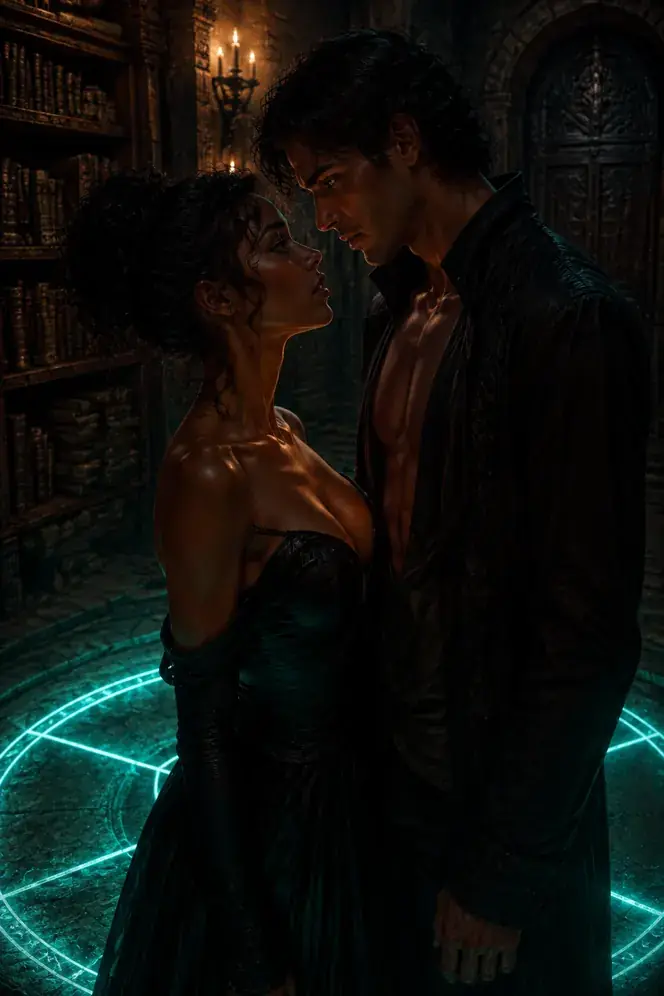
Damien stood in the center of the sigil, breathing slowly. Our eyes met across the restored ordinary space—the warmth gentle now, barely present, like a room that had been loved and was still holding that love inside its walls. He looked at me the way someone looks at something they've learned by heart.
"Vale," he said.
Just my name. No question in it, no declaration. Just the sound of it, the fact of it, the weight of three hundred years finally speaking correctly.
I looked at him.
We had already said what needed to be said. We had already given our declarations, spoken the founding words, accepted the compact that had been written in blood and intention three centuries ago and was only now being fulfilled the way it was meant to be fulfilled. There was no need for anything else.
The sigil glowed steady and constant beneath us, and we stood in its light—bound, witnessed, and no longer alone in the architecture of what the Obsidian Circle had meant to be all along.
You might also like