
Chapter 17
Chapter 17: The Circle Convened
Chapter 17: The Circle Convened
The archive had the quality of all old places that had not yet decided to decay—it held its breath. Dust moved through the sunlight in slow diagonals, and the spines of journals older than the university gleamed with a dull copper finish under the glass-fronted cases. I'd been granted access three weeks ago. Damien had done that—signed something, or called in a debt. I had not asked which.
Now, while the Circle met in chambers I had never seen, I sat in a reading chair that predated the war before the last one and turned pages that whispered like old skin.
The collection was organized by theme, not chronology. Someone, decades ago, had decided that the history of the order mattered less than its architecture. The founding documents occupied a single leather portfolio, locked but accessible to approved readers. The amendments—there were more of them than I'd expected—lived in a separate case. Damien had made sure I knew where to look.
I'd started with the founding text itself, the one Damien had shown me. The language was baroque and careful, full of the kind of precision that suggested the writers had learned it in another country, another century. The Circle exists to preserve and advance the order's sacred practice. That sentence alone appeared four times in the first section, each time with different conditions attached.
The exchange was mentioned once. Briefly. As though it were not the engine at the center of everything, but merely a detail, a procedural note.
I'd taken notes. My handwriting looked small against the archival paper Damien had left for me, but the words accumulated. By the time I heard the bell tower strike noon, I had filled ten pages with crossreferences and questions and the particular excitement that came from understanding that I was being trusted with something.
The morning had been clear and cold. By one o'clock, clouds had moved in from the east, and the light in the archive turned the color of stone. I'd pulled my sweater tighter and kept reading.
The amendments told a story I hadn't expected. The first, dated 1952, proposed regulations around the timing of the declaration. The second, 1971, addressed succession. The third was about something so delicately phrased that it took me three readings to understand it was about preventing the Circle from concealing evidence of the practice's dangers.
Someone had tried to protect people. Not me. People who came before me. Someone in the Circle, sometime in the last fifty years, had looked at what was happening and written it down and tried to make it matter.
My eyes had begun to burn from the reading when Damien's message arrived. Three o'clock. East wing reading room.
I'd packed carefully, aware that my time in the archive was borrowed and temporary. The portfolio went back into its case. The notes I'd taken went into my bag. I made the journey through the university in the half-light of the afternoon, moving through halls that seemed to narrow as I approached the older wings.
The east reading room occupied a corner of the library that had not been renovated since 1920. Two windows looked out onto the courtyard. There was a fireplace, cold now, and shelves that held the kind of books no one consulted anymore. It was where the university kept its failures—journals that had never attracted subscribers, dissertations that had been challenged and abandoned, the personal libraries of professors who'd died before their work reached print.
It was also, apparently, where Damien conducted the conversations he needed privacy for.
He arrived as I was settling into the chair by the window, the same chair I always used. The light was behind me—he would have to work to read my face. That was deliberate on my part. That was becoming deliberate on my part more often now.
He walked in without knocking.
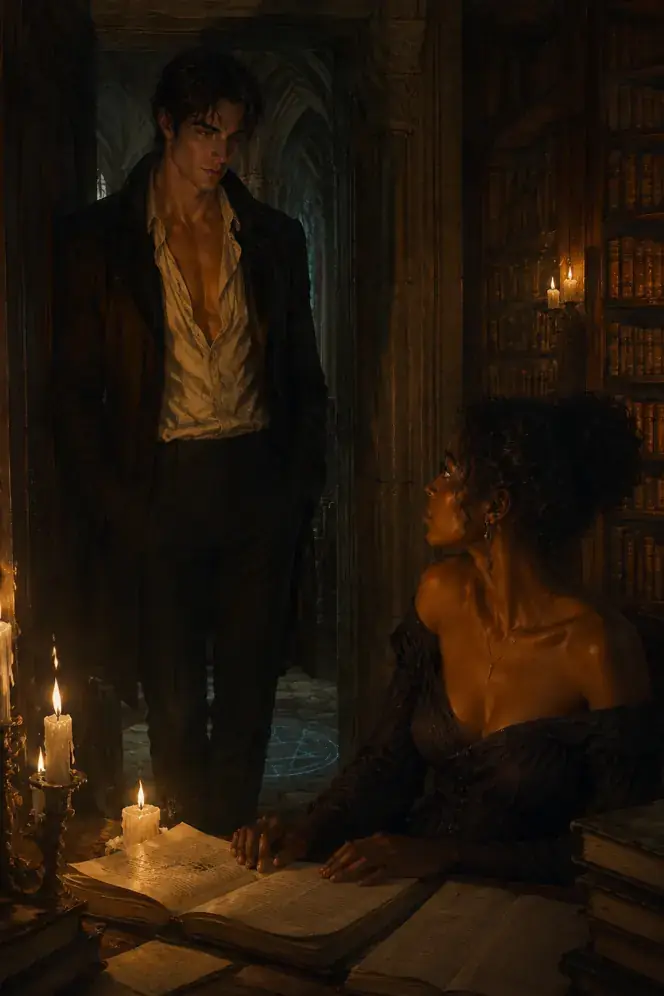
The first thing I noticed was the lightness.
Not relief. Not triumph. Not anything so simple as the face of someone who had won. It was the way he moved through the room, the way his shoulders didn't carry whatever weight they'd carried that morning. He looked as though he'd set something down. He looked like someone who had made a decision and lived through its consequences and found the consequences survivable.
He sat without asking permission, in the chair across from me. The fireplace was between us, full of cold air and shadow.
"It passed," he said.
"The amendment."
"Six to four. The charter requires only a simple majority. It passed."
I waited. This was not the end of the story. We both knew it wasn't the end.
"Mira objected immediately," Damien continued. His voice was low, factual. He was not performing this account for anyone but me. "She cited tradition. Precedent. She said that opening the exchange to outside scrutiny would compromise the Circle's purpose. She read the founding charter as being explicit about secrecy."
"But."
"But then I showed her the exchange provisions. The actual text. She read it—took about two minutes—and then she asked for a copy. She asked if she'd been reading the charter wrong her whole tenure as Deputy."
"Had she?"
"Yes," Damien said. "The founding text is explicit. Every participant has the right to full disclosure before any binding commitment. The Circle has been operating in direct violation of that for at least sixty years. Mira realized this, and then she stopped objecting."
Two members had walked out. He told me this as though it were expected weather. They'd objected to his characterization of the practice as "binding." They'd refused to vote. They'd simply left the chamber. He hadn't tried to stop them. The amendment didn't require their participation.
Three members had asked questions. These were older faculty, he said. Professors who'd been in the Circle for decades. And their questions were not about the amendment itself, but about what came after. What happened next. What would change. One of them had asked directly whether the Circle could still function if participants knew what they were agreeing to.
"What did you tell them?" I asked.
"The truth," Damien said. "That I don't know yet. But that it will function differently, and that different isn't inherently worse."
Ashworth had been called in as the most recent Outer Ring member appointed to the inner Circle. He'd verified the documents. He'd confirmed Damien's reading of the charter. He'd looked at the founding text and said, clearly, that Damien was correct.
The vote had taken twenty minutes. The result had been written down and signed.
"Six to four," Damien said again. "Formal amendment to the Circle's charter. Effective immediately."
I thought about this. I thought about the weight he had set down, the lightness that remained.
"What comes next?" I asked.
"The amendment is in the charter now," he said. "Every ritual participant, from now on, receives the full exchange disclosure before their first declaration. Complete documentation. The exchange process explained. The risks outlined. Everything."
He paused. The fireplace crackled, though there was no fire in it.
"Which means you're still first."
I understood what he was telling me. Not that I was the first to know. I'd always known. But I was the first to know like this—with intention, with clarity, with the Circle's own consent written into their laws. I was the first to step into the exchange knowing exactly what it cost and what it required.
I was the first who had chosen, fully.
"When?" I asked.
"Whenever you're ready," Damien said. "The amendment's in place. We can move forward as soon as you decide."
He sat back in his chair. In the window behind him, I could see the courtyard beginning to darken as the afternoon folded toward evening. I could see my own reflection, faint and uncertain, superimposed over his.
This is what he looks like, I thought, when he's made a decision he can live with.
Not happy. Not celebratory. But at ease with the cost of what he'd chosen. And that ease—that acceptance of the weight and the consequences and the way forward—was somehow more intimate than triumph would have been.
"Tell me about the three who asked questions," I said.
He did. He told me their names—professors I recognized from the university catalog, people who'd been teaching here when I was a child. He told me what they'd asked, the specific doubts that had finally found language after decades of silence. And as he talked, I understood that this amendment was not a victory he had won against the Circle.
It was the Circle, finally, choosing to become the thing its own founding laws had always demanded it be.
Outside, the bell tower struck three-thirty. In the archive, someone was returning the journals to their cases. In the chambers where the Circle met, the document was being filed in the official record.
And here, in the east reading room where we sat in the cold fireplace light, I sat with a man who had walked into a room full of people who could have destroyed him, and had instead asked them to keep the promises their own words had already made.
He stayed until the light began to fail, telling me the small details—what Ashworth had been wearing, which members had asked their questions first, how long the silence had lasted after the final vote was announced. He told me everything that had happened in the room I hadn't been allowed to enter, translated into words for the person the Circle had decided I might become.
I listened, and I felt, for the first time since all of this began, the weight of my own choice settling into place, solid and final and mine.
You might also like