
Chapter 10
Chapter 10: The First Truth
Chapter 10: The First Truth
Damien was waiting by the north stairwell when I finished my Monday seminar—which meant he had timed something, which meant this had been planned. He handed me a key card without preamble.
"East wing. Top floor. No one goes up there."
I took the card. "That's ominous."
"It's efficient." He was already moving toward the stairs. "Come on."
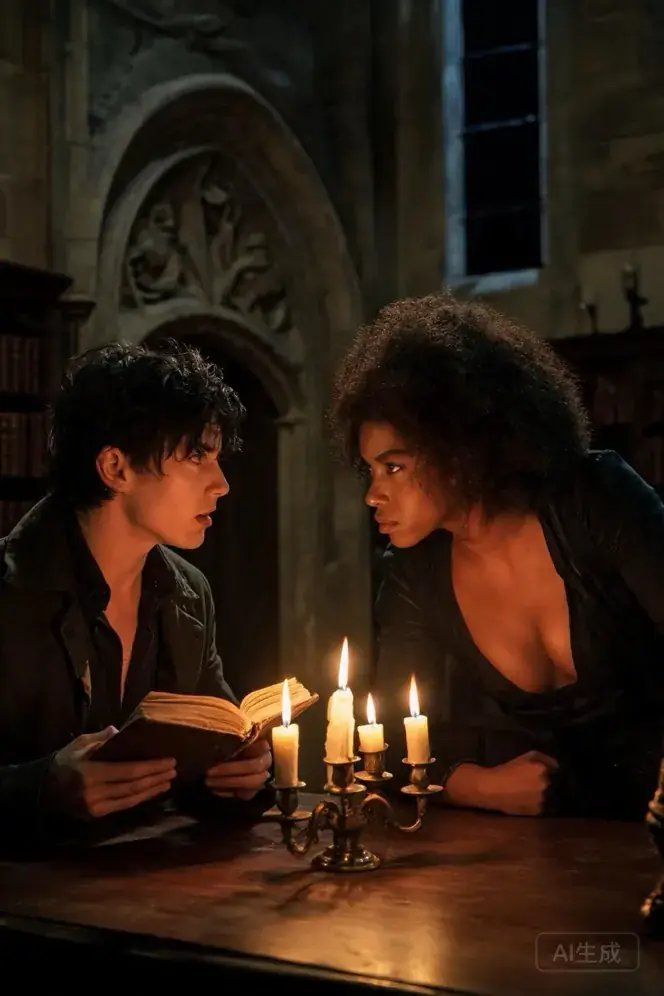
The east wing felt like a different building entirely. The stone here was older, less fitted; the windows looked out over the promontory, and the light that came through them was the color of a photograph left in the sun. By the time we reached the top floor, we were alone in a way I'd never experienced at Rothesfield—not the alone of empty hallways, but the alone of a space that had simply been abandoned to particular purposes.
He used an actual key on an actual wooden door, the kind that probably hadn't been opened more than twice since 1987. Inside was a reading room that looked like someone's scholarly life had been neatly archived and then paused mid-breath.
There was a desk under the window, papers stacked in careful order. A wing chair with a blanket folded over its arm. Books everywhere—not decorative books, but working books, marked and split at the spine. A coffee mug sat on the side table, empty but recent. This was a room where thinking happened. This was his room.
"Sit," he said, and moved to a locked cabinet built into the wall.
I took the chair by the desk. From here I could see the promontory in full, the black water beyond it, the sky starting to bruise toward evening. The room was cold—not unpleasant, just the kind of cold that came with old stone and windows that didn't quite seal. I pulled the blanket over my lap.
He opened the cabinet with a key from his jacket—not the key card, an actual brass key that looked like it belonged to something from another century. Inside were documents in a folder, tan and careful, and he carried them to the desk like they might disintegrate.
"The founding documents," he said. "These are a translation. The originals are in the archive, sealed."
He didn't hand me the folder. He opened it himself and read.
"The Circle was established in 1847 by the Voss family and four others who believed that certain bloodlines carried a resonance that could anchor a place—strengthen it, protect it, give it structure that regular power couldn't maintain. They called it attunement. The ritual of renewal binds the Circle to the participating bloodline member for a term of seven years. At the end of that term, the participant may choose to renew, step back, or—" He paused. His finger traced the line. "Or complete a final ascension into the archive itself."
I watched his hands on the paper. Fine hands. Controlled.
"What does ascension mean?" I asked.
"Physical death on Circle grounds leads to a particular kind of preservation. They call it anchoring. You become—" He looked for a word. "Resident."
"A ghost."
"A presence with agency. With will. With function." He turned the page. "But that's the third option, and it's not offered immediately."
"What are the first two?"
"Renewal or withdrawal." He found another section. "But before either option, the participant receives permanent archive access. And they receive a seat on the Circle itself—one of the five permanent positions."
I'd been sitting with my hands under the blanket, and the blanket was already tighter in my grip.
"So the ritual isn't just a one-way—" I started.
"No," he said. "It's an exchange."
The way he said it made it clear this was significant. He read on, pulling out the terms: what the participant gave (five years of monthly resonance, essentially—a directed emotional and spiritual attunement that kept the Circle's foundations in place), and what they received in return.
"This is the part that was never explained to me," I said. I watched him read the words from the document, his voice steady. "Access to the archive. A seat. Permanence."
The room was very quiet. Outside, the light was fading.
"You're choosing what to read," I said.
He stopped. Looked up. Met my eyes and didn't look away.
"Yes," he said. "I'm also the only other person in this building who has read this, and I've read it in the context of what I was told to do with it, which I'm not going to do."
My chest went very tight.
"What were you told to do?" I asked.
He looked back down at the folder. Closed it. Kept his hand on top of it like it might try to escape.
"Not tonight," he said.
I sat there with the blanket in my lap, watching him sit in the cold light with the founding documents under his hand. The promontory was almost black now, the water beyond it darker still. In a few minutes, they would turn on the lights in the courtyard, and this moment would be over.
"Can I ask something else?"
"Yes."
"Why read it to me instead of giving me the papers?"
He was quiet for a long moment. "Because I want you to hear it through me first. Because when I hand them over—and I will—I want you to know that I was here, that I saw you learning this, that I didn't make you learn it alone." He paused. "And because I'm still deciding what to tell you next, and I wanted to know how you'd take what I've already said."
"And?"
"You're taking it seriously. That's good."
I stood up. The blanket fell away. He didn't move, just watched me walk to the window and look out at the darkening water.
"The scholarship," I said. "The letter. It had your family crest on it."
"Yes."
"You sent it to me."
"Yes."
"Because I was supposed to be—" I didn't finish. The weight of what he'd just told me settled down over everything, recontextualized everything. The invitation. His attention. The way he'd warned me against going alone to the archive door.
He had been supposed to bring me to this room and perform a ritual. And then I would have been bound to something I didn't fully understand, given something I didn't consent to, made a party to an exchange I'd never been told was an exchange at all.
And he wasn't doing it.
"I need to go home," I said.
"I know."
I turned from the window. He was still sitting at the desk, the folder under his hands like an anchor. In the last light coming through the glass, his face was half-shadow, half-something else—some particular intensity that I was starting to recognize as the thing underneath his control.
"Vale—"
"Not tonight," I said.
He closed his mouth. Nodded once.
I walked out of the reading room and down the cold stairwell, and I didn't look back to see if he was watching me go. By the time I reached my apartment, the scholarship letter was on my desk again, and I was holding it up to the lamp light, looking at that crest—the interlocked C and V, the blood-red seal.
He had been supposed to bind me. And he was not going to.
I didn't know what to do with that yet. I didn't know what it meant for him, or for me, or for whatever happened next. But I knew it was the most important thing I had ever learned about Damien Voss, and I knew I would spend the next week—the next month, maybe longer—turning it over in my mind like a key I didn't yet know how to use.
I looked at my phone. No message. Nothing from the reading room. Just the silence of a decision that had been made and the silence of a decision that wasn't quite finished being made.
Outside my window, the city lights were coming on. Somewhere in the east wing, the lights were probably going off. And Damien was sitting in the dark with a folder full of secrets, choosing which ones I got to know.
I wasn't sure if that terrified me or not.
But I was sure it mattered.
You might also like