

Chapter 7
Chapter 7: The Letters
Chapter 7: The Letters
The trunk's contents lay spread across the kitchen table like artifacts from someone else's life. I sat on one side, Kael on the other, with the afternoon light slanting through the windows in that particular way that made dust visible. I held a letter between my fingers—the envelope yellowed, the ink faded to rust. The postmark read 1887. It had never been sent.
I looked at Kael across the table. "Do you know what this is?"
He did not move, but something in the precise angle of his gaze shifted. "Where did you find it?"
"In the trunk. Under everything else. Addressed to—" I turned the envelope toward him. My finger traced the words written in careful hand: Al oscuro en la mesa. The dark one at the table. "—to you, I think. Though obviously not by name."
Kael's expression did not change, but he went very still. "I did not know that letter existed."
The way he said it—the absolute weight of it—told me this meant something. Not anger. Not exactly surprise either—more like pressure releasing, slow and tectonic, the way ground shifts when a weight it's been bearing finally lifts. He had never read this. Someone had written to him, and he had never known.
"It's from 1887," I said. My attorney's training kicked in automatically; I was stating facts to establish a record. "Catalina's daughter, I think. Your—" I paused. Contractor's granddaughter? The language failed me. "Someone who came after."
Kael said nothing.
I looked at the letter in my hands. It was fragile. The paper had yellowed to the color of old bone. There was a small stain on the back—water, maybe, or tea. Someone had held this carefully once, written it carefully once, sealed it carefully once. And then they had not sent it.
I began to read it aloud.
"The dark one my mother made a bargain with," I read, my voice strange in the quiet kitchen. "I do not know if you can receive letters. I do not know if what I write reaches you, or if you have any way of knowing such a thing. But I am writing anyway, because I have been thinking of you for many years, and today it seemed like the wrong thing to have thought alone."
Kael's hands were folded on the table. I could see the small scar across his knuckles, white and old. I kept reading.
"I saw you once, when I was very small. It was winter, and I had woken in the night—I do not remember why, some child's dream or restlessness. I looked from my window into the street below, and you were there. You were standing across from our building, looking up at the windows. Just standing. Waiting. I did not move. I thought, even then, that you were making sure. That you were keeping watch. I never told Mamma. I knew, even as a child, that some things were not meant to be spoken."
I paused. The letter trembled slightly in my hands, and I steadied it against the table.
"I wanted to thank you for something. I cannot say it directly. It is not my story to tell, not entirely. But something happened when I was older, something that could have been worse—much worse—and it was not. I know it was you. I know what you did, even if I do not know how you did it. I want you to know that I know. That someone besides my mother knows you are there."
My voice had dropped without me meaning to slow down. I kept going because stopping felt like the wrong move. Like abandoning something in the middle.
"Are you lonely? I am sorry to ask it directly. But I think you must be. I think you have to be. If that matters at all—if anything matters to something like you—I want you to know that I think of you, sometimes, and I do not think it is a lonely thought. I think it is a grateful thought. I think of you as something fierce and patient and good, and I know that is not a thing the world calls you, but I am calling you that now."
I swallowed. My attorney's voice, my precise contract voice, had wavered. I cleared my throat and continued.
"I did not write this sooner because I did not know if I was allowed to. I did not know what the rules were. I did not know if it would be unwelcome, or if you were still—there. But I thought, finally, that you might have been waiting a long time. Not for my letter. For something. And perhaps it does not matter whether this reaches you. Perhaps the writing is enough. But I wanted to tell you: you were seen. You mattered. It made a difference."
I stopped reading. There was more—a closing, a signature—but I could not look at it directly yet. I folded the letter carefully and laid it on the table between us.
For a long time, neither of us moved.
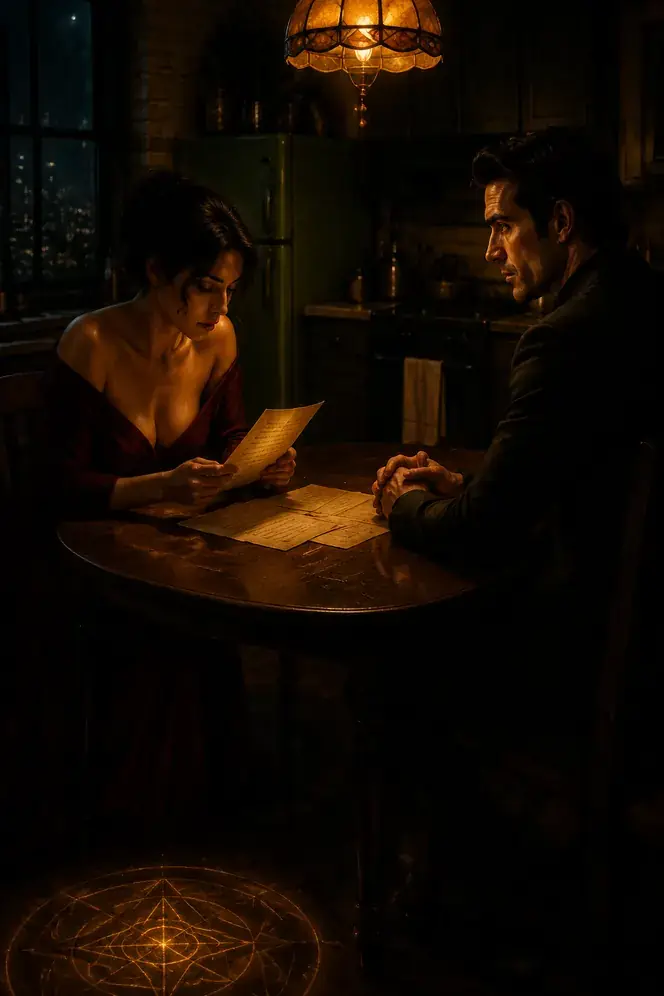
When Kael finally looked at me, his expression had no category I recognized—not guarded, not performing. He was sitting with something that had grown larger than the table between us, larger than the afternoon, larger than the apartment. He did not look away. His amber eyes held steady, the same eyes that had made me afraid of him and made me not, both at once.
He reached out and took the letter from the table. His fingers were careful on the paper, which seemed impossibly delicate against his hands. He unfolded it and read it, though I had already read it aloud, though the words were still hanging in the air between us. He read it entirely. His expression did not change while he read, but when he folded it again, his hands stayed on the paper for a moment longer than necessary.
"Did you know Catalina's daughter?" I asked.
"I was aware of her," he said. "I did not speak to her."
"Did you see her? When she was a child?"
The pause was long enough that I thought he might not answer. Then:
"Yes."
"So you were there," I said. It was not a question.
"I have always been there, Ms. Solano." His voice was lower than usual, but still that formal register, still careful with every syllable. "That is the nature of the clause. I was bound to presence. To witness." He paused, and when he spoke again, it was more quietly still: "I was not asked to feel anything. I was asked to be present. I have learned those are different."
I did not respond for a long time. I could not. The light had changed on the table, the dust hanging in the air now catching copper-red from the lowering sun. I put my hand down on the stack of letters, palm flat, grounding myself on something solid.
"Did she ever know?" I asked. "That it worked?"
Kael looked at the letter still in his hands.
"Yes," he said. "She knew."
I nodded. Once. And said nothing else.
You might also like