

Chapter 7
Chapter 7: The Blackfen
The Blackfen smelled of rot and cold iron — still water, clay, and the particular growth that happened in places where light arrived sideways and left early.
Aldric entered it on a Tuesday. He counted from the last firm ground: four steps into the sedge grass before his right boot found water, three more before both feet were committed. He had left everything unnecessary at camp: fire kit, food, the wool blanket that would be useless in this cold anyway. He carried his coat, his boots, and a knife that would be useless for what he was here to do and necessary for everything else.
He had a direction. He followed it.
The first day was physical. Cold worked through the boot seams within the first two hours. The ground alternated between firm and soft without pattern, so each step required a small judgment. By midday his body had registered the absence of food and filed a formal objection. He noted it and continued.
He had been told, by the only person he'd found who had come back from the Blackfen with anything useful to say, that what happened there was not navigated. You did not locate the Hollow. You made yourself available to be located. This was not mystical guidance — it was practical. The Hollow did not respond to preparation. It responded to a specific sustained condition of the body and the attention.
The man who had told him this had survived it and returned without much ability to describe what he'd experienced, which Aldric had taken as useful data.
He found a slightly elevated depression between two root-arches where he was less likely to wake in water, pulled his coat closer, and did not sleep.
The second day was harder and stranger.
The shapes of things developed a quality around midday that he didn't have a word for. Not hallucination — everything he saw was there. But the relationship between things had acquired emphasis. A fallen branch crossing another branch was not just wood on wood; he was aware of it as an event. He watched a heron stand motionless in the shallows for what might have been an hour and understood, with the complete certainty of the severely sleep-deprived, exactly what the heron was and what it was waiting for and that the heron cared nothing at all about his understanding of it.
The pragmatic part of his mind — the part that ran independently of whatever else occupied him, the part that had always kept count of exits — continued its work. Tree lines. Water levels. The direction the reeds bent in the variable wind. He could find his way out. He could always find his way out.
He had not slept in two days. He got to the third day.
The Hollow did not appear in any way that the word "appear" usually meant.
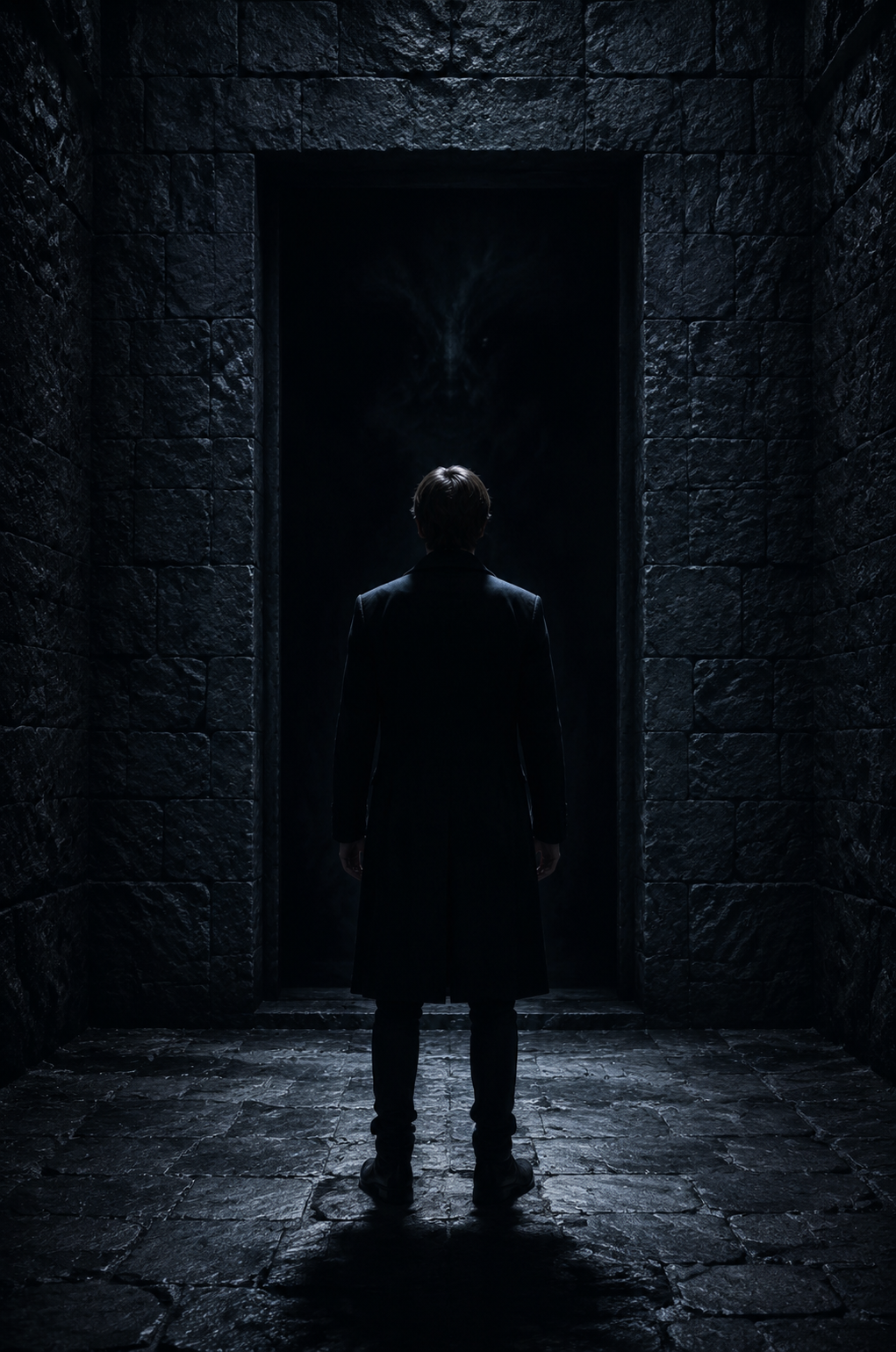
He had been sitting with his back against a root-arch — past midday by the quality of the light, though he had stopped tracking the hours with precision — when he became aware that the space around him was no longer empty in the same way. Not the temperature. Not the sound. The quality of presence itself. He had once walked into a room immediately after a death, the body still warm, and understood from the room that the thing which had made the man a person was no longer in it. This was like that, except in reverse. Something was present that had not been present before, and it was present with attention directed at him.
He did not look up immediately. He sat with the awareness of it the way you sat with a sound at the edge of hearing, waiting to determine if it was real.
It was real.
When he looked up, there was nothing to see. The same dark water, the same bent sedge, the same angled light through overcast. But the space in front of him was different in a way that had nothing to do with what was visible. He was very aware of the Hollow and the Hollow was very aware of him and neither of them moved.
He did not speak. He had nothing to offer, and he understood, arriving here, that nothing was required — no vow, no blood, no exchange of terms. The Hollow did not negotiate because the Hollow did not want anything. Whatever was happening was not a transaction. It had no structure he could recognize as a transaction.
The cold had stopped signifying. His hands were at the ends of his arms, distantly. He was aware of the Hollow with the kind of total attention that three days without sleep sometimes produced, everything else having contracted to background.
What unnerved him was not its presence. It was the absence of anything that could be called intention. He had faced men who wanted him dead, men who wanted to use him, men who had discarded him entirely. This was different from all of those. The Hollow attended to him the way a very old thing attends to something it has been waiting beside for a long time. Without urgency. Without appetite.
It watched.
When the transfer happened, there was no ceremony. There was a moment in which the topology of the world shifted by a small and specific amount, as though a layer had been added to it — a layer that had always been there, but not accessible. Like a door that had been in the wall all along, and now was open.
And then it was done.
The Hollow remained. He could feel it attending, without urgency, without interest in whether he was comfortable with the attending. It watched for some time.
Then it wasn't there.
He stayed where he was until the quality of the air had returned to something ordinary. Then he got up and found his way out.
He followed the water levels and root-patterns back the way he'd come, the navigational count he'd kept running without effort doing its work. It took the rest of the day and into full dark to reach the Blackfen's margin.
Gosse was there — a marsh trapper hired to wait at the edge and ask nothing about what might come out of the sedge. He was coiling and uncoiling a length of rope when Aldric came out of the tall grass. He stood when he saw him. He reached out a hand in the automatic way of a man who had spent his working life helping people across uncertain ground — a reflex, without thought.
His hand found Aldric's wrist. Skin on skin where the coat sleeve had pulled back.
The vision arrived without introduction.
He saw a woman. Not as a sequence of images — as a total understanding of a person, the way you sometimes know a thing all at once in a dream without having been told it. The particular tilt of her head when she was choosing to believe in something. The quality of her attention on Gosse. He understood without being told that she was dead, that she had died loving Gosse with a completeness that had organized his life. He understood what she had loved — a version of Gosse that was partly true, partly aspiration, partly things Gosse had allowed her to believe because they were easier than the correction and because he had wanted, badly, to become the man she was seeing. He had never corrected her. He could not correct her now.
And the correction was the only thing that remained to be done, and it was permanently impossible, and he would spend whatever years remained to him carrying the weight of having been loved for something he had only sometimes managed to be.
He became aware that they were standing on solid ground and that Gosse was looking at him with the uncertain expression of a man waiting to learn if something had come back intact.
"Right," Gosse said.
Aldric walked.
He walked for four hours. Gosse had the sense to keep his distance. The road north was empty. Aldric did not think about Gosse's wife. He thought about other things, and thought about her anyway, and did not slow down.
Somewhere above the treeline, something was still watching. Not following. Not interfering. Watching the way a quality of light persists in a room long after the candle is moved. Not malevolent. Not anything.
He kept walking.
Corvus was at the fire when he came into camp. He handed Aldric a cup of broth that was still warm and moved back to his position near the horses without comment.
After some time, Corvus said: "Productive?"
"Yes," Aldric said.
Corvus said nothing else.
Aldric noted this. Filed it.
He stared at the fire and drank the broth. The new thing in him was quiet. It had no presence he could feel, not until there was skin contact to anchor it. But it was there, the way a door that has been opened is different from a door that has not, even after you've stepped back through it.
He thought about Gosse's wife and the specific impossibility of a correction that had no remaining object.
He did not think about what it meant that he could now see them.
He put the cup down and watched the fire and did not think about it for the rest of the night.
You might also like