

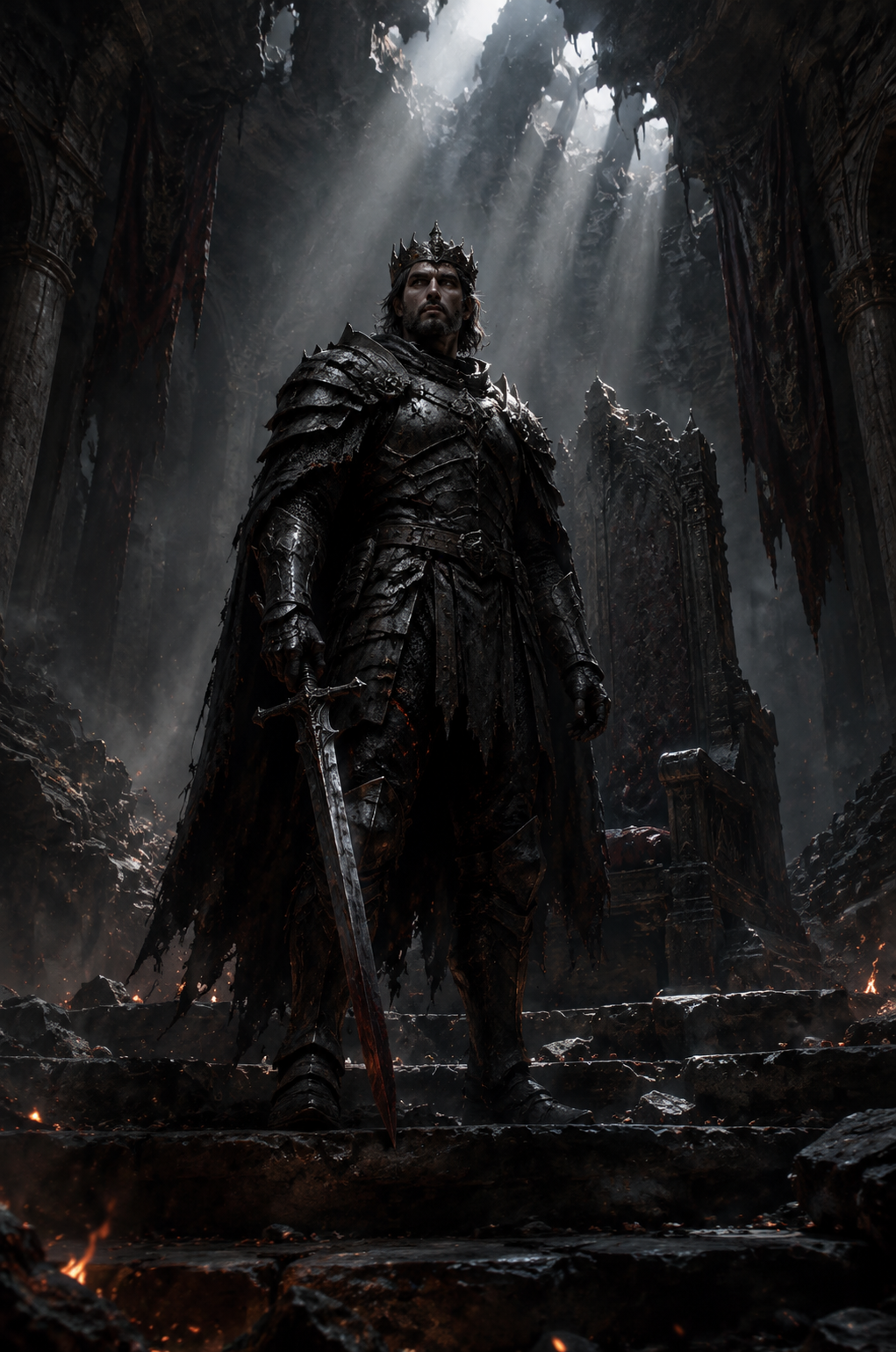
The Ashen King
Chapter 1
Chapter 1: The Weight of Late
The wagon was twenty minutes late, and lateness in a Conclave transfer was always information.
Aldric Vane lay flat on the tannery roof at Mercer's Lane, chin at the parapet's cracked edge, and ran the possibilities. Change of route: he would lose this window and need three more days to establish another. Delay at origin: manageable, if the overall timing still tracked to the facility changeover. Something he hadn't planned for: he left that category open. Closing it was the kind of comfort a man in his position couldn't afford.
Below, the street ran sixty yards straight before bending at the bridge. Iron lampposts on either side marked the natural chokepoints — he'd noted them on his first walk-through eight days ago and hadn't built them into his primary approach. They were there if the situation reduced him to secondary options.
He had been on the roof an hour and forty minutes. His count was six guards.
Two on the wagon box, angled outward — watching the street's flanks rather than each other, which indicated training. Two flanking horseback, bracketing lateral approaches from the side streets. One posted at the gate a hundred yards back, only relevant if the convoy reversed, which convoys did not do. One walking point, twenty feet ahead of the team.
The flankers were professional. They maintained interval without overcorrecting and watched angles the way experienced soldiers do — comprehensively, without preference for comfortable directions. The point guard was different. His reversal intervals were identical. His distance from the lamppost at each turn was constant within a foot. He was not reading the street. He was executing a pattern someone had handed him, which meant someone with authority over this transfer had identified its vulnerabilities and added a countermeasure.
That someone was most likely Lady Vauren, whose intelligence operations had a documented preference for addressing exactly one weak point in an otherwise adequate plan and leaving everything else exactly adequate. He filed it: adapt if required.
The wagon came around the corner at Mercer's Lane.
Grain merchant's box, iron-banded, canvas cinched at all four corners. No markings. The Conclave's transportation division had abandoned marked vehicles nine months ago, after the second incident on the south road. Four incidents total on Conclave transport routes in the past year. Two had been Aldric's work. The other two hadn't, and he'd spent some effort trying to determine the source without useful result. Either the opposition was careful or there was no single organized opposition to identify. Both possibilities complicated his plans in different ways.
He watched the canvas.
It shifted. Twice — small, controlled, the adjustment of a body choosing a position within constraint, not cargo settling after a rough road. Then held.
She was sitting up. They'd given her enough slack to choose a position.
Her name was Thessaly. Third-most-junior court archivist before the Winter Court massacre, which put her — by the arithmetic of survival — as the most senior living record-keeper of any institution the Conclave had officially liquidated. In a functioning court, third-most-junior archivist was a clerical rank. In the current situation it was nearly the only rank that mattered.
The junior archivists had managed the secondary collections. Correspondence between high houses, including letters that predated the current alliance by two full years. Expenditure records and discretionary accounts. Procurement logs that documented the movement of men and resources in ways a summary could obscure but a primary document could not. Administrative material, until you needed to prove in writing what fifteen high lords had agreed to before they murdered a king.
She had been in Conclave custody for nine months. She had not given them what they needed.
He'd seen what nine months in a Conclave facility did to people. The facilities did not practice overt brutality — it was bad for information quality, and the people running them understood that much. What they practiced was sustained administrative pressure: reduced comfort, sustained uncertainty, isolation calibrated to erode the sense that the world outside the cell continued to function without you. People who came through it cooperative had generally concluded that cooperation was the only available future. People who came through it intact had found something to hold to that the administration couldn't reach.
The canvas's small, controlled adjustment was not the movement of someone who had concluded cooperation was the only available future.
He'd confirmed her name six weeks ago from a court runner who hadn't known he was providing it. Her location eleven days ago through a separate channel. The transit manifest four days ago via the clerk network, which had taken eight weeks to build and had now returned its investment three times over. She was being moved because the primary facility had been compromised — not by Aldric, which made the other two incidents relevant in a way he hadn't had time to address.
The wagon reached the bridge.
The point guard hit his reversal mark and turned. The flanking horsemen were crossing behind the bridge parapet, temporarily obscured. The right-side box guard was watching the left half of the street.
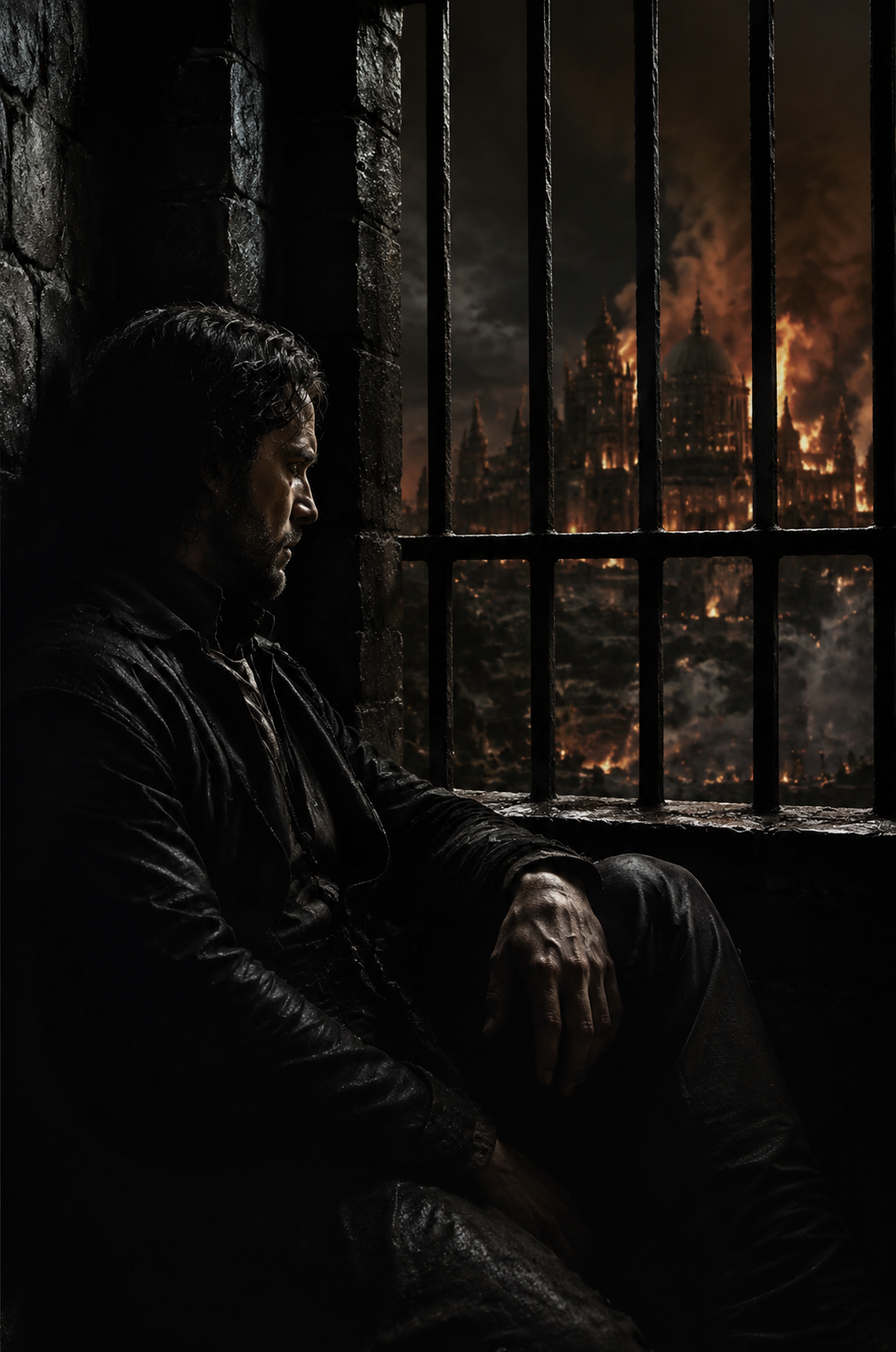
From the point guard's current pace: thirty-five seconds to the alley mouth below him. After the bridge the road narrowed, collapsing the flankers' lateral sightline to a window he could work inside. The secondary stable off Torren Street had been unoccupied for six consecutive days — the drayman had a legitimate illness Aldric hadn't caused and had documented once he identified it.
Eighteen minutes at this pace to the secondary facility.
He checked equipment by feel. Rope, forty feet, anchored to the chimney stack with a figure-eight release. Knife at his right hip, plain and unregistered. Two cord lengths. A cloth hood. The wagon's rear gate was a Derrick-Senne sliding iron bar — model confirmed from the manifest, release practiced seventeen times on a duplicate he'd commissioned from a locksmith who thought he was testing security improvements. Four more repetitions than he usually needed. The margin here required better than his usual tolerance.
He'd spent three weeks in the city before committing to this approach. Three weeks of small acquisitions: the manifest, the route, the timing, the stable. Each had cost something — time, favors, exposure risk. A year ago he'd have had all of it inside three days. A year ago the Crown's Champion required something done and the institutional systems moved to do it, and his own skill was engaged only when the systems fell short.
The institutional weight was gone. The capability turned out to be more portable than he'd credited it. But it was slower without the systems behind it. Slower, and more expensive, and it required a patience that had not previously been his particular strength.
What he'd built instead was a network of small connections — debts, obligations, people who had cause to be careful and cause to be useful. Eleven years of court service had produced a useful inventory of exactly that kind of connection. He'd been drawing on it. The drawing was slow, because each connection was a single thread rather than a system, and single threads required care.
The Conclave had burned his records alongside the formal accusations — not exile on record, not disgrace on record, but absence on record, which was a different thing entirely. A death order assumed a living man still worth hunting. Erasure assumed the story was already finished. That the chapter reading Aldric Vane had been cut from the binding, and the book continued without a gap anyone would notice or miss.
He had views on that.
A cracked tile under his left knee groaned along an existing fault. He shifted off it without looking down.
The point guard cleared the alley mouth and turned his back.
Aldric pushed off the parapet and fell.
The rope ran through his hands at the calibrated rate. He hit the alley floor with his weight forward, bent his knees to absorb the landing before it reached the stone, and was moving before the sound of it finished. The wagon was twelve feet ahead. He covered the distance in a low jog that the cut-leather soles of his boots made nothing of on the cobblestones.
The rear corner of the wagon came level with his shoulder. He reached up with his right hand and caught the iron frame.
The wagon kept moving. He let it carry him.
His feet cleared the cobblestones by a handspan. He fitted his left thumb under the sliding bar and found the release notch by position rather than sight — the same position, the same angle, the same pressure that seventeen repetitions had turned into something close to reflex.
The fit was right. The resistance was what the duplicate had taught him to expect. The point guard was walking his pattern. The flankers hadn't changed position. The alley mouth behind him was empty.
He began.
You might also like