

Chapter 18
Chapter 18: Venn's Loyalty Test
He brought her the data node forty-seven hours after the Ceros engagement, during the post-battle systems recovery period when the flag bridge was running at reduced staff and the senior command were in repair oversight meetings she was technically supposed to be attending.
"I need a minute," Venn said. That was the phrase he used when he needed considerably more than a minute. She had learned that in the second year of working together. She had stopped arguing with the phrase.
She turned from the viewport. She had been standing in front of the stars without looking at them — not a habit she had before three weeks ago. Something the knowledge had done to her, given her mind a place to go when she needed to be not-present. She found Venn standing just inside the door, holding a data node in his right hand, with the particular tension in his grip that he used when he was uncertain about the weight of what he was carrying and had already decided what he was going to do with it.
Six years. She had known the shape of his decisions by their approach for six years now.
"Captured from the Senn's Word during boarding," he said. "The intelligence team catalogued it as low-priority — standard Fracture political files. They passed it to me for tactical relevance screening, which is protocol for anything they can't immediately classify."
"And?" she asked.
He set the node on the console between them. He didn't look away from her face. "It contains a partial copy of a classified archive. Dominion Red-Clearance. Soverlight-Auth-43."
Kael looked at the data node.
The moment had a very specific quality of stillness. She could hear the ventilation system overhead, the distant vibration of the primary drive, the soft chime of a status update from the engineering board that neither of them moved to check.
"I read it," he said. His voice was level. The control it took to keep that voice level told her something about what reading it had cost him. "I know I should have flagged it and sent it to full intelligence processing. But I read it first. I don't usually read before I escalate. This one I read."
She held his gaze. He was thirty-one years old, and she had watched him grow from a sharp junior officer who asked excellent questions into a man she trusted with the operational reality of what she was doing. Whatever compartment he would have put this in, it had not held.
"You've already read it," she said. Not a question.
"I've read enough to understand what it is," he said carefully. "I stopped halfway through. I thought I should talk to you before I read the rest. I thought that if you already knew about it, you'd want to know that I'd found it. And if you didn't know about it—" He stopped.
If she didn't know, he still needed to tell her. He had known she would want to know either way.
She looked at him for a long moment. The calculation moved through her quickly — not whether to trust him, she had already made that determination six years ago, but how much to tell him and in what order. Not telling him meant he held partial information, which was the most dangerous kind.
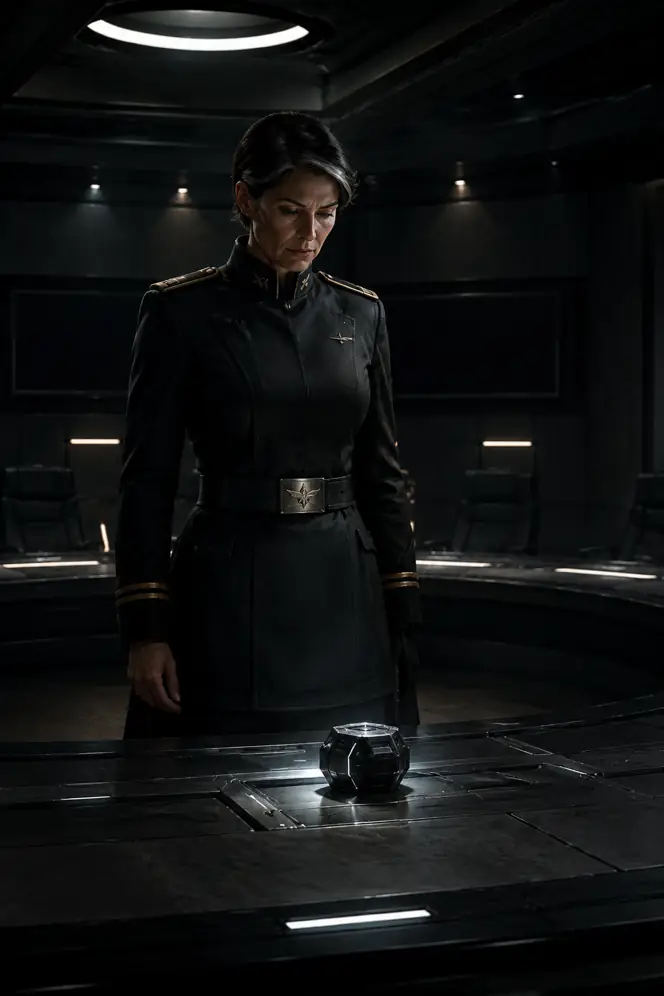
"Read the rest," she said. "And then come back."
He was gone for three hours, which meant he read carefully. She spent those hours in the post-battle prisoner processing review, signing off on manifests, approving medical clearances, working through the bureaucratic aftermath of winning a battle she had wanted not to fight. She did not think about what he was reading. She had already done her reading.
When he returned, he sat down in the secondary tactical chair without being invited, which he had never done before. He set the data node on the console. He looked at his hands.
"Six billion," he said.
"Six billion," she confirmed.
"The Consolidation." The word came out of him like something he was expelling. "We had a whole module on the Consolidation in second-year history. Admiral Ardent, the trade conflict, Dominion military superiority over less developed spacefaring cultures. The narrative of expansion as progress." He looked up. "I wrote a strategy analysis on Ardent's tactics. I got the highest mark in my year."
"All of us did something like that," Kael said.
"You've known for how long?" He was doing the arithmetic. Reading her face the way he read sensor feeds. "Before Ceros," he said. "The timing adjustment in the approach plan. You were off your standard pattern. I thought you were being conservative after high losses. But that's not what it was."
She waited.
"You knew before Ceros," he said again. "And you still executed the battle."
"I executed the orders I'd been given," she said. "The only question was how."
Venn absorbed that in silence. She watched him work through it — the sequence of what she had done, the choices she had made in the margins of the orders, the way the engagement had resolved with the Senn's Word's crew taken alive when the operational calculus had not required it.
"Is it verified?" he asked. "The original."
"I accessed the Dominion archive directly. Command authority pull from the Veradis central servers. Cross-referenced against six internal consistency metrics. It's real."
Venn nodded. His face changed — not grief exactly, but the structural change of a worldview losing a load-bearing element. "We should have known," he said finally. "The historical record has gaps. I've read enough cross-system archaeology reports to know that the early Dominion period has significant archival lacunae. I thought it was poor record-keeping. I never asked what was missing." He looked at his hands again. "We should have known this whole time."
"The archive is classified at the highest level," Kael said. "The history we were taught was internally consistent. You can't question a gap you don't know is there."
"Senn knew," Venn said.
"Senn found it by accident during a supply chain research project. And then she tried to report it and was almost arrested. There was no path inside the institution that led to the truth becoming public. The institution designed itself to prevent that." She paused. "The Fracture is the result of the institution being unreformable from inside."
Venn was quiet for a long moment. The engineering board chimed again — something routine, something that could wait. Neither of them moved.
You might also like