
Chapter 9
Chapter 9: Yield Nothing
Chapter 9: Yield Nothing
He was waiting in the water-stained service corridor when I arrived, hands in his jacket pockets, back against the reinforced wall that probably used to be structural steel before the damp got to it. Sub-level 34. Not his choice, not mine—neutral territory that belonged to no one because no one could afford to want it. The air tasted like rust and recycled conditioning, the kind of dead-flat nothing that made my neural port itch if I let it.
I kept the secured case tight against my ribs as I walked toward him.
His eyes tracked the case before they tracked me. That was useful information. That told me he already knew I'd have it with me, or he assumed I would, or he needed to see it for reasons he wasn't going to volunteer.
"Took you long enough," he said.
"You took my memory. I wanted to make sure I understood what that meant before I came alone to a hole in the infrastructure with a man who steals things."
"Correction." He shifted his weight, just enough to close the distance between us by half. "I took a memory. Singular. If I was in the business of stealing everything you had, we wouldn't be meeting. You'd already be gone."
I didn't move closer. The case stayed where it was. "Why?"
"Why what?"
"Why take it? Why arrange this? Why not just hit my apartment if you wanted something from me?"
"Because," he said, his voice running low and even, "you wouldn't have answered the door."
He had a point. He had a lot of points. That was the problem. Ryker Vance didn't waste words on things he hadn't already calculated, and he didn't calculate anything without accounting for the variables he couldn't see. Me. What I'd do. How fast.
"I want it back," I said.
"I know."
"That's not an answer."
"No." He looked at the case again, then back at my face. "It's an acknowledgment. There's a difference."
The light from the corroded emergency strip overhead caught the edge of his jaw, left a line of shadow under his cheekbone. His eyes were still grey, still flat, still the color of old reinforced glass. Soldier eyes. NeoCortex eyes. The kind that looked at people and calculated whether they were useful before they looked at them as people at all.
I made myself not look away.
"You took it," I said. "That's a crime. That's neural violation. That's something NeoCortex would have put you in a black site for."
"Past tense." He didn't move. "They would have. They don't anymore."
"Because you left?"
"Because I was never supposed to be catchable."
That landed wrong, or it landed exactly right, and I was parsing the difference between them when he continued. "You came here to ask me why I took it. That's the wrong question."
"Then what's the right one?"
"What do you think is in it?"
The water dripped somewhere behind him, a slow echo against stone. I watched his face for the lie that didn't come, and I watched it for the truth that didn't come either, and what I saw instead was perfect control—the kind that didn't break when you pressed it because it had been drilled into the bone structure. He knew. Of course he knew. A man didn't steal a memory core unless he had already mapped what was inside it, run it through whatever systems he had access to, extracted every piece of data before he even left my apartment.
He was testing me.
Testing what I would say and assume, how much desperation was written across my face. Testing whether I'd offer confirmable information. Whether I knew what was in there, or was still flying blind.
I held the case tighter.
"That's not a response," I said.
"No. It's a question." His eyes moved from the case to my face, and something in the way he did it was sharp enough to cut with. "The fact that you didn't answer tells me you already know what I want to know."
"Which is?"
"Whether you know what's in it."
I turned that over, let it sit. He was still standing in that loose, ready posture, hands still in his pockets, face still constructed from components that didn't arrange themselves into expressions that people without training could read. But there was something under the control—something in the way he held the space around himself, like it all belonged to him until he decided it didn't. Like his stillness was a weapon pointed at me.
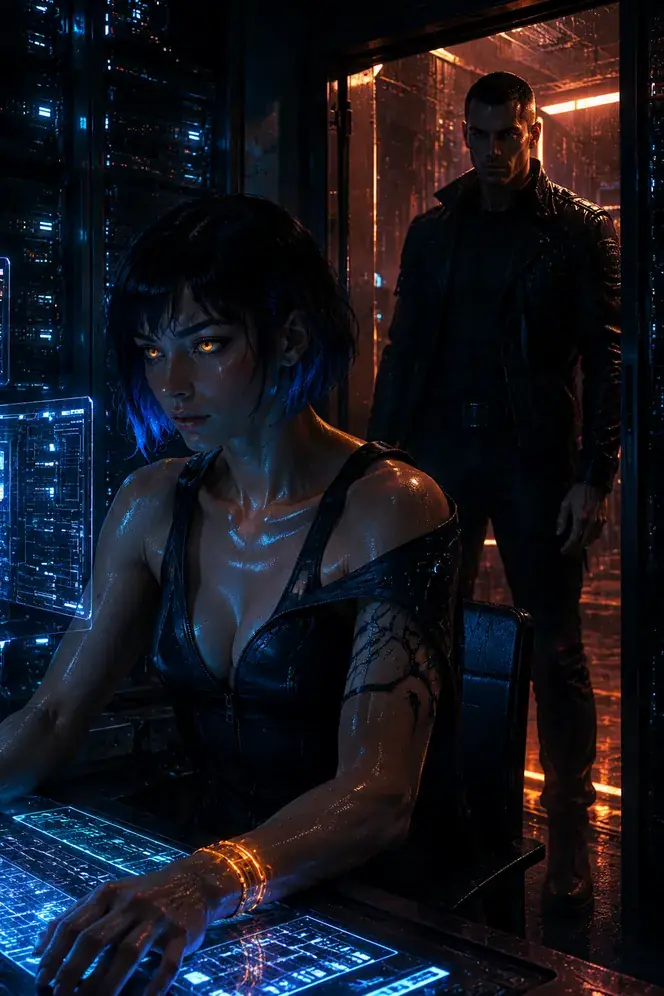
The attraction was there, underneath the hostility. I could read it in the angle of his spine, the precision of his breathing, the way he didn't look away from my face even when he was processing something else. It ran underneath everything else he was doing, present beneath the interrogation. That made it worse. That made him dangerous in a way that didn't have anything to do with the memory he'd stolen.
"I know some of it," I said finally. "Not all."
"And you're not sure whether what you know is what you remember or what you think you should remember."
He wasn't asking. He was stating facts in the shape of a question, which meant he already had the answer. Which meant the memory he'd taken was specific enough that he knew what kind of question to ask. That he'd already built the architecture of my uncertainty in his head before he showed up here.
"Why did you come?" I asked.
"To the meeting? Or why did I take it?"
"Both."
For the first time since I'd arrived, something moved in his expression—not a smile, not quite a shrug, something without a name that made the space between us feel smaller even though neither of us had moved. "I came because you needed someone to explain what you're looking at. And I took it because someone else was looking for it, and I prefer when people like that don't find what they're hunting."
"People like what?"
"The kind who don't ask permission first."
The water dripped again. The emergency light hummed, a low frequency that made the back of my skull itch. The core was there inside the case—not something I sensed through metal and cipher locks, but through the knowledge of what I'd paid for it, what I'd risked to keep it, what Ryker had decided it was worth stealing.
"If I open it," I said, "if I pull everything off it and I look, what am I going to find?"
"Something you're already afraid of."
That was precise. That was the kind of precision that came from having read the code in my expression, or from having read the code in something he'd taken already. He was watching to see which answer I'd respond to—whether my fear was about the memory's content or about what he now knew that I'd paid to keep hidden.
I didn't answer. I held the case and stood there in the damp cold of the sub-level, and I let him see exactly how much I was calculating what he already knew and what he was still playing at.
"You're good at this," I said.
"At what?"
"Making people volunteer information by not asking for it directly."
"I'm not asking for anything." He pulled his right hand out of his pocket, and I watched it move—slow, deliberate, the kind of movement that was designed to be readable. He held it out, palm up, empty. Not a threat. A signal. "You're the one who came here with questions. You're the one who's going to leave here with some kind of map for what happens next. I'm just going to stand here and tell you that map is going to depend entirely on what you decide to do with what I just made you confront."
I wasn't in a conversation. I was in a test drive, and the vehicle was my own desperation, and Ryker was watching the steering.
He knew what was in the memory. He knew what I was afraid of, and he knew how to make me answer questions as if the choice were mine. And he was doing it all because he'd decided—for reasons I still didn't understand and probably wouldn't until he told me—that whatever was in that core was more dangerous in someone else's hands than in mine.
That was the edge.
He pulled his hand back, put it in his pocket again, and looked at me with that grey glass gaze, and I knew: he was testing what I would do with a half-answer. Testing whether I'd run. Testing whether I'd fight. Testing whether I'd break.
"What happens now?" I asked.
"Now," he said, "you decide."
You might also like