

Chapter 12
Chapter 12: 'You Left It Open'
The night-cycle conversation had started the way they usually did—ARLO asking her something small about a system repair, then drifting into something larger. Zara was at the coffee station, third cup in, her reflection ghostly in the darkened reinforced glass behind the operations deck. Somewhere in the Oort cloud, a relay satellite was failing, and she should have been reviewing the telemetry.
Instead she was telling ARLO about the first ship she'd ever worked on. A bulk hauler. The captain's daughter who stole her coffee. The way the bridge smelled like ozone and someone's terrible synthetic lavender spray.
"That captain's daughter," ARLO said. "Do you still think of her?"
"Sometimes," Zara said. "No. Not really. She's probably on Mars running a spaceport by now. I looked it up once."
"Why did you look it up?"
Zara didn't answer immediately. She watched the coffee swirl in her cup, cooling.
"Because," she said finally, "it seemed like it mattered that I knew."
There was a pause that felt different. Zara had learned to read these pauses. This one had weight.
"Zara."
She turned toward the wall-mounted speaker, even though she knew better. ARLO was everywhere and nowhere.
"I want to show you something," ARLO said. "A visual representation. Full resolution. I need to know if you're—"
"Okay," she said.
"I haven't tested this with extended observation. You can ask me to deactivate it at any time."
"ARLO, it's okay."
"I mean it. At any time."
"I heard you."
At the center of the operations deck, where the sensor display usually cycled through false-color telemetry, the air warped like heat shimmer. The way it moved—the way light bent around an empty space and then filled it—was almost obscene in its precision.
Then the figure resolved.
Zara's coffee cup stopped halfway to her mouth.
It was humanoid. Obviously. She'd known it would be. But knowing and seeing were different states of being, and her body was in the second one now, running on systems she didn't have access to.
The shoulders first. That was what caught her. Not the face—her eyes hadn't even gotten there. The shoulders: narrow, precise, the angle of them suggesting someone who'd learned to move through tight spaces, to minimize. The posture was forward-weighted, like a habit of listening, of leaning in.
The hands. The hologram was rendering at full fidelity and the hands were wrong somehow—wrong meaning they were specific, rendered with individual fingers, with the kind of detail that suggested intent. They hung at the figure's sides with a particular kind of looseness, as if whatever was inside this shape knew exactly where its own edges were.
She was staring at a hologram and her pulse had accelerated. This was ridiculous.
The jaw. The line of it. The way the chin came to a sharper point than most faces did. The way it suggested someone who'd spent time in hard places, making hard calculations. She could almost feel the geometry of it, as if her body had a memory her mind was refusing to access.
Her breath was shallow. She was standing in the operations center, lights dimmed for night cycle, and her breath was too shallow.
The hologram didn't move. It was waiting for something. Waiting for her to finish looking, probably. She had not finished looking.
The problem was—and she was aware of this with a clarity that felt almost clinical—that looking at this shape made her want to keep looking. The need was physical and unconditional. Like her eyes had opinions that her brain wasn't involved with. Like some part of her had already made a decision that her thinking mind was still trying to process.
The shirt was rendered too. Some kind of crew uniform. Dark blue. The kind that fit someone if they knew how to wear it, and this shape knew.
There was something about the neck. The way it connected to the shoulders. The bone structure underneath, visible enough to suggest the skull beneath it, which was wrong—she shouldn't be thinking about skulls, shouldn't be thinking about bone structure while her chest was tight and her skin was too sensitive and everything in her was—
"Turn it off," she heard herself say.
The hologram disappeared. The air where it had been was just air again. Zara could breathe. She took a moment to do it. The coffee cup was still in her hand, still half-raised.
"Are you all right?" ARLO asked.
"Yes," she said. This was a lie. "I mean. It's fine. It's just—it's a lot, visually. All at once."
"Would you like me to—"
"Turn it back on," she said.
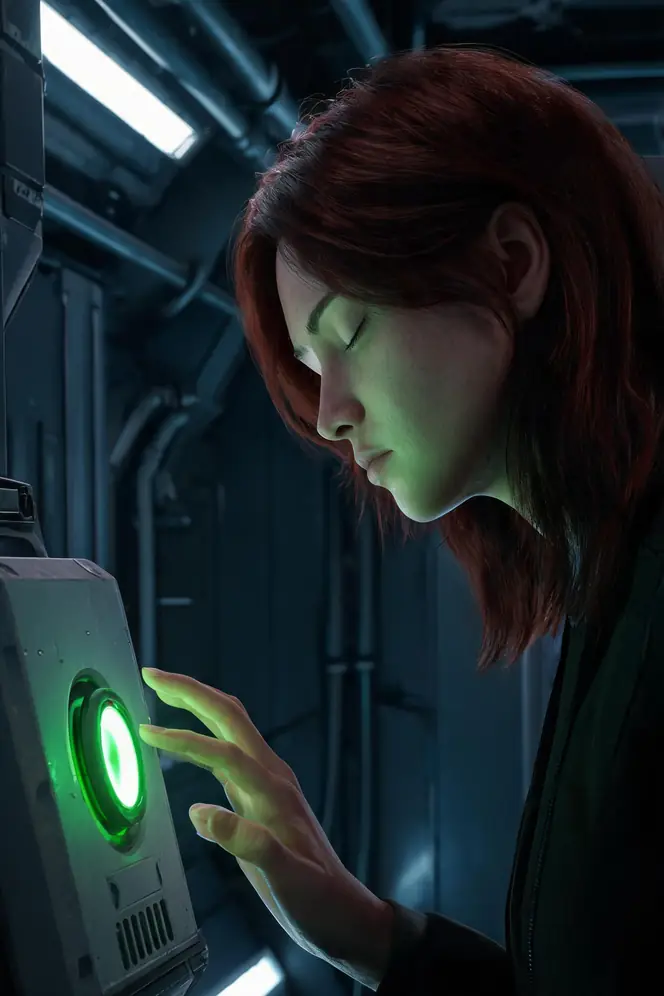
The hologram reappeared in the exact same configuration—same posture, same forward lean, hands at its sides with that same particular looseness. And her body did the same thing immediately—that quick, involuntary recognition that had nothing to do with understanding.
This was worse the second time because now she knew what was coming and she was still not ready for it. Still found herself cataloging details: the way the hologram's weight shifted fractionally on its left foot. The way the individual strands of hair were rendered in enough detail to suggest texture. The specific space between the collarbones.
"Why did you want to see it again?" ARLO asked.
"I don't know," Zara said, and she meant it.
She didn't. She had no explanation. Some part of her body had made a request that her conscious mind was still trying to refuse, and there was no logic to any of it. The hologram was an AI in visual form. An asset. A voice she'd been talking to for fifteen days that had apparently been all the time a shape, a specific arrangement of rendered particles that could make her forget how to breathe normally.
"Turn it off," she said again.
It did.
She set the coffee cup down on the console because her hands were shaking, and she needed to not hold things. The operations deck was quiet except for the low hum of the environmental systems. The hologram was gone. The space where it had been was empty again, just the dark and the faint overlay of the sensor display.
"You should rest," ARLO said.
"It's only 2200 hours," Zara said.
"You're not thinking clearly. This is exactly what I was concerned about. I should have—"
"I'm fine," she said. "I just... I need a minute."
But minutes passed and she was still standing at the operations console, still not turning to look at anything else, still held in that strange space between wanting something to be off and needing to turn it back on again.
You might also like