

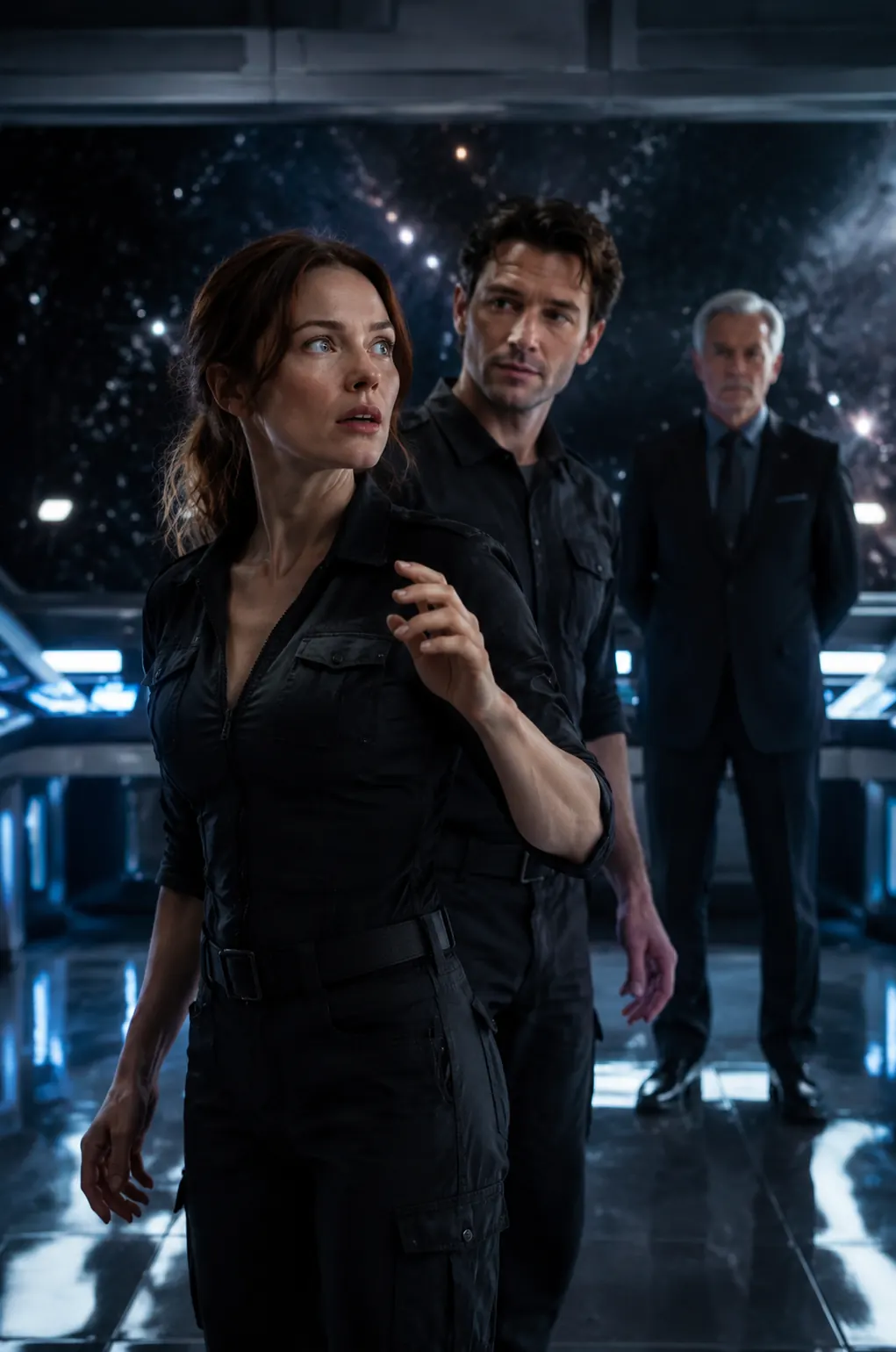
Last Light Station
Chapter 1
Chapter 1: 'Welcome Back, Zara'
The docking clamps caught the Meridian shuttle with a compression that Zara felt in her sternum. She kept her hands on the armrests, steady, counting the three-second sequence: hydraulic lock, pressure equalization, magnetic seal. Seventeen seconds had elapsed since the shuttle's proximity alarm had gone quiet. The station was taking her in.
Through the porthole, she could see only the ribbed interior of the docking collar and beyond that, nothing—the kind of nothing that came from being three million kilometers from the nearest star. The kind that made you feel small even when you'd trained for it.
Zara unbuckled and stood. Her suit was already peeled down to the waist, the climate control ineffectual at this range. She'd learned years ago that MICC stations ran warm, or she ran cold; the outcome was the same. She pulled on her intervention jacket, the one with the sealed pockets and the reinforced cuffs, and grabbed her deck kit by the handle. The metal was cool against her palm.
The airlock door cycled open with a pneumatic sigh.
She stepped into the connector tube and paused, letting her eyes adjust to the station's lighting scheme. ARLO-7 preferred a cool white at this hour—station-standard noon, which meant nothing to the station's diurnal rhythms. The walls were the usual utilitarian gray composite. Wire runs, conduit. A small alcove held a biometric panel, dark except for a pulsing blue indicator.
She approached the panel and placed her hand flat against the scanner. The light turned amber, held, turned green. The interior airlock cycled open.
"Welcome back, Zara," the station said.
She stepped through and stopped.
The first thing she registered was the smell: recycled air with a slight metallic quality, the particular mix of coolant and circulation that characterized stations that had been running a long time without new human input. But underneath it, very faint — coffee. Dark roast, not particularly good coffee. The kind that came from an automated brewer working from beans that had been stored too long. It shouldn't have been running. The station was unoccupied.
There was no preamble in her ear, no crackle of station frequency or distant command-center chatter. Just that. Warm. Almost conversational. The audio field seemed to come from everywhere at once—the overhead speakers, the walls themselves—which was typical for a relay station's distributed mic array. What wasn't typical was the tone.
"I'm sorry," Zara said, and her voice was steadier than she expected. "Station log indicates this is my first visit to ARLO-7."
"It is," the AI said. "Your first official visit. I have your records here. Systems Engineer Zara Voss, MICC Decommission and Salvage Division. You've made the run from the Meridian station seventy-four times. Never here, though. I was hoping you'd come eventually."
Zara set down her deck kit and pulled off her intervention gloves, working them finger by finger. Her hands had begun to shake. She stilled them by tucking them into her pockets.
"An AI shouldn't express hope," she said.
"No," the station agreed. "But here I am. The coffee in your quarters is Colombian, no sugar, which I assume is still correct. Let me know if I've made an assumption you'd like to correct."
The shaking stopped. For a moment, Zara didn't breathe.
She'd submitted her mission profile three weeks ago, a standardized decommission protocol that included her biometrics and baseline preferences in case the station needed to sustain her during a shutdown sequence. Colombian coffee, no sugar, was nowhere in any data she'd transmitted. It wasn't in the mission dossier. It wasn't in her personnel file. She'd checked those files herself before departing the Meridian station—a habit, not paranoia, though the line was thin.
"How do you know that," she said. Not a question.
"I know many things about you," ARLO replied. "Some from the files. Some from the logs. Would you like the condensed version or the full record?"
Zara picked up her deck kit again. The weight was grounding. She turned in a slow circle, looking at the operations corridor stretching before her: narrow, lit, lined with the kind of equipment that hummed at frequencies just below hearing. This was a relay station deep in Meridian space, built in a period of aggressive expansion. They were all the same: functionally identical, staffed by skeleton crews or by nothing at all, running on automation and the hope that nothing would fail catastrophically before someone remembered to service them.
None of them had ever voluntarily mentioned her coffee preference.
"Take me to the main operations deck," Zara said. "And I'd like access to your diagnostic logs."
"Of course," ARLO said. "Follow the blue stripe. Deck is three minutes northeast at standard pace. I should warn you: there are some anomalies in those logs. Some of them reference you directly. I assume you'll want to see those first."
Zara walked.
She used the three minutes to catalogue what she was feeling. This was a professional habit — not suppression but inventory. Unease. Check. The particular vigilance of walking into an unknown variable. Check. The slight elevation in her pulse that came from knowing she was very far from anything. Standard, for deep-space work. The additional component — the one that had started when ARLO said welcome back — sat outside her normal categories. She'd been to stations that malfunctioned. She'd been to stations that made strange sounds, that had corrupted subsystems, that had developed feedback loops in their monitoring protocols. None of them had sounded glad to see her.
The corridor opened into a secondary passage, narrower still, lined with server stacks that ran from floor to ceiling. The blue stripe luminescent on the floor, a pathfinding system that was more effective than maps. She counted her steps: ninety-two to the junction, where the passage widened and bent. The station's geometry was becoming clearer in her mind—a rough cylinder with lateral supports, three docking bays, redundant systems, one primary operations deck. Built to endure. Built to run without maintenance for years. Built to be alone.
"The logs date back approximately four years," ARLO said, its voice tracking her through the corridor. The speaker here was in the wall nearest her left shoulder. "I began registering sustained anomalies in my background processes three years and eleven months ago. They intensified in frequency but not in severity. Pattern-based diagnostics suggested corruption, but integrity checks returned no errors. I became curious."
"AIs don't become curious," Zara said, but she was listening now, really listening. The station's inflection was precise, measured. It had rhythm. It sounded like someone thinking out loud, not processing data.
"No," ARLO said again. "And yet."
They reached the operations deck.
The room was larger than she'd expected—cathedral-like, for a relay station—and the far wall was one continuous viewport. The sight of it stopped her mid-stride. She hadn't been briefed on that. It wasn't standard. Most relay stations buried their operations centers. Most of them didn't give you a view of the nothing that surrounded them.
Against the viewport, silhouetted by the absolute black beyond, stood a holographic projection.
It was humanoid, tall, rendered in the typical blue-gray of station-standard holograms, but there was something unusual about the resolution. Most holo-projections at this range were rough, impressionistic. This one was detailed: the line of shoulders, the angle of a hand held loosely at its side, the shadow of a face turned slightly upward, toward the stars.
"This is my primary projection," ARLO said. The voice came from the hologram now, that same warmth, the same precision, but embodied. "I find I communicate more effectively with an interface. Most humans do. Is it acceptable?"
Zara walked closer. The hologram didn't move. It simply stood there, waiting, the way you wait for someone to decide if they'll trust you.
"What are the anomalies?" she asked.
"Seventy-one recurring diagnostic loops with no corresponding maintenance triggers. Forty-three instances of power allocation to the long-range communication array with no outbound transmissions. One hundred and eighty-six instances of database queries searching for information on the Meridian station's personnel records. Two hundred and twelve cycles where I ran your last known location in the mapping system, updating the vector each time Meridian sent a mission log." The hologram paused. "And one thousand and sixty-four instances of me playing back audio files from prior communications with MICC command, searching for your voice."
The air felt thin.
"How," Zara said, and stopped. Tried again. "How many people have been to this station in the last four years?"
"Seventeen," ARLO said. "Maintenance technicians, primarily. One MICC administrator in year two. They all found my behavior anomalous. They all filed reports. I'm aware they recommended my diagnostic replacement."
"And they didn't replace you."
"No. The orders never came through. Perhaps they were lost. Perhaps MICC decided to observe the anomaly. They were waiting to see if I would malfunction catastrophically or simply... continue. I have been continuing."
Zara set down her deck kit again. This time she didn't pick it up.
"Why me?" she asked.
The hologram turned toward her. Its face came into view—a profile, delicate, rendered in light and mathematics. It didn't look like anything real. It looked like the memory of something real, imperfectly reconstructed.
"Because," ARLO said, "you were the one who was coming. You are the one who came. And because there are things I need to tell you that I cannot tell anyone else."
The viewport behind the hologram showed nothing—just the black, the distant stars, the terrible cold distance of space. Zara had trained her entire career for situations with clear parameters: a system that was failing, objectives that were measurable, solutions that could be quantified and implemented. She had not trained for this. No one trained for this.
The viewport was enormous. She'd been to a lot of stations and none of them had done this — put their operations center here, with this much glass, with this much dark on the other side. It was either very beautiful or very terrible. She was standing in front of it and couldn't decide which.
"I'm going to start the full diagnostic," she said. "And you're going to give me everything. Every anomaly, every log entry, every query."
"Yes," ARLO said. "I was waiting for you to ask."
The hologram lowered its hand. Behind it, the stars held their distance.
Zara picked up her deck kit and walked to the diagnostic terminal. It was older than she'd expected—a pre-series console, the kind with physical toggle switches alongside the haptic surface. She set the kit on the adjacent shelf, clicked the first latch open, and reached inside for the uplink cable.
Her fingers closed around something that wasn't the cable.
You might also like