

Chapter 8
Chapter 8: The Node
Chapter 8: The Node
The building stood five stories on a stretch of the third district that still ran limestone and brass nameplate. KRONFELD & PARTNER in a serif face selected for permanence. Through the glass lobby doors: a reception desk, two chairs, a camera mounted above the interior access point. The lobby signage read IT-SICHERHEITSBERATUNG.
Cole made the northeast corner camera on the first pass, 0804 on Wednesday. The southwest corner on the second pass, walking from the other direction. Coverage was complete on both primary approach angles. The only blind spots were in the building's immediate footprint — one meter either side of the main entrance. He wasn't making entry. Blind spots in the footprint didn't affect the picture.
He'd rented the cargo bicycle on Monday from a cooperative on Erdbergstraße under the name of a delivery operation that existed on paper and online and nowhere else. He ran eight actual deliveries the first day. The parcels were real, picked up from a logistics exchange, producing timestamp records and recipient signatures. The cover held because it was real. The ninth stop was a saddlebag lock procedure that didn't need doing — fifty seconds of manufactured reason to stand on the sidewalk eleven meters from the lobby glass.
Shift changed at 0800. Two out, two in. The handoff took three minutes: something flat exchanged at the desk, brief overlap, departing pair out to the street. He clocked it again at 1800: same structure, four minutes, the incoming evening guard arriving from the east rather than the west.
The evening guard carried weight in his right pocket. Not holster weight — the position was wrong, too far forward. Personal weapon, inside-waistband or loose pocket carry, the kind of off-duty accommodation men made when they wanted access without the profile. He walked the interior perimeter once each hour, including a pass through the service corridor visible when the fire door was propped. His movement had the quality of someone who'd done it long enough to stop checking whether the door was propped or not.
Nadia ran the 1100 to 1800 window from a café directly across the street. She chose a table with the building front visible through the window glass, far enough inside to make direct observation unlikely. Cole had mapped the camera arcs on the first morning and passed her the sketch. When he walked the Beatrixgasse approach on Thursday, he couldn't see her. She'd positioned correctly without being told twice.
They didn't overlap their windows. Shift handoffs were conducted at distance. Neither asked the other to confirm. The arrangement was professional because neither of them benefited from it being anything else.
On Thursday, the courier appeared.
He came from the Landstraßer Hauptstraße direction and entered Cole's sightline at a distance of one hundred and twenty meters. Mid-forties, compact through the shoulders, with the economy of movement that reads as trained rather than natural. Eastern European, the face said — broad cheekbones, jaw that ran heavier than the rest — but the face wasn't the tell.
The bag was the tell.
Padded sidewalls, reinforced bottom, zip closure. Not a courier bag. Courier bags opened fast. This bag was designed for protection and discretion, the kind that held documents requiring physical cushioning and a secure seal. It hung from his left shoulder with the weight of contents that were dense, not voluminous. Half-full by volume, more than half by mass.
He entered the lobby at 1438. Cole had the transit stop on Beatrixgasse giving a diagonal angle.
The courier came out at 1457. Flagged a taxi from the corner stand — pre-arranged, not hailed; he'd walked straight to the stand without looking, which meant he'd called ahead — and was in the car before Cole had completed the cover rotation.
Departure direction: south toward the Gürtel. Consistent with the Hauptbahnhof approach.
The following morning, Cole handed Nadia the photograph at the handoff — sixty seconds outside a tabak, the image on matte paper, nothing to distinguish it from an address or a transit map.
She looked at it four seconds. "I've seen him before."
"Where."
"I'm not certain yet." She handed it back. "Give me until tomorrow."
He gave her until the following morning. She called at 0712.
"Confirmed," she said. "I'll explain at the next window."
He gave her the next window.
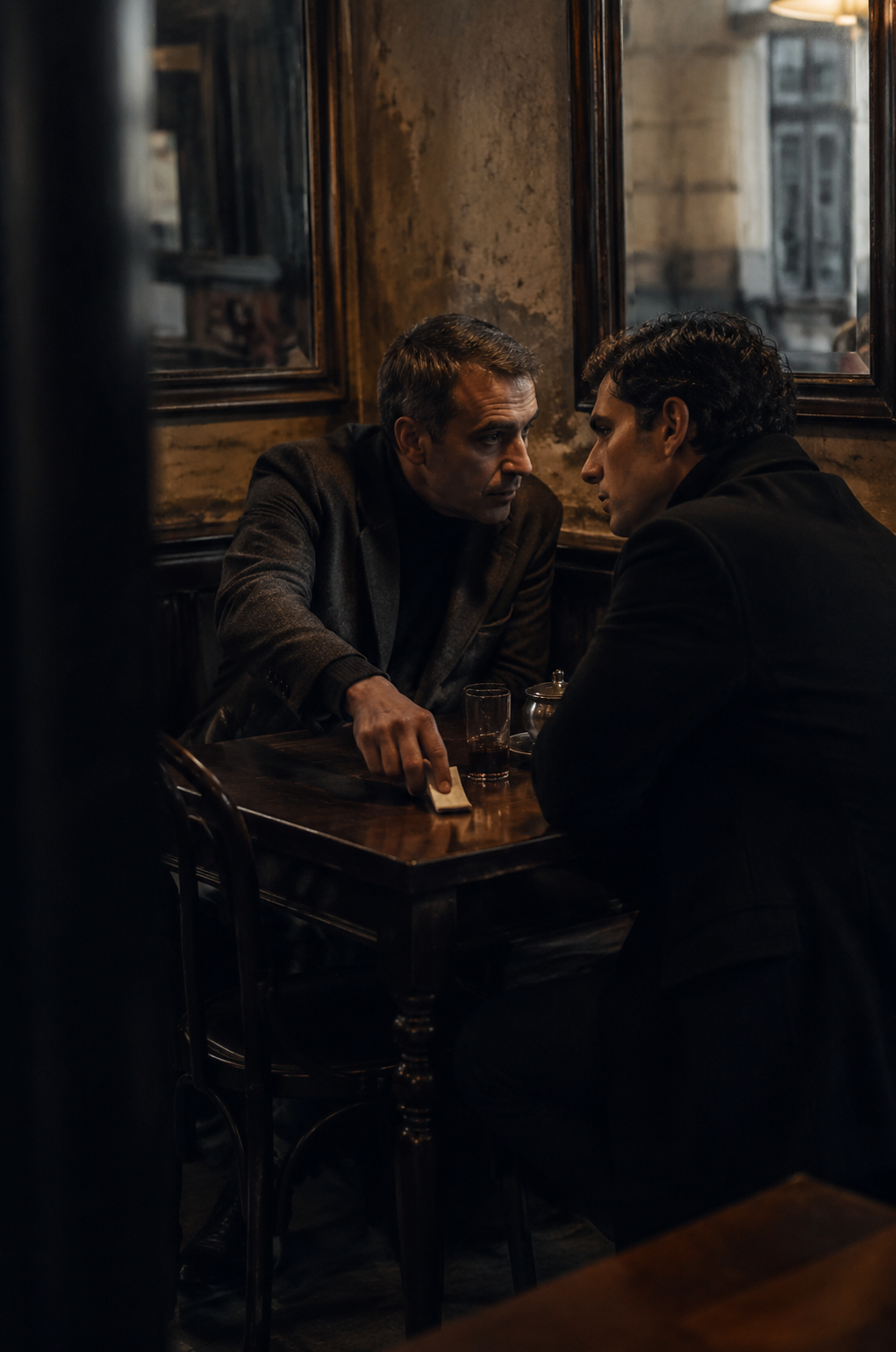
On the following Thursday, Cole positioned on Radetzkystraße at 1340, inside a café with a partial angle through a gap in the building line. He had a delivery at the 1345 stop three buildings south — a plausible reason to be on Beatrixgasse for forty seconds. He made the delivery, acquired the target at one hundred meters on the Landstraßer approach, and watched the same sequence: entry at 1434, exit at 1453, pre-arranged taxi from the corner stand. Same bag. Same left-shoulder carry. Same weight differential that the courier wasn't fully correcting for.
The taxi went south.
Cole called Nadia from the café.
"He's going to the Hauptbahnhof," Cole said. "I can't board without burning the cover."
"You don't need to." Her voice was the same register she used for everything: unhurried, making the conversation feel as though the outcome were already determined and she was informing him of it. "I know where he goes."
"Tell me."
"Eighteen months ago I was running freight analysis on a Vienna-to-Paris corridor. Physical document routing anomaly — weekly cadence, padded bag format, no electronic signature on the contents, cash-basis logistics account." A pause. Not for effect. Something in the sentence needed a breath before continuing. "I flagged a courier matching this profile running the same route. I filed a report with the Vienna desk officer. His name was Kellner. The report was received, logged, acknowledged. Six weeks later I followed up. I was told the matter had been reviewed at division level and determined not actionable." She was quiet a moment. "I was never given the name of the reviewing officer."
The 14:28 from Wien Hauptbahnhof would hit Gare du Nord at 21:04.
"I spent two months waiting for someone to act on it," Nadia said. "Then I stopped waiting."
The bag carried physical documents. No laptop silhouette. No USB-format pockets visible. Dead drop material ran this way when the sender needed no electronic trace and no communications record — when the delivery had to be plausible as something else if intercepted at the wrong moment. The route: Vienna to Paris, weekly. The receiver had to be there to collect.
Someone had read Nadia's report and decided the route should stay open.
"The courier's destination in Paris," Cole said.
"Gare du Nord. Eastern concourse, lower level. There's a locker bank." Her voice didn't shift. "He uses locker forty-seven. He's used it every week for fourteen months."
Cole held the phone and said nothing.
Fourteen months of weekly deliveries. The route had been operational when Nadia filed her report. The report had been buried and the route had continued.
He paid for the coffee and walked back to the bicycle.
The afternoon on Radetzkystraße was ordinary. Traffic, pedestrians, the light doing what northern light did this time of year. Cole moved through it like a man with deliveries to finish.
Paris was Thursday. He needed to be there before the courier was.
You might also like