

Chapter 15
Chapter 15: Geneva Picture
Chapter 15: Geneva Picture
Cole had arrived in Geneva four days ago with three names and two phone numbers written in the inside back cover of a secondhand German grammar text he'd bought at a bookshop near the Gare de Lyon before he left Paris.
The names were approach vectors. Two he'd developed from the Gare du Nord documents — financial contacts in the Geneva banking layer, individuals who appeared in the document trail at enough distance to be reachable without walking into whatever Senn had set up to catch him. The third had come from Nadia.
Before she went dark, Nadia had embedded one additional piece in their last working protocol. A name, and a contact procedure: three frequencies, a time window, a challenge phrase that only worked once. No explanation of who or what. That was her discipline. He understood it. The contact procedure had been her last move, given without obligation, and he'd used it the second night in Geneva from a position in the Plainpalais in the rain, collar up, transmission time forty seconds. The response came back twenty-six hours later through a Swiss number that routed to a street-level receiver and then terminated. One message: a building address on a narrow street south of the Rue de Carouge, and a time window.
He ran the full box on the morning of the meeting. Forty minutes, two loops, two pace variations, two position holds at separate ends of the block. The street ran to a close at the south end. Anyone stationary in the lower half had a reason to be there. No one was.
The stairwell smelled of old paper and radiator heat. Third floor. The door was open a half-inch.
Bauer was in her mid-sixties, compact, with the kind of face that recorded things without showing that it was recording them. The office corresponded to her exactly: floor-to-ceiling files on two walls in a system that appeared cluttered and probably wasn't, a desk supporting three different generations of computer equipment, a thermal carafe, a window facing the interior courtyard. No window on the street side. Three exits Cole could identify. He registered the fourth before he sat.
"You used the Vienna contact's introduction protocol," Bauer said.
"Yes."
"She trusted you."
"She made a calculation." He kept his hands loose on his knees. "They're not the same thing."
Bauer absorbed this without comment. She looked at Cole for a moment with the evaluative quality of a person who had spent thirty years in rooms exactly like this one, determining how much information a situation warranted, and had usually gotten the determination right.
"I have been building a case for eighteen months," she said. "Private client — a family office with reason to believe their assets were being used as infrastructure in a banking structure without the principal's knowledge. The client is no longer my client. The engagement was terminated three months ago." She didn't elaborate on the termination. "I have continued at my own expense."
"What did you find."
"I'll show you what I found. Then you show me what you have."
Cole took the documents from his inside jacket pocket and set them on the desk. Photographs, not originals, printed on standard stock in a Geneva copy shop two days ago. The Gare du Nord dead drop trail. The London financial thread, summarized on two sheets he'd written out by hand. Bauer looked at them without touching them for a moment, then picked up the London summary.
She read it. Set it down. Opened her own folder.
"Six months into the investigation," Bauer said, "I found this." She slid a single page across the desk. "The original is in a secure deposit facility. This is a certified copy."
Cole picked it up.
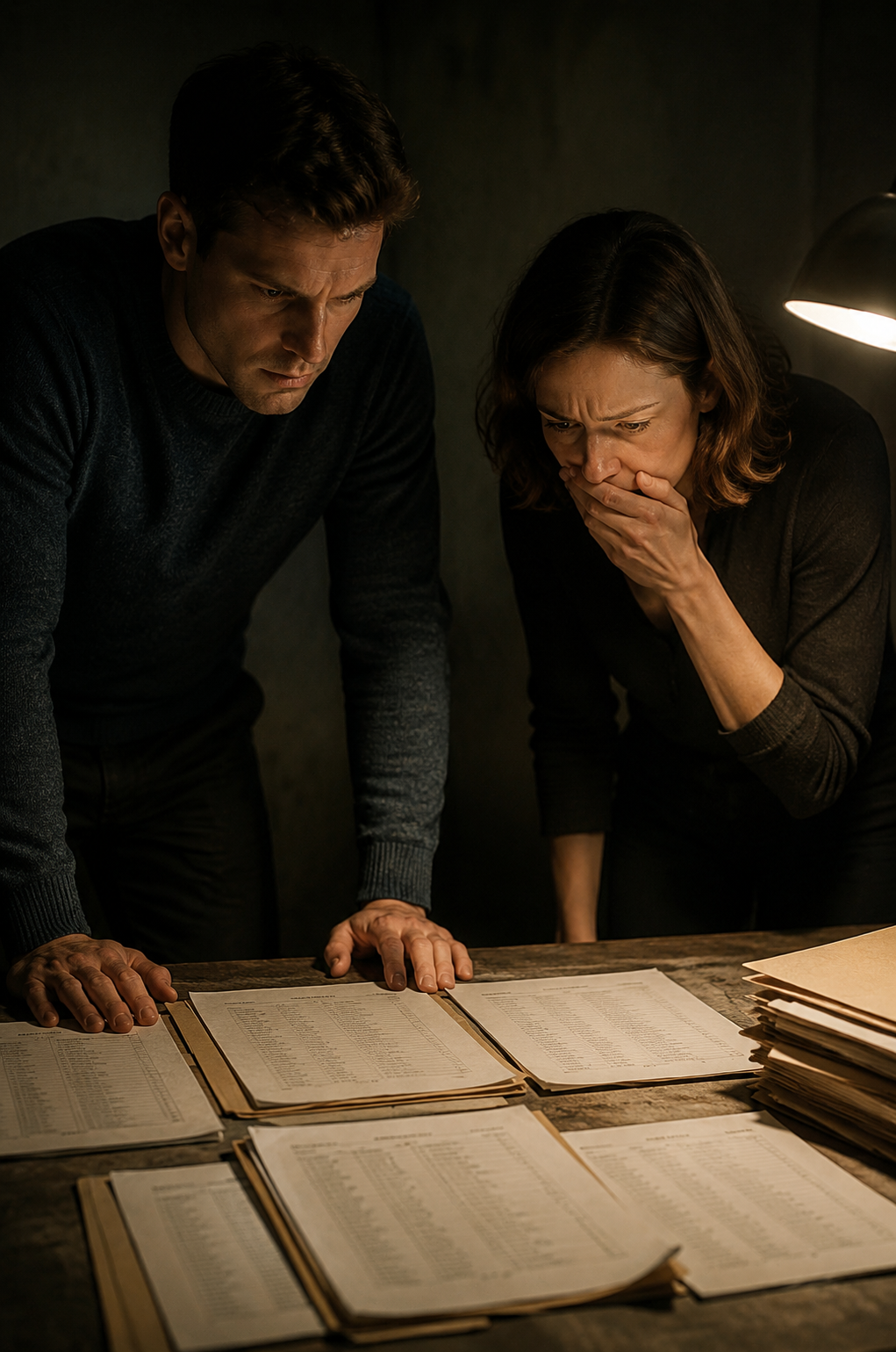
The document was a financial record — a payment table, dense columns in a precision typeface. At the top right corner, in a font different from the rest: MERIDIAN-CLOSE. Sub-program. Internal routing only.
Then the table. Eleven rows.
Each row had four fields: a date, a code formatted as a personnel designation — two letters, hyphen, four digits — a location, and a figure in euros. The figures were small. The largest was six thousand two hundred. Most ran between two and four thousand. Expense reimbursements, in structure and scale. The dates spanned four years.
Cole read the table twice.
He recognized the format of the personnel designations. He'd seen them on operational rosters, on equipment allocation records, on after-action report headers from a specific program management tier. They were not standard DoD coding. They were specific to MERIDIAN.
The locations were cities and one designator that looked like a training range code rather than a city name. European capitals, a Gulf city, two US locations.
The amounts were consistent with what a small team spent over a defined operational window — travel, materiel, contingency. Not the cost of a strike package or a tactical unit deployment. The cost of a limited-scope operation. Precision engagement, sized for a specific purpose.
Eleven rows. Eleven operations. Four years.
He read the program designation again. MERIDIAN-CLOSE. A sub-program running on a separate financial track, routed through a three-hop banking chain that connected to the Geneva layer he'd traced from Senn's Paris operation. A sub-program whose billing structure matched targeted personal operations. Not against external threats. Against participants.
He looked at the dates.
The most recent entry was eight months ago. The earliest was forty-seven months ago. The pattern of the table was not a program that had run its course. It was a program in regular operation, engagements separated by three to five months each, cost structure varying by location but consistent in type.
Moldova was not in the table. He checked every date. Moldova had happened four months ago.
He set the document on Bauer's desk.
He got up from the chair. He walked to the courtyard-side window and stood looking at the interior courtyard below — pale gravel, a bicycle chained to a drainpipe, a potted tree that hadn't been watered in some time. He stood there for ten seconds. Then he came back, sat down, and looked at Bauer.
"I need a copy of this."
Bauer had a small scanner behind her. She ran the document through without comment and handed Cole the copy. Warm from the machine.
Cole folded it once and put it in his jacket. He thanked Bauer. Bauer did not tell him to be careful. Cole left by the stairwell.
On the street below, he walked north at a pace that was not hurried. Hurry was visible and visible was exploitable. He had four blocks between him and the Rue de Carouge, where the foot traffic would absorb him. He used those blocks to run the table again in his mind.
Eleven operations. Four years. Pre-dating HARROW by thirty-seven months. The structure was not a cleanup — not a reactive measure taken in response to Moldova. It was a standing program. MERIDIAN-CLOSE had been built into the operational architecture from the beginning. The operators who had accumulated access to the program's compartmented material — authorization chains, site locations, the specific machinery of what MERIDIAN had been sanctioned to do — had been assessed as a risk category, and the risk category had its own solution mechanism, its own funding track, its own billing codes.
He did not run the moral weight. The moral weight had no output for the next twenty-four hours.
He ran the operational weight: eleven documented operations, a financial structure built to service them, a Geneva investigator who had found it from the outside in eighteen months and sent a summary to a financial regulator six months ago and received silence. The silence had a source. He didn't know what it was yet.
The folder was the asset. What he did with it was the mission.
Back at the rented room on the Rue de Candolle at 17:40, he set the copy on the table. He left it there. He made tea from a bag he'd bought three days ago and stood at the window while it cooled and watched the street below be ordinary — a family, a delivery cyclist, a man walking a dog in a direction that had no significance.
He sat down.
He'd been inside MERIDIAN long enough to have memorized approximately forty of the personnel designations — the ones that had appeared on shared rosters, equipment allocation records, debrief distribution lists. He had never been given the master key. Nobody at his level had been given the master key. But forty partial references was enough to start.
He picked up a pen.
The first designation in the table — BM-1147 — didn't correspond to any he knew. He set it aside.
The second was K-2031.
He looked at it for a moment. He knew it. It had appeared on a joint training rotation roster in 2021, listed under a name he'd read once and retained: Torres, E.J. Staff Sergeant. Iron Division, attached rotation. Cole had been present for the first four days of that exercise. He'd attended Torres's memorial in November of that year. The army had listed the cause as a training accident at a live-fire range in Colorado. There had been a flag. There had been sixty people in the room.
The MERIDIAN-CLOSE record for K-2031 listed the cause as field termination.
Cole looked at the date in the first column. October 14, 2021.
He looked at it for a moment. Then he picked up the pen and wrote a second date from memory — the date Torres's internal complaint about MERIDIAN operational parameters had been forwarded through the unit review chain. Cole had seen it tangentially, included on a distribution list he'd been added to by error. He'd registered it as administrative noise. He hadn't thought about it since.
That date was September 30, 2021.
He set the pen down. He looked at both dates without calculating, because the calculation was already finished and it didn't require a pen.
Fourteen days.
He did not pick up the pen again.
You might also like