

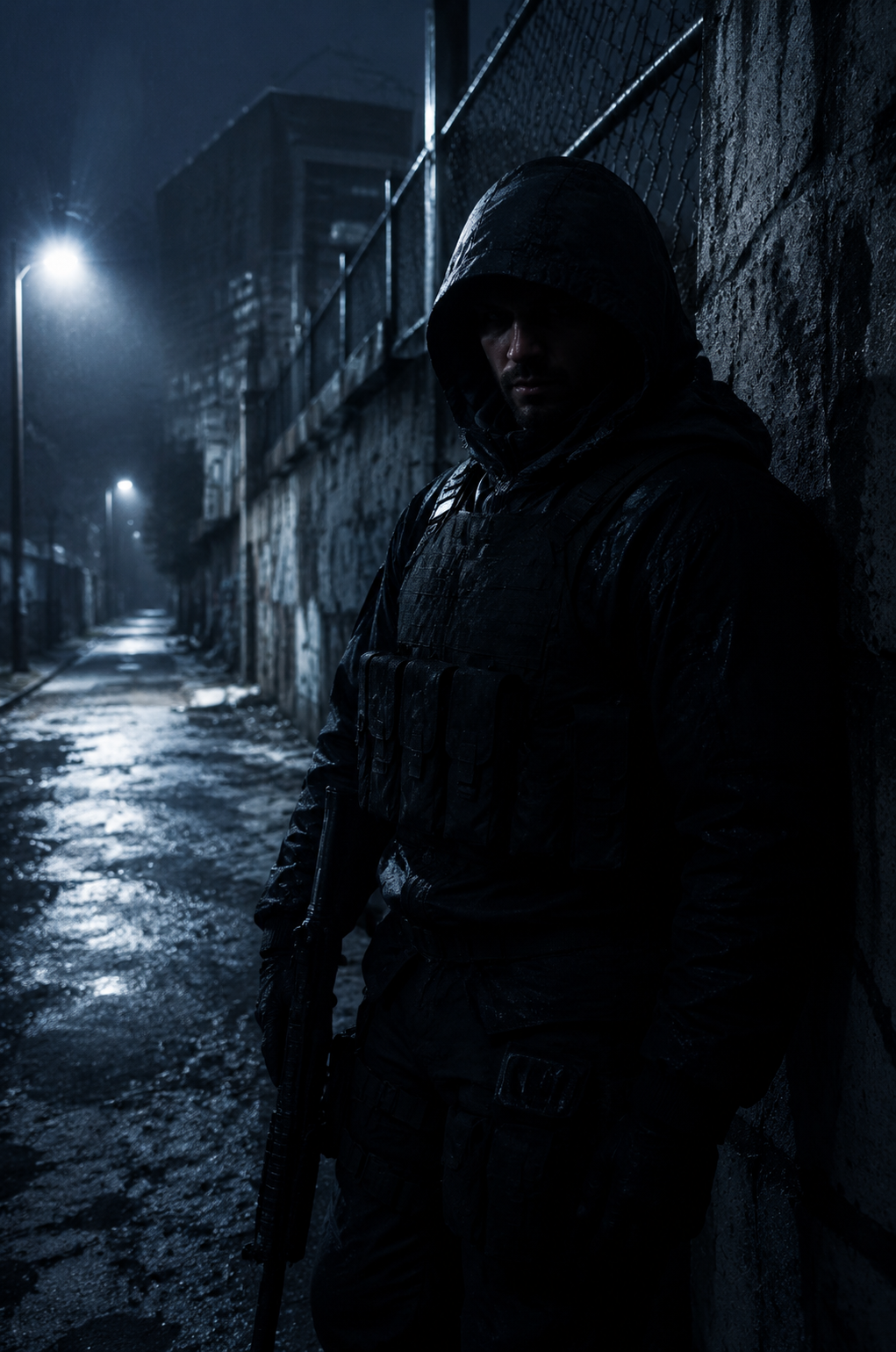
Iron Meridian
Chapter 1
Chapter 1: Three Bodies
Chapter 1: Three Bodies
The first thing that registered was the diesel.
Not the pain. Not the weight. The diesel—old, agricultural, the kind that seeped into everything in this part of Moldova and never fully left. It mixed with wet earth and something copper underneath, and Cole processed this in the half-second before he understood he was still alive.
He didn't move.
The weight above him was significant. He catalogued it: two points of distributed pressure across his chest and left shoulder, one across his legs from mid-thigh down. He read the shapes by pressure. Shoulders. A rib cage. A hip. His left hand was pinned under something he identified as a forearm.
He knew whose forearm it was. He didn't think about that.
Above the weight: sky. The color of old concrete at 0340. He had twelve seconds of consciousness before he'd gone under—he'd counted them on the way down—so it was somewhere between 0340 and 0600 now. No way to be more precise without moving, and he wasn't moving yet.
He ran the inventory first.
Neck: stiff, full range available if he went slowly. Head: impact site behind his right ear, dried. Not actively bleeding. He probed it with the inside of his awareness and found no vertigo, no narrowing of vision. He hadn't been concussed. Whatever had hit him hadn't hit him squarely.
Chest: breathing was full. Ribs were intact. He could tell because he was breathing without the catching sensation of a floating rib end. This surprised him. The pressure above him should have meant broken ribs. He'd been lucky in exactly the way the rest of the mission had not been lucky.
Shoulders: left was pinned, right was free. He flexed the fingers of his right hand inside his glove. All five responded. He located his right arm by feel—it was at his side, bent at the elbow, half under his body. He could work with that.
Hips: the weight across his legs was heavier than the chest weight. He shifted a millimeter and felt the mass adjust—dead weight, no resistance. He stopped shifting.
He did not move for another ninety seconds.
Then he heard the drone.
It was distinct from the first one—lower tone, wider arc. The first one had come in tight, a point-source pop of rotor noise that arrived eight seconds before the strike. He'd had just enough time to get behind Specialist Kowalski and pull him down. This one was making a surveillance pass, not a strike pass. The sound peaked at perhaps sixty meters above the ditch, then began to fade northeast.
Cole tracked it by ear until he couldn't hear it anymore.
Forty seconds.
He spent the forty seconds doing what he always did when the situation clarified: he reconstructed what he knew and separated it from what he'd assumed.
What he knew: four-man team. Extraction op, black-site prisoner in a farmhouse outside Orhei. Primary and secondary exfil compromised before they reached the site. The team had shifted to tertiary—overland, drainage ditch network to the agricultural road—when the first drone struck. The strike was precise. It hit the column at the center, which was where Reeves and Ortega had been moving. Cole had been rear. Wren had been point, fifteen meters ahead.
The column spacing in tertiary was fifteen meters. Reeves and Ortega were at the column's midpoint. A strike designed to stop the mission—to stop an extraction—would have targeted the prisoner, or targeted the point element to break communication. A strike at the column's center was designed to maximize team casualties. That was a different objective.
What he'd assumed, before the forty seconds: enemy action. Rogue asset tipped them. Bad intelligence on the site.
What the forty seconds showed him was wrong with that assumption: the tertiary exfil route had been generated in-country, at 2200, using a contingency code that wasn't in any pre-mission documentation. It lived on a mission tablet that hadn't left Cole's person until he shared it with Wren. Three people knew the tertiary route. Cole. Wren. And whoever Wren had transmitted it to.
An adversarial asset—a local informant, a compromised handler, someone in the regional network—would have known about the primary and secondary routes, which were pre-planned and pre-documented. They wouldn't have known about the tertiary. The tertiary had been improvised at 2200, in the field, in response to conditions on the ground. No one outside the team could have known it in time to vector a drone strike at 2214.
No one outside who had called out of the team.
Cole began extracting himself.
He did it the way he'd been trained to do everything in the field—slow, deliberate, without wasted movement. He slid his right arm free first, then used it as a brace against the earth wall of the ditch. The earth was soft from recent rain. His elbow sank in two centimeters and held. He applied pressure to the chest weight above him and shifted it eighteen degrees—enough to clear his left shoulder. The forearm slid off. He got his left arm under him.
He lay still again for thirty seconds. Listening.
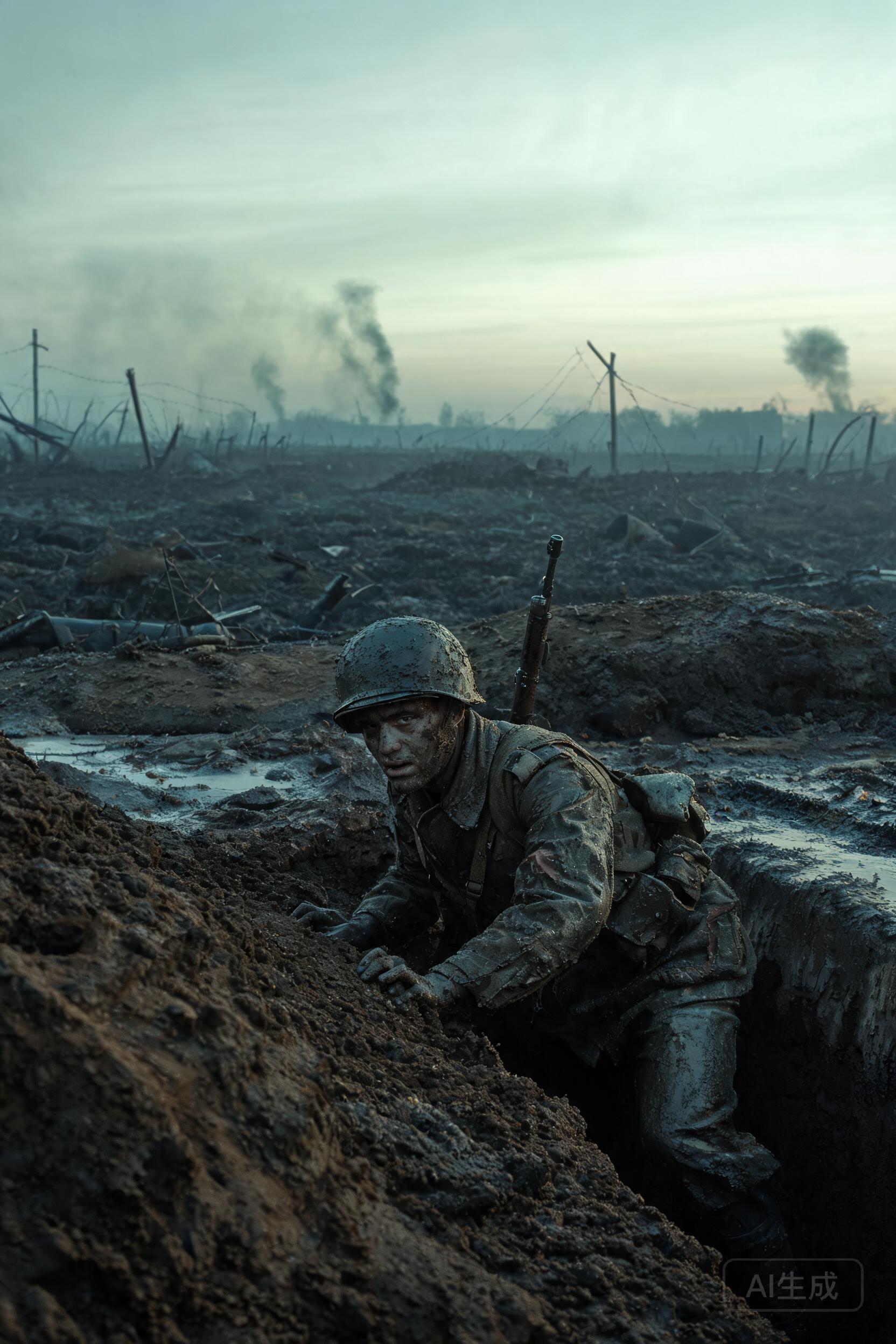
Wind from the northwest, four or five knots. Somewhere distant, a dog. Nothing rotary.
He sat up.
The bodies were what they were. He didn't look longer than necessary. Reeves still had his rifle but it was bent at the handguard from the blast and wouldn't function. Ortega's sidearm was missing. Kowalski had been between Cole and the first strike and had taken the worst of the fragmentation—his plate carrier was shredded but his secondary was still holstered on his right thigh. Cole pulled it. He found two spare magazines in the left cargo pocket.
He did a slow three-sixty from his crouch. The ditch ran north-south. To the south, a half-kilometer, there was the tree line he'd marked on the approach. To the north, the agricultural road, and past it, three kilometers of open flatland before the first village.
The ditch itself was unremarkable—the kind of drainage infrastructure that criss-crossed the agricultural flatland of Ciocana, designed for spring runoff and repurposed over decades for anything that needed to move without being seen from the road. The earth walls were a meter high on each side. The bottom was wet but not standing water. Cole had used infrastructure like this three times in Eastern Europe, always as a last option, always because something earlier in the plan had failed.
He looked at the bodies one more time. Not for sentiment. For information.
Wren was facedown, six meters north, at the point position. Cole moved to him in a crouch, staying below the ditch lip. Wren's gear was still mostly intact—the strike had fragmented outward from center and point had caught concussive wash rather than shrapnel. One arm was wrong. The equipment vest was functional.
Cole checked the vest pockets in order. Nothing useful in the first two. In the third—the inside pocket, the one you kept things you needed to keep—he found the satellite phone.
He held it without turning it on.
The sat-phone was mission-issue. Cole had the same model in his own kit, destroyed in the blast. Mission-issue phones logged outgoing calls in encrypted memory, and that memory synced to field command every twelve hours. If Wren had used this phone during the mission, the log would exist.
Cole turned it on.
The battery was at sixty-three percent. The encrypted log required a six-digit PIN. He used Wren's unit code—every Iron Division operator used it as a default, procedure be damned—and it opened.
Three outgoing calls in the past eighteen hours. The first two were to mission control, standard check-ins, forty-second duration each.
The third was at 2214. Three minutes after Cole had generated the tertiary exfil route on the mission tablet and shared it with Wren.
The third call was four minutes and seventeen seconds long. The number was not a mission control number. It was not any field office number Cole recognized. It was a Langley exchange.
Cole memorized the number. He went through it twice, the way he memorized everything—forward, then backward, then in groups of three—until it was fixed. Then he powered the phone down and held it in his hand for a moment.
The phone was evidence. Carrying it was risk. But the log was encrypted and the data was inside it and he had no other way to access what was inside it until he had institutional resources or a technician, and he had neither of those things and wouldn't for some time.
He slid it into his inside pocket, next to his chest.
He did a final check of Wren's vest. Nothing else. He did a check of his own remaining equipment: Kowalski's sidearm with two spare magazines, ninety-three rounds total. A folding knife, five-centimeter blade, which had survived because he'd had it in a back pocket rather than in his gear. Forty-two dollars in mixed currency—Ukrainian hryvnias and a few Romanian lei—from various pockets across the dead. No documentation. His documentation had been in his kit bag, which had been at the column's center, which no longer existed.
He was six feet, one hundred eighty-five pounds, armed with a handgun and carrying a dead man's phone, standing in a drainage ditch in an agricultural region of Moldova with no cover identity and a Langley BOLO that would be generated before sunrise.
He had everything he needed to begin.
Cole climbed out of the ditch facing south, toward the trees, staying low until the ditch lip cleared him.
The second drone completed its return arc somewhere to the east. He didn't stop moving.
You might also like


