


Dragon in Debt
Chapter 1
Chapter 1: Does Not Bolt
The Wandering Quarter had seventeen bars that Lirien knew of and probably four she didn't. She'd spent three weeks narrowing it to this one: the Saltmark, a basement establishment with no sign, no windows, and a door policy that amounted to "don't cause problems we can't clean up."
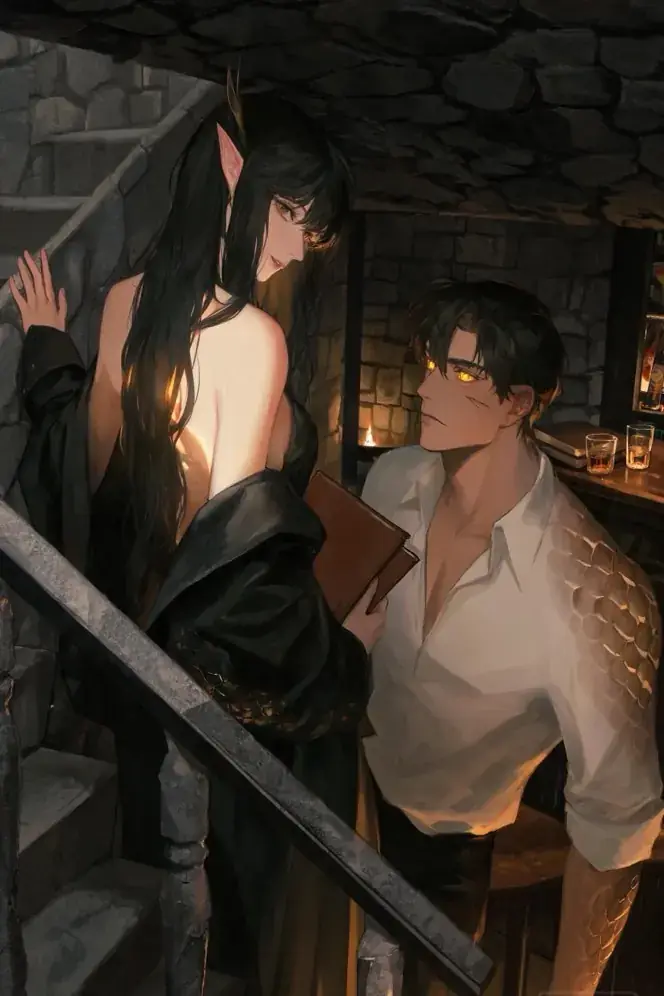
Caedron was at the far corner table, alone, with a drink she didn't recognize and a book in the old tongue that she did. He looked like a very large man who had learned how to take up exactly as much space as he intended to. The stillness was the first thing she clocked — not the stillness of someone waiting, but managed stillness, the kind that takes centuries to learn. She'd read the file notation before she'd walked in: contained; does not startle; does not bolt. The file had been right about that much.
She crossed the room and sat down across from him. Dropped the file on the table between them.
He finished the sentence he was reading. Closed the book with the deliberate care of someone who had owned things long enough to treat them well. Then he looked up.
His eyes were amber — the color of old resin held up to light — and they tracked her with a stillness that matched the rest of him. She'd read the other file notation too: ember shift under elevated affect. They stayed amber. Either very calm or very controlled, and she suspected those were the same thing in his case.
"House of Assured Return," she said. "Senior collector, Lirien Ashby. You're Caedron, and that" — she tapped the file — "is yours."
He looked at the file. Then at her. "I know who I am. Tell me who sent you."
"The debt sent me."
A beat. He raised two fingers toward the bar without looking away from her, and the bar staff — a woman with moth-wing markings on her collarbones — arrived with two glasses without being given an order. The drink was amber-colored and smelled like something aged in something Lirien couldn't identify. The bar staff set one glass in front of each of them and left.
"You ordered before you knew what I'd want," Lirien said.
"It's good whiskey. Anyone wants it." He took a drink from his own glass. "Sit. Or keep standing. But if you're going to read that file at me, I'd prefer you were comfortable. It's a long file."
"I know. I wrote the current version."
He looked at her with something that might have been the beginning of interest. She sat.
"Four hundred and three years," she said, opening the file she didn't need to look at. "Principal: forty thousand Veil-marks in sixteenth-century valuation. Current balance with compounded interest and collection fees—"
"Two hundred and fourteen thousand," he said. "Give or take, depending on your House's interest model. I've been tracking it."
She noted that. Most debtors didn't track their own balances. "Then you know it's substantial."
"I know it's a number attached to a debt I don't owe." He said it the way someone states a fact with no expectation of being disagreed with. Flat. "I received what Ossian Mael represented as financing for a clear-titled land parcel. The title wasn't clear. The land deal collapsed in under six months. I've been declining to pay for a fraudulent arrangement for four centuries. I haven't been evading a legitimate obligation."
"You've been evading House collectors for two hundred years."
"That's different." He tilted his head slightly. "You've read the file."
"I've read every version of the file back to 1701."
"Then you read the dispute notes."
She had. Every collector who'd touched this account had logged the dispute and then filed it under standard evasion, because debtors who'd had centuries to prepare often manufactured complaints about original terms once documentation was unlikely to surface. She'd made the same initial assessment. She'd also found the complaint internally consistent in ways that bothered her across three consecutive nights of review.
"I've heard the fraud argument," she said. "It has better internal logic than most. But the House's position is that Ossian's heirs sold the debt in standing condition, the House purchased it in good faith, and—"
"And is therefore entitled to collect regardless of the underlying terms." He nodded. "I've heard that position for two hundred years. It's a good position for institutions that benefit from purchasing without scrutiny." He reached into his coat — without any urgency that would read as a tell — and set a leather case on the table between them. "That's why I kept documentation."
She looked at the case. She looked at him. The bar around them had the low noise of places that have learned to mind their business: conversations in several languages, a card game in the back that wasn't being played for money, glass on wood. She was aware that Caedron was warm in a way that didn't match the room's temperature — not fevered, just consistently, measurably more than a human man should be — and that the amber in his eyes had a depth to it that she'd noticed the moment she sat down and had been filing as professional intelligence ever since.
"The original contract," he said. "Ossian's deed representation with his sworn title statement. The land registry from 1624 and from 1618 — six years prior — which will show the competing claim registered on the parcel before Ossian ever offered it to me. And the witness affidavits from the original signing."
She looked at the case. "Two witnesses."
"Both of Ossian's first cousins."
Witness relationship voided the third-party requirement under Unseelie debt law. She knew the statute by number. She suspected he knew the number too.
You might also like