
Chapter 6
Chapter Six: Nineteen Hours
She had been awake for nineteen hours. The number had taken on a quality of abstraction by the time she noticed it—nineteen hours was not a time of day anymore, it was a state of existence, a particular flavor of exhaustion that tasted like copper and felt like moving through water.
The double shift had started at seven in the morning with a priority-one multi-trauma: three-car pileup on the Kennedy, and the hospital had received two of them. Mara's patient was a forty-one-year-old with a crushed left side and internal bleeding that hadn't stopped cooperating with pressure alone. Three hours in the OR. Then post-op management. Then a consult from the ICU on a patient who'd taken a turn. Then, at six in the evening, just as she was thinking about heading to the lounge to sleep, the red phone rang.
Sixteen-year-old with a stab wound and a collapsed lung.
She'd been back in the OR at 6:47 p.m.
The clock on the cafeteria wall showed 2:53 a.m. when she pushed through the double doors. The fluorescent lights were particularly aggressive at this hour—too bright, too close, rendering everything the color of institutional defeat. The cafeteria was nearly empty. There was a nurse from the night shift in the corner with a sad sandwich and a phone. There was a custodian restocking the pastry case with an expression of profound disinterest.
And there was Jack.
He was sitting at the corner table by the windows, the one Mara had claimed as her own over the past three weeks—not through any deliberate act of ownership, but simply because it was far enough from the entrance that she could exist without being observed. He had a coffee in front of him. His scrubs were still on, the top unbuttoned at the collar, his dark hair slightly flattened on one side. He looked like he'd been put through something and had come out the other side not quite settled.
She registered all of this in the two seconds it took for the cafeteria doors to close behind her. Then she did what she had learned to do: she noticed him, acknowledged him as a spatial reality, and determined a course of action around him.
There was another table, one she didn't prefer, closer to the vending machines. Her feet hurt. Her shoulders hurt. Her hands hurt from the fine motor control of the sutures, the particular kind of pain that only surgeons and pianists understood. She could sit there. She could make the effort.
She took two steps in that direction.
Then she stopped.
The calculus had shifted at some point in the past hour—or perhaps it had been shifting gradually across three weeks and she was only now noticing it. She was too tired to fight for territory. She was too tired to arrange her exhaustion in a way that didn't include him. She was too tired to pretend that sitting at the other table meant something other than what it meant: that his presence in a room still required acknowledgment, still required accommodation, still mattered in the specific architecture of her choices.
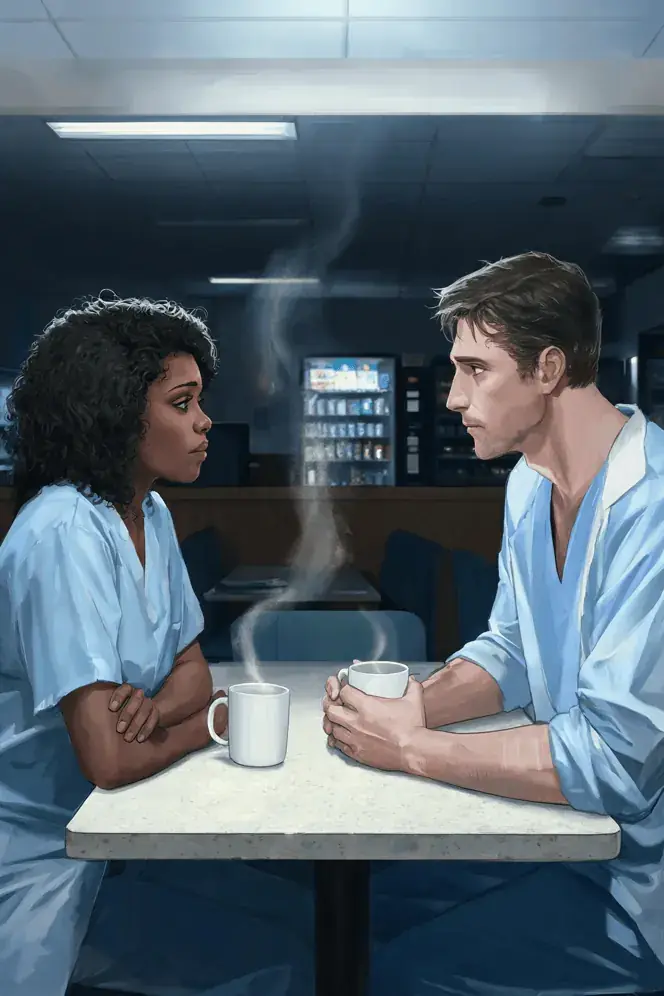
She turned back toward the corner table.
He watched her approach, and she watched his hands—whether they'd move, whether he'd stand, whether he'd do any of the things that would require her to do something in return. They didn't move. He sat still, and that stillness was an answer too.
"There are other seats," he said quietly, as she sat down across from him.
"Yes," Mara said. She did not look at him. She looked at her hands instead, at the small cuts on her knuckles, at the places where the latex gloves had rubbed her skin raw over the course of sixteen hours. "My feet hurt."
It was not what she'd meant to say. It was not professional, not measured, not the kind of thing you offered as explanation to someone who'd left seven years ago and come back without warning. But exhaustion had a way of dissolving the architecture of guard, of making honesty seem simpler than the performance of distance.
She got up to pour coffee. Black, bitter, strong enough to taste like punishment. When she returned to the table, he hadn't moved. She sat in the same chair, pulled it closer to the edge so that she could stretch her legs without them touching his.
The cafeteria hummed. The vending machine made its mechanical sounds. Outside the windows, the Chicago night was very dark and very quiet.
"Why Chicago," she said. Not a question, exactly. A fact she was stating, a thing she'd decided to know.
He didn't answer immediately. His hands were wrapped around his own coffee cup, and she could see the small scar on his left index finger—he'd cut it on glass when they were together, back when they still existed in proximity, and she'd been the one to bandage it. She wondered if he remembered that. She wondered if the scar still meant anything to him or if it had become just a scar, a thing his body carried without narrative.
"My mother's in Evanston," he said finally. "She had a fall. Not serious, but it made me think I'd been gone long enough."
Mara absorbed this. It was so precisely not the answer she'd been bracing herself against that it took her a moment to understand what he'd said.
"She's fine now?" she asked.
"Recovered fine. Physical therapy for her shoulder, but she's stubborn. Refused anything beyond that." He paused. "She's the reason I took the position. But by the time I got here, I'd already been gone so long. Distance has a way of becoming normal. I was done with normal."
There was a quality of precision to the way he spoke—measured, careful, as though every word mattered because he'd considered it beforehand. As though honesty, in his particular grammar, meant accounting for each phrase with precision.
He'd come back because of distance. He'd come back because staying away had become its own kind of decision, and seven years of that decision had added up to something he couldn't sustain. He hadn't come back for her. He'd come back despite her, which was somehow worse, somehow more destabilizing, because it meant she hadn't been the central architecture of his life the way he'd become the central absence of hers.
"Your mother didn't tell me," Mara said. It was not accusation. It was fact, and she was interested in facts.
"She didn't know about—" He stopped. Shifted. "About the situation. I didn't discuss it with her. It's complicated."
"That's not an answer."
"No," he agreed. "It's not. The answer is that I didn't know how to explain. My mother likes you. She always has. Telling her I'd left, and then telling her I was coming back, and then not mentioning that you worked there—it seemed simpler to not explain anything at all."
Mara drank her coffee. It was terrible coffee, the kind hospitals made in bulk and kept hot for hours, but it was warm and it was sharp and it required something of her attention. She used the time to understand what he'd said: that he'd taken the job knowing she worked here. That he'd known before he arrived.
"You applied knowing," she said.
"Yes."
"And you didn't think that was something worth mentioning. Before you arrived."
"No," he said. And then, with that precision: "Because any mention would have been an explanation, and I didn't have one that was honest. I could have said I wanted to make things right. That would have been a lie. I could have said I wasn't thinking about you. That would have been a lie too. So I didn't mention it because nothing I could say would have been true in all the ways that matter."
She should have been angry. The anger was there, somewhere in the architecture of her exhaustion, a thing with texture and weight. But she was too tired to access it. She was too tired to do anything except sit with what he'd said and understand that he'd left her a note seven years ago because he'd been twenty-nine and terrified of needing her, and seven years later he'd come back knowing she was here, and he'd walked into the hospital and seen her and said nothing at all.
"You left a note," she said.
"I know."
"You didn't say anything in it."
"I know."
She was quiet for a long time. The nurse in the corner finished her sandwich and left. The custodian finished restocking and disappeared into the depths of the hospital. It was only the two of them now, and the vending machines, and the terrible coffee, and the weight of nineteen hours of surgery and exhaustion and the particular understanding that comes with being awake so long that everything seems both more important and less real than it actually is.
"I deleted it," she said. "Burned it, actually. In my sink. I wanted to not have evidence that you'd ever explained anything at all."
"I know," he said again. Not defensive. Not apologetic either. Just aware.
"How do you know?"
"Because you wouldn't have kept it if it mattered to you. And you would have kept it if it didn't. The fact that it's gone tells me I made the right choice to leave it unsigned. There was nothing in that note that was worth your having to remember."
She understood what he was doing—he was refusing to give her the architecture of narrative. He was refusing to make his departure matter in the specific ways she'd prepared herself for. He was not saying he'd been wrong, because he hadn't, not in the way that would let her put the past back together in a way that made sense. He was saying that the past was past and that he'd made a decision that was true at the time and that seven years later he'd made another decision, and both of those things could be true without either of them being redeemable or explainable in the language she'd been constructing.
She pushed back from the table. Her legs felt strange, the way they did after surgery—half-awake, not quite responsive to intention. She stood for a moment and thought about leaving. Then she thought about sitting back down. The exhaustion made both choices feel equivalent.
"You should sleep," she said. She didn't say "we should sleep." She said "you," which was its own kind of precision.
"Yeah," he said.
She turned to leave. Her hand found the cafeteria door—the one that always caught at the top of its swing—and she pushed it open. In the narrow panel of glass, she could see the reflection of the corner table behind her. Jack, still sitting. Not watching her go.
She pushed the door the rest of the way open.
You might also like