

Chapter 4
Chapter Four: Three Weeks Ago
The alert came through at 11:47 a.m.: mass casualty. I-90 eastbound, a semi jackknifed into traffic. Mara was in the residents' conference room reviewing imaging when the overhead page killed the background murmur of voices. She was moving before the trauma surgery code finished playing, muscle memory carrying her toward the bay.
Two minutes to scrub. Four ambulances inbound. Level I protocols meant she was already in motion with Priya at her shoulder, both of them reviewing reports on tablets while they walked. The triage summary was terse: three yellow, one red. The red was a crush injury—sedan pinned sideways under the trailer, driver's door caved in. Estimated extrication time seventy-two minutes. By the time he arrived at the hospital, he'd been compressed for nearly two hours.
"That's ours," Mara said, and Priya nodded without hesitation.
The OR was already being prepped. Sandra Okafor had the team moving in practiced formation: anesthesia setting up for a Code Red blood protocol, circulating nurse calling out to surgical tech, the bed stripped and fitted with fresh linens. The crash cart was positioned. Two massive infusion pumps were running their self-tests.
Mara's hands were steady as she scrubbed in, the warm water and soap a ritual she'd performed ten thousand times. The muscle memory was bone-deep and automatic, which meant her mind could stay in the place that scared her. The place where she was preparing to spend the next hour or more in close quarters with Jack Dalton.
She didn't know he was assigned to this case until she turned from the sink and saw him already gowned at the opposite table, his hands in the air, wrists up, gloved fingers spreading while a surgical tech ran the second glove up his forearm. He was focused on the OR, not on her. His face was that perfect blank that meant he was already inside the case, already thinking three moves ahead.
The patient arrived in a controlled chaos of motion. The EMS team transferred the man from the gurney to the OR table with practiced efficiency, hands moving in the synchronization of people who had done this together many times. Seventy-three-year-old male, crush injury to abdomen and left side, estimated four hours of compression, blood pressure 84 over 52 despite two liters crystalloid en route, left femur with obvious fracture, bruising across entire left abdomen that was already mottled purple and black.
"We need labs, type and cross, get me two units of O-neg while we're looking," Mara said, moving around the table. The resident glanced at Jack—she saw it, that tiny hesitation—and Mara realized in that moment that Priya had worked with Jack before. "You with me, Priya?"
"Yes."
The anesthesiologist counted down the induction. Mara waited for the patient to lose consciousness, then nodded to Sandra, who began prepping the abdomen with antiseptic in brisk efficient strokes. The purple-black bruising told a story of massive trauma. The vitals were still dropping.
"Open," Mara said, and Sandra passed the scalpel.
The incision was a long clean line, and what she found under the fascia made her breath catch. Retroperitoneal hematoma, massive, already organizing. The pressure of all that blood had tamponaded everything else, and now—now that they'd opened the abdomen, the pressure would release. Hemorrhage.
"Suction. Retractor." Bookwalter was already positioned. Priya was at the opposite side with lap pads, and Mara could feel Jack moving into place at her shoulder, not crowding, just—there. Available. "We've got bleeding from multiple sources, and this hematoma is—"
She didn't finish the sentence. Jack was already moving a retractor to expose the left paracolic gutter, and she could see what he was seeing before he even said it aloud. The splenic vessels were torn. Not cleanly torn—traumatically avulsed from the pressure of the crush.
"Spleen's gone," she said. "We need to control the bleeders first. Satinsky."
Jack placed it before she finished reaching, the vascular clamp sitting in her palm with the instrument in exactly the angle she needed. The blood flow slowed. Her fingers were moving on pure knowing now, the knowledge that lived in her muscles and nerves, the muscle memory that included his hands moving parallel to hers, handing her the suction at the moment when he saw the puddle of blood obscuring her view, when she'd only just begun to need it.
"Pressure's still dropping," anesthesia called. "Getting more O-neg."
This was the part that required speed and precision in equal measure. The crush had done damage she couldn't fully see until she worked through the blood. The aorta was her concern now. If the aorta was compromised, if the trauma extended that high—
"I need to see higher," she said, and Jack anticipated. He angled the retractor, opened the space without her asking, and she could see the aorta at the level of the left renal artery. Intact so far, but the area around it was a dark mass of blood and devitalized tissue.
"We're going to lose him if we can't get ahead of this," she said quietly, and she felt Jack shift beside her.
"I can get a clamp in there. Just above the left renal."
It wasn't standard. The crush was extensive, the anatomy obscured by blood and trauma. But she saw it—she saw exactly what he was proposing, and she knew without looking at his face that it would work. She knew because she'd watched him in the OR enough times over seven years to know how he thought, the geometric logic of his hands, the way his mind moved through three-dimensional space faster than most people could follow.
"Do it," she said.
He reached across her—not brushing, never quite touching, but she could feel the heat of his arm as it passed above hers. The DeBakey clamp was already in his hand, his movements precise and controlled. He worked from the upper abdomen, from an angle she couldn't access cleanly, and the clamp seated with a soft click that meant it was exactly right.
The bleeding slowed to an ooze.
"Good," she breathed. "I have the distal."
She placed a Satinsky clamp below the injury site, and suddenly the field that had been chaos was a controlled space. The bleeding wasn't stopped—the man was still hemorrhaging into the tissues—but it was manageable. Priya was calling out units transfused. The IV pumps were singing their high-speed whine.
They worked through the abdomen in a synchronized dance that had no words. When Mara needed the bovie, Jack had already called for it. When he retracted to give her a better angle, she shifted without discussing it, because both of them knew the anatomy, knew the limitations of space, knew each other's reach and timing in the way that came only from hours logged in this exact collaboration.
She was acutely aware of his hands. The left one, which had a small scar on the dorsal surface near the thumb—from an old skiing accident, she remembered that from seven years ago, remembered running her own finger over it once, in a moment when they'd been close enough to touch outside the sterile field. Now that hand moved with the precision of a surgeon who had spent the intervening years getting even better at this, more refined, more certain.
The crush had destroyed the kidney. The left renal artery was already ligated. She was working on cleaning out the retroperitoneal hematoma when Jack spoke.
"I'm getting expansile swelling along the external iliac."
She already saw it. He always spoke when the situation changed, when they needed explicit confirmation of the threat. The vessels in his line of sight were at risk of rupture if the pressure built.
"Help me open that space," Mara said, and together they carefully separated the tissue, working around the clamp he'd already placed, around the delicate architecture of the iliac vessels. The artery was intact but traumatized, the intima potentially damaged. If it went into spasm, if it ruptured—
"We need to repair this," Jack said. It wasn't a question.
Mara held the space open. "Silk, fine."
The sutures were 4-0, delicate and precise. Jack worked the repair with his head bent close to the field, and she could see the exact moment when he knew the repair was holding, when the vessel color changed from that frightened purple back to the healthy deep pink of normal perfusion. His hands didn't shake. His breathing didn't change. This was just work, just a problem to solve.
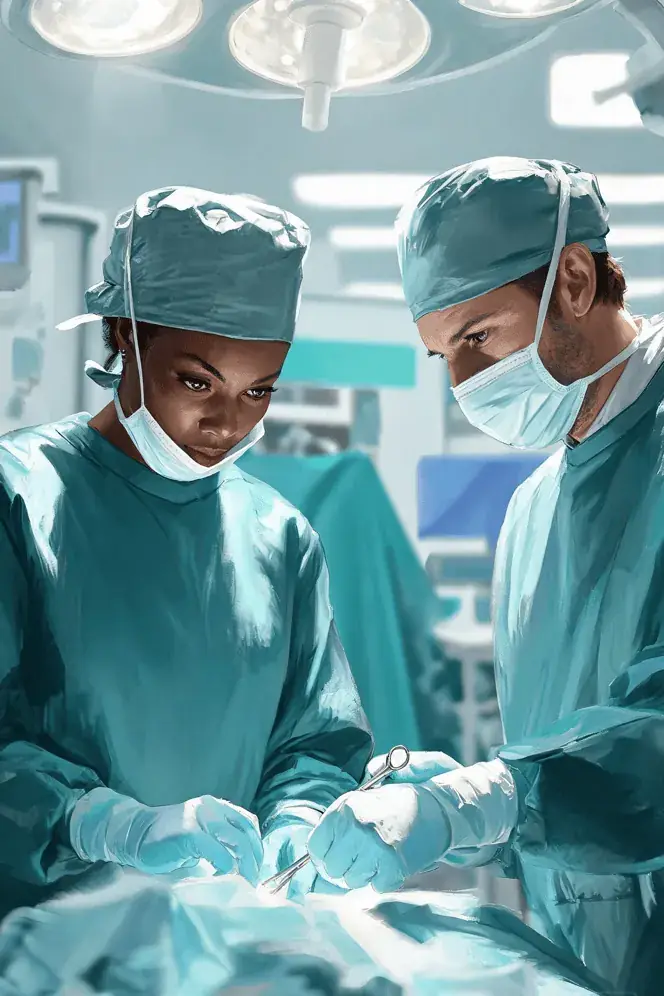
But it wasn't, and they both knew it. This was the two of them inside a body, reading each other's intentions without speaking. This was the thing that had frightened her every day for seven years—the fact that she could walk away from someone, that she could build a new life and a new marriage and a new practice, but her body still remembered his rhythms. Her hands still moved to accommodate his hands. Her mind still predicted his next move.
"Pressure's stable," anesthesia said. "Coming up. He's getting better perfusion."
The bleeding had stopped. The immediate threat was past. What remained was damage control: splenectomy, left nephrectomy, extensive irrigation, packing to manage the remaining hematoma that was too extensive to close over. They'd bring him back in forty-eight hours, re-explore, see what else needed to be done. If he survived that long.
Mara worked through the closure like someone moving through water. The adrenaline had faded. She was aware of fatigue, of the small ache in her lower back from standing in one position, of the dryness of her mouth. She was aware of Jack moving to the opposite side of the field when they didn't need to be as close anymore.
By the time they finished, two hours and twenty minutes had passed. The patient was alive, which on the highway was a miracle. Whether he'd stay alive was a question that would answer itself over the next several days.
Mara stripped off her gloves at the sink. The feel of the latex releasing from her hands was a distinct relief, like setting down weight. She stripped off the gown, deposited both in the bin, and was at the sink running water when Jack stepped up to the adjacent sink.
She didn't plan to speak. She didn't plan to acknowledge that anything had happened other than a successful case and good teamwork. But the words came out anyway, her voice controlled and quiet.
"Good call on the aortic clamp."
He was rinsing his hands, his shoulders slightly hunched over the sink. He didn't turn to look at her.
"You saw it first," he said.
Neither of them moved. The water ran over her hands, warm and real, and behind them she could hear the sounds of the post-op team beginning their work, beginning to clean up, beginning to move on to the next case and the next and the next. The ordinary work of saving lives.
She turned off the water. Reached for a paper towel. Did not look at him.
"I'll dictate the note," she said.
She walked out without waiting for a response.
Behind her, she heard him turn off his own water. She didn't hear him follow. That was the mercy—the small distance she could maintain by being faster, by always being the one who left first. She could almost convince herself that what had happened in that OR was technical. That the synchronization was just years of training recognizing years of training. That her body's memory of his hands was not the most frightening thing she'd had to face since he came back to Memorial Northwestern.
Almost.
In the locker room, she changed out of her scrubs with shaking hands. Just adrenaline crash, she told herself. Just the aftermath of a difficult case. The lie was familiar enough that she could feel it settling, smoothing over the last two hours into something she could file away and not touch. She had done this before. She would do it again.
Her phone was face-down on the shelf. She picked it up.
A text from Priya, sent while they were still closing: I thought you knew. He requested the reassignment to your service. Put in the paperwork three weeks ago.
You might also like