
Chapter 13
Chapter Thirteen: Borrowed Time
The stab wound was half an inch from the pericardium.
Mara saw it the moment the attending made the midline sternotomy and she was already moving, already calling for the internal defibrillator pads because the patient's heart was fibrillating, throwing irregular beats that wouldn't sustain perfusion. Thirty-eight-year-old male, knife fight outside a bar on the South Side, ETA'd in with vitals that made the first-year resident sweat.
"Clamp," she said, and the surgical tech was there before the word finished.
The attending—Rosenberg, sixty-three, steady hands—looked over at her and nodded once. He was already reaching for the suction. The patient's left ventricle was struggling, and if they didn't decompress the pericardium fast, the tamponade would kill him before they got the knife wound closed.
Jack was circulating this OR, had been since noon, and when he moved to adjust the light for her sightline she felt the specific weight of his presence—that steadiness that didn't waver when things went knife-edge. She didn't have time to register it as more than muscle memory. The body did what it had been trained to do.
"Needle for the pericardial window," she said.
Rosenberg made the incision. The fluid came—dark blood that had pooled around the heart like a warning that nobody had seen coming because trauma didn't announce itself. It came with the darkness. Mara aspirated, her hands moving with the precision of someone who had done this two hundred times and was treating this as if it were the first and only time that mattered.
The heart rate regularized. Not perfect, not safe, but regular. Okay. Okay.
"Let's get him on cardiopulmonary bypass," Rosenberg said. "Call perfusion. We're going to need to visualize the full wound tract."
The next hour was arithmetic. Wires and tubes, monitor beeping, the steady hiss of the ventilator. The knife had nicked the anterior wall of the left ventricle—not a full-thickness perforation, thank God, but deep enough that the layering was going to take time, care, a willingness to sit with the risk while you stitched. Mara worked the closure in layers. Pledgets and four-oh prolene. Her hands remembered the choreography even while her mind stayed suspended in the narrow space between success and the abyss.
Ninety-five minutes in, the heart started to come off bypass.
It wasn't pretty. The rhythm was irregular again, weaker. Mara could feel Rosenberg tense beside her, could hear it in his breathing, the change in the quality of his stillness.
"We've got a bleed," she said, and it wasn't a question. She could see it—arterial ooze coming from the suture line, the kind of slow weeping that looked benign until it wasn't.
"Get me another set of hands," Rosenberg said to Jack. "Get Dr. Dalton. Tell him I need him in here now."
Jack was already moving, already gone, but Mara didn't let herself look for him because she was re-gowning, re-prepping, and by the time she stepped back up to the table Jack was there in the scrubs and the cap, his hands already scrubbed, already gloved, and he didn't say anything, didn't need to. He positioned himself on the opposite side of the table from her.
"The suture line is tearing," she said. "We need to go back in, but if we disrupt the knots—"
"We reinforce from inside," Jack said. He was already pulling up visualization, his hands steady. "Four-oh prolene, fresh knots, fresh pledgets. We take it slow."
It took forty-two minutes to re-do the work. Mara could feel the careful geometry of their hands in the same surgical field, the way he would retract and she would stitch, the way she would pause and he would keep the field clear, the way their rhythm synced into something that wasn't conscious anymore. It was just what happened when two people knew what they were doing and refused to let the patient die.
The heart stayed regular. Stayed strong.
When the attending finally closed the sternum and Mara stepped back from the table, her hands were shaking so badly that she couldn't unfold them.
It took three tries to remove her gloves.
She made it to the scrub room before she sat down on the bench, still in her surgical gown, her hands making fists and then opening and then fists again. Post-operative adrenaline crash. Her body releasing what it had held locked down for two and a half hours. The tremor moved through her shoulders, her arms, made her jaw clench so hard her teeth ached.
"Hey." Jack's voice came from the doorway. He was still in his scrubs, still wearing his cap. He'd come in to wash up, and when he saw her sitting there, he stopped moving.
He didn't say anything. He pulled off his cap and his gloves and his gown, and then he scrubbed his hands and his arms like he always did—methodical, careful, up to the elbows. The sound of water and soap was very loud in the quiet room. When he was done, he came over and sat next to her on the bench. Close enough that she could feel the warmth coming off his body. Far enough that it was her choice if she wanted to close the distance.
"That was—" she started, and couldn't finish it.
"I know," he said. "You both were incredible."
Another tremor moved through her. She closed her eyes. The shaking was just her nervous system catching up to the fact that they had held the line. That it was over. That the patient was going to live.
She put her forehead on his shoulder.
His hand came up to the back of her neck—not gentle, but firm, the pressure of it grounding her back into her body, into the fact that she was here, on a bench in a scrub room, skin and bone and blood pressure that was probably dangerously elevated but was slowly, slowly coming back down.
"I missed you," she said into his shoulder. "I'm furious about it."
He didn't move his hand. "I know. I know both of those."
And because he didn't say anything else, because he didn't try to fix it or minimize it or turn it into something manageable, she stayed there with her forehead against his shoulder, letting the tremors work their way through her body while his hand stayed warm and steady on her neck.
Time worked differently when you were close to someone like this. It moved slower. It felt infinite in a way that wasn't about forever but about this, right now, the only moment that mattered.
After maybe ten minutes, maybe longer, her body stopped shaking. The adrenaline crash had hit its bottom and was starting to come back up, but differently—not the sharp edge of surgery, but something warmer, lower in her body. She could feel her heart rate evening out. Could feel the specific texture of his shoulder through the thin cotton of his scrub shirt.
"I need to shower," she said. Her voice sounded raw.
"Okay," he said. He didn't move his hand.
"Will you—" She didn't finish it. Didn't know how.
He was already understanding her. "Yeah. Where?"
"On-call room. Third floor. I need five minutes."
He pulled his hand back, but slowly, like he was mapping the distance in case he needed to close it again. "I'll be there."
The shower was perfunctory—she stood under hot water and washed away the ghost of the OR, the traces of surgical glove and antiseptic, the invisible residue of having been as close to death as it was possible to be without crossing over. When she got out, she didn't bother with anything except a tank top and sleep shorts. The on-call room was small and the night was warm.
Jack was already there, sitting on the edge of the narrow bed. He was wearing fresh scrubs, still damp hair from his own shower, and when she came through the door he just looked at her. Waited.
She closed the door. The click of the lock was very loud in the quiet room.
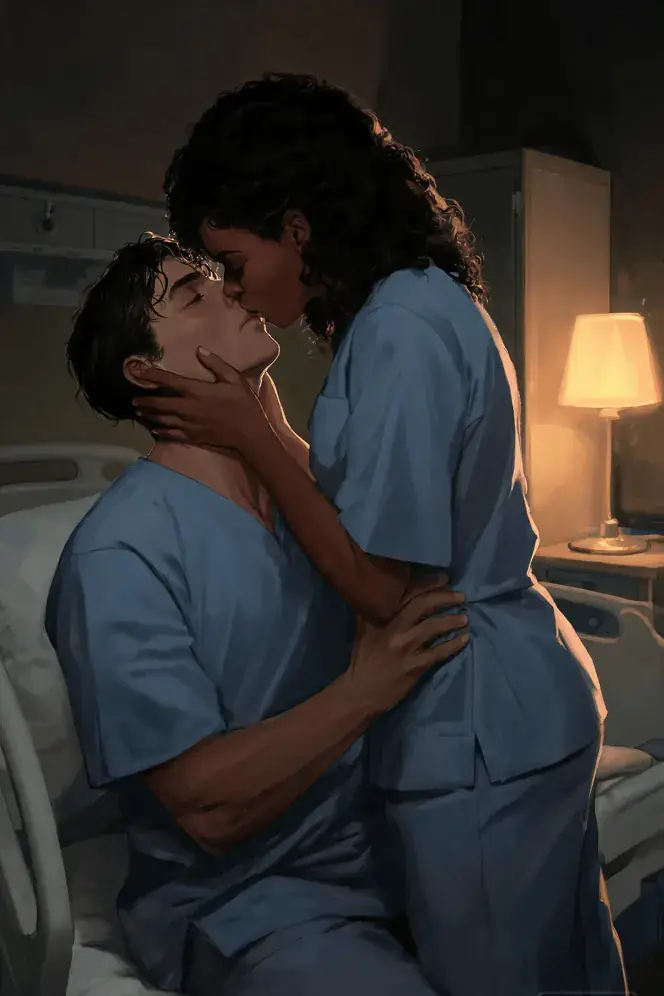
She came toward him the way you cross the last distance in a dark room—certain, committed, no hesitation. When she reached him, he reached up and pulled her down onto his lap, her legs straddling his, his hands settling on her waist.
"Tell me to stop," he said.
"No," she said.
She kissed him first—took his face in her hands and kissed him like she'd been thinking about it for longer than she wanted to admit, with the same precision and commitment she'd brought to the operating room. His hands tightened on her waist. He kissed her back the way he did everything—no pretense, no holding back, just absolute presence.
When she shifted her hips closer, he groaned her name into the kiss, and she felt the vibration of it in her chest. His hands moved up her back, under the tank top, and she could feel how warm his palms were, how solid. She pulled back just far enough to pull his shirt over his head, and then she was against his bare chest, skin to skin, and it was even better than the operating room because there was no distance left.
There was still one word left. She could feel it sitting in her chest like a held breath, like the moment before the first incision when everything is still possible and nothing is yet committed. He would understand what it meant. He would know she wasn't asking about tonight.
She looked at him.
He was looking back at her, waiting, and his hands were warm and still on her waist, and the room was very quiet, and she knew—had known since the scrub room, maybe since longer than that—exactly what the word was.
She had not said it yet.
You might also like