

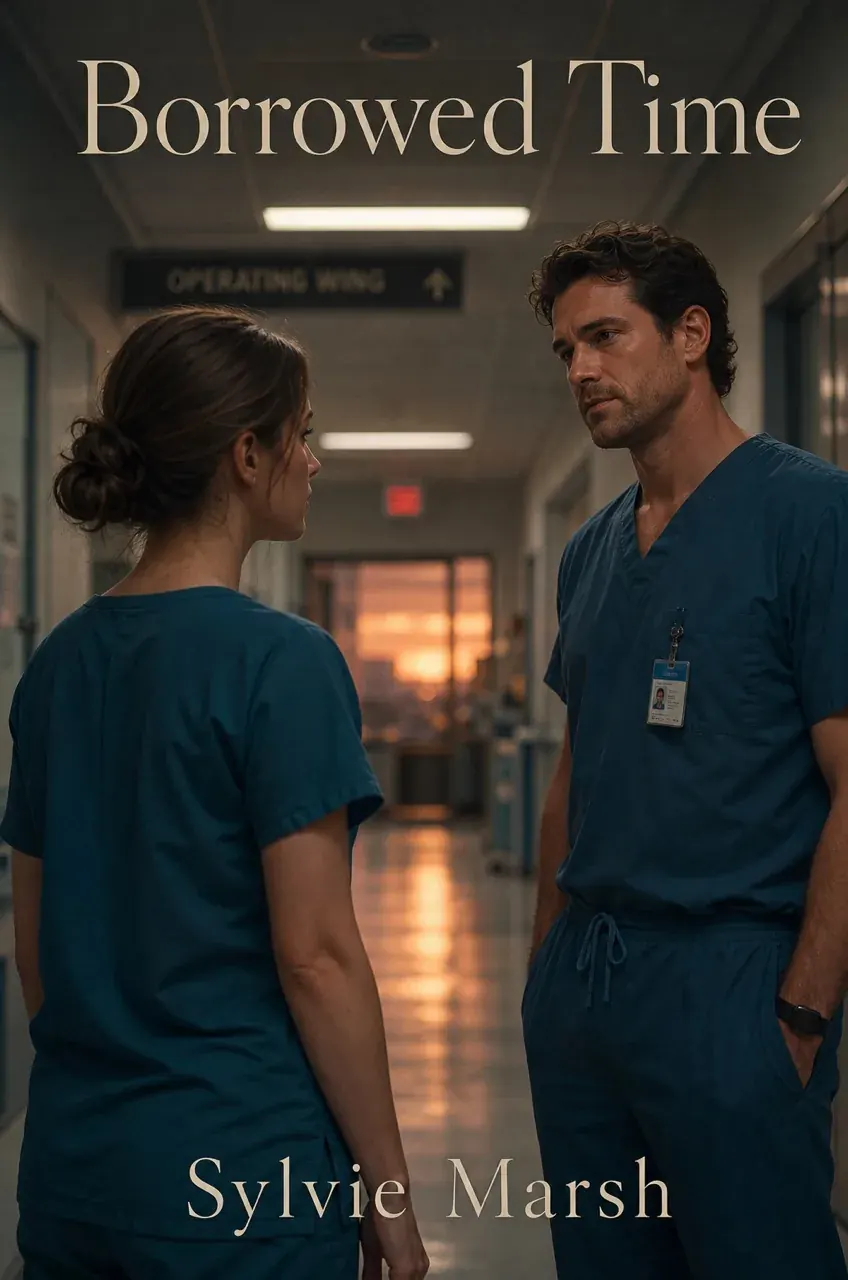
Borrowed Time
Chapter 1
Chapter One: The Note Was on the Kitchen Table
The overhead lights turned everything the color of exposed bone.
"Pressure?" Mara called, not looking up from the abdomen she'd opened four minutes ago.
"Eighty-two over fifty-two," the anesthesiologist answered. Behind his mask, she could hear the tight efficiency that meant he was already running numbers. "Dropping."
The patient was a 19-year-old male, driver's side of a T-bone collision on Lake Shore Drive. Entry wound from the steering column: blunt force across the abdomen. The paramedics had called it in as a probable hepatic injury. Probable was generous. From what Mara could see, the liver looked like someone had fed it through a blender.
"Suction," she said. The surgical tech was already moving. This team had worked together long enough that anticipation had become reflex. The catheter hummed, clearing the field. Red became viscera became the architecture of damage.
"Pressure's dropping faster," anesthesia reported. Ninety seconds had passed since she'd made the incision. The numbers didn't have time to be catastrophic.
"Let's get him typed and crossed. Two units of O-neg in here now." Mara's hands moved through the familiar geometry of exposure. Clamp. Retractor. She needed to see the portal vein, needed to know if the retroperitoneum was holding or if the bleeding was coming from somewhere that would require a different prayer.
The doors to Trauma Bay 1 swept open. Mara didn't look. New arrivals meant new chaos, and the chaos had a sound—the metallic clatter of equipment, the burst of voices, the organized pandemonium of another team responding to the board. Someone would be calling out vitals. Someone would be running. That was how it worked down here.
"Another GSW coming in," someone shouted from across the bay. "Right flank entry, exit wound upper left shoulder."
Mara's hands stayed steady. Her vision tunneled down to four inches of open abdomen and the arterial bleeding that was trying to quit before she'd figured out how to make it stop. The retractor in her left hand held tissue. The suction tip in her right kept the field clear. Everything else—the shouting, the footsteps, the arrival of another surgeon who must have been paged while she was already prepping—became white noise.
"What do we have?" A man's voice. Lower register, not one she heard every day.
She found the hepatic artery. It was torn. Of course it was torn. The liver damage told her that story: the steering column had compressed everything and then stopped, and the liver kept trying to move forward while everything else held it in place. Physics. Anatomy. Chaos with a mechanical explanation.
"Severe hepatic laceration, probable vascular injury," the surgical tech called to the newcomer. Mara was already working on vascular clamps. This was the moment where luck mattered. Either the remaining hepatic tissue would hold or it wouldn't. Either she could control the bleeding in the next sixty seconds or she was going to be telling a 19-year-old's mother that they'd tried everything.
"Pressure's at sixty-five," anesthesia said. Not a question. A fact delivered like a clock.
The trauma board mounted on the wall above the sink showed all four bays. Mara didn't look up at it. Didn't need to. All of her attention was three centimeters deep, working in the space between the patient's ribs and his spine.
Someone moved into the adjacent bay. The new surgeon. She knew this because the scrub tech's attention split, and because she heard the zip of gloves being changed, the sudden focus of another team.
The arterial bleed slowed. Mara had the vascular clamp on the hepatic artery, and the tissue beyond it was no longer trying to pour itself into the abdomen. She could breathe now. Not visibly. Not really. But the initial catastrophe had been downgraded. The patient wasn't dying in the next two minutes.
"Pressure stabilizing," anesthesia said. "Seventy-four over forty-eight."
That would work. It wasn't good, but it would keep tissue viable. Mara was already thinking about the next step, about whether she needed to ligate off all the damaged portions of the liver or whether she could preserve enough parenchyma to keep the patient's own organ in place. The body did remarkable things when you gave it the chance.
She became aware of the other surgeon the way she became aware of background noise: gradually, and only because it had acquired a pattern.
He wasn't talking. That was the first thing. Most of the attendings narrated their decisions. She heard it from the surgical attending in Bay 2, heard it from Dr. Carver in the clinic's simulation lab: the running commentary, the explanation, the decision-making made audible. This one worked in silence. Clamp. Retract. Cut. The movements economical and precise, no wasted motion, no performance.
She knew that way of working.
Mara's hand paused for one-tenth of a second. Not visible. No one would have caught it. The clamp remained exactly where she'd placed it, exerting exactly the pressure needed to stop the bleeding without crushing tissue.
The trauma board above the sink: she wasn't reading it. Wasn't even looking in that direction. But she'd seen it in her peripheral vision when she'd come in, just for a moment while they were prepping. New attending notation, surgical assignments, the day's roster. She'd seen a name written in the careful dry-erase of the scheduling coordinator.
She finished the thought about the hepatic tissue first. Then she finished the clamp placement. The next step was deciding whether the patient would keep a liver or whether she was looking at a transplant wait list.
The other surgeon in Bay 2 was moving with an economy that suggested he'd been doing this for years. Not decades. Decades looked different—slower, heavier with the weight of every patient who hadn't made it. This was a man who'd learned the language and then spent time abroad perfecting it. Somewhere else. Somewhere not here.
"How's your pressure recovery?" the attending in Bay 2 called across.
"Stable," the new surgeon answered. Just the one word. Like even that much was more talking than he preferred to do.
Mara focused on the liver. On the portion that was salvageable. On the small mathematical certainty that she could get this patient to recovery and alive, which was the only thing that actually mattered when you were standing over an open abdomen.
Twenty minutes had passed. The patient's pressure had recovered enough that she could think about something other than the second-to-second survival metrics. She worked on the decision: preserve as much tissue as possible, or take the damaged portion and hope the remaining liver was enough.
Sandra, the charge nurse, was opening backup supplies. Mara could hear the rustle of the wrapper on a fresh instrument tray. Sandra had been here longer than Mara had—four years now, and before that three years at Northwestern in the cardiac unit. She knew when a case was going to go long.
"Priya," Mara said quietly. "Irrigate and clear the field."
The resident moved in, and Mara stepped back just far enough to let her work while she mentally mapped the remaining damage. The liver was trying to repair itself in real time, clotting in the spaces Mara's work had cleared. Evolution trying to undo catastrophe. She could work with this. She could preserve enough.
The other surgeon was finishing up in Bay 2. Mara caught a glimpse of his profile as he leaned in close to evaluate his work—the line of his jaw, dark hair that had a silver stripe running through it at the temple. Gray at forty looked different than gray at twenty-five. It looked like time, and weight, and the kind of distance you couldn't measure in miles.
No. She shut that down. Closed that door immediately. She was in the middle of saving a patient's life, and her brain could not afford to go to war with itself.
"Pressure?" she asked.
"Eighty-two over fifty-five. Climbing slow," anesthesia reported.
The patient would live. The math was working. She could see it now in the way the bleeding was slowing, in the way the tissue was starting to clot on its own, in the small grace of a body that refused to give up.
It took another forty minutes to close. Mara worked through it with the kind of focus that made everything else disappear. The world narrowed to sutures and anatomy and the tight geometry of closure. By the time she was tying off the last layer, the nineteen-year-old's blood pressure had recovered enough that anesthesia was charting normal oxygen saturation and a heart rate that suggested the worst was over.
"Good work," Sandra said quietly. "He's going to make it."
Mara didn't answer. She was already peeling off gloves, already moving toward the sink, already getting out of the way so the cleanup team could start the work of restoring the room for the next emergency.
She was washing her hands when she heard him turn on the faucet at the adjacent sink. She didn't look. Didn't acknowledge the sound of water and the movement that came with it. The professional protocol was clean separation: you worked your case, you exited, you got on with your shift.
She was drying her hands when she felt him stop moving.
He stopped without turning. The pause in motion that carries its own weight.
After seven years, she knew exactly what a room felt like when he was in it.
Mara finished drying her hands. Every second of it took a thousand years. The paper towel under her fingers, the clinical white of the surgical wall, the small decision about whether she was going to turn or walk away.
She turned.
He was still at the sink, one hand under the running water, his gaze on something that wasn't there. Then his eyes moved. Found hers.
Mara's hand, still holding the paper towel, stopped halfway to the waste bin.
You might also like